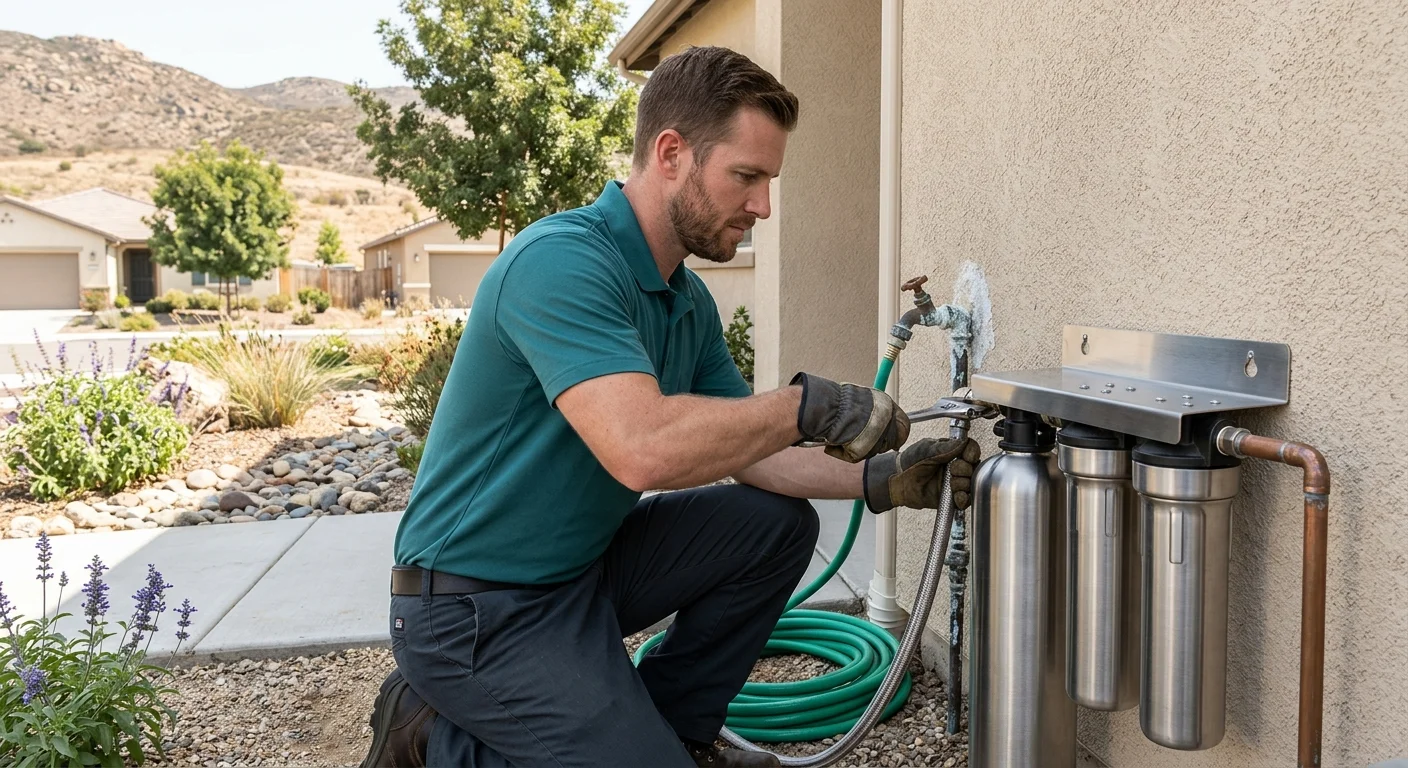
A Santee hose bib on a hot afternoon often shows the story before anyone opens a report. White crust on the threads, a spotted windshield, a shower door that never quite rinses clear. Those signs are common on Padre Dam Municipal Water District taps in Santee, Lakeside, and along the San Vicente corridor, and they sit on a different retailer than Helix Water District next door in El Cajon.
How Padre Dam water differs from Helix next door
Santee is Padre Dam territory. El Cajon is Helix. The city line is not a suggestion. A house on one side of Magnolia can sit in a different water district than the house across it. Each district publishes its own Consumer Confidence Report. Read the name on the bill before you borrow a neighbor’s number.
Padre Dam Municipal Water District is the retail utility for the City of Santee and for many nearby East County addresses, including much of Lakeside. Helix Water District is the retailer for El Cajon, La Mesa, and Lemon Grove. The Helix-side picture is in El Cajon hard water on Helix. This page stays on Padre Dam.
Both retailers sit in a county that buys imported Colorado River and State Water Project water through the San Diego County Water Authority. Helix Water District states that water with 10 or more grains of hardness is considered hard, and that imported water from the Colorado River and State Water Project averages 14 grains of hardness. That is a statement about the imported supply the region buys. It is not a Padre Dam tap reading. It is not a promise for every Santee kitchen.
The City of San Diego publishes still another figure, and only for its own system. City plumbing pages describe typical City drinking water around 16 grains per gallon, ranging from 16 to 18 depending on demand and the area of the City. The City’s 2025 Consumer Confidence Report lists plant-level hardness that is a different measurement in a different publication. None of those City numbers describe Padre Dam, Lakeside, or a private well.
A Padre Dam hardness grain count could not be confirmed from the verified sources this site is allowed to cite. Do not copy a Helix, City, or “county average” figure onto a Santee address. Confirm the current number in Padre Dam’s own water-quality report. Countywide rankings and “hardest in California” claims are not in those reports, and we do not use them.
Is San Diego water hard is the county-level explainer. The short version for this ZIP is simpler. Hardness is real on imported East County supply. Your exact grains belong to Padre Dam’s current report and to a test at your tap.
Finished water still differs even when the wholesale source looks similar. Different plants, operators, and sampling schedules produce different reports. That is why a Carlton Hills home and an El Cajon home a few minutes west should not share a hardness screenshot.
Lakeside needs the same bill check. Unincorporated lots along Highway 67, Moreno Avenue, Mapleview, and the San Vicente corridor are not automatically on the same system as Santee Town Center. Some East County properties use a private well. Utility numbers do not apply to well water.
Santee Lakes is a recycled-water recreation facility along the river corridor. It is not a stand-in for the drinking-water report. Mission Trails sits on the west edge of town. Heat, stucco, and dry winds still do the same work on hose bibs from Fanita to Mast Park.
Scale, skin, and fixtures in Santee and Lakeside
East County summers cook mineral onto anything that stays wet and then dries. Hose bibs on stucco walls in Carlton Hills, Fanita, and the Mast Boulevard corridor show it. So do glass shower doors in Town Center condos and older Lakeside ranch houses. The white crust is calcium and magnesium left behind when water evaporates. It is scale, not dirt.
USGS classifies hardness as calcium carbonate: 0–60 mg/L soft, 61–120 moderately hard, 121–180 hard, and over 180 very hard. Their calculator treats about 17.1 mg/L as one grain per gallon. Once you have a real milligrams-per-liter or grains figure from Padre Dam or from a test, that scale is how to read it. It is classification guidance. It is not a home-safety grade. It does not predict what a water heater will do next year.
Scale shows up in predictable places. Faucet aerators clog. Toilet bowls pick up a ring. Spotting on glasses survives the dishwasher. Showerheads lose spray pattern. Tankless heaters are common in newer Santee tracts. Navien says annual flushing and descaling of heat exchangers is part of maintenance, that hard water may need more frequent service, and that skipping the manual’s maintenance can void a warranty. Other brands write their own terms. Follow the unit you own.
Hard water carries calcium and magnesium. That does not make it better or worse as drinking water. Contaminant limits are set by EPA under the Safe Drinking Water Act, with California adding limits through the Division of Drinking Water. Hardness is mostly about scale, soap, and fixtures. It is not a score for “the worst tap water in the country.”
Skin and hair complaints are common in hard-water houses, and they are easy to oversell. Soap lathers poorly and can leave a film. That film can make skin feel tight after a shower. A 2013 hair-strand experiment found no significant tensile-strength or elasticity difference between hard-water and distilled-water exposures under its conditions. A 2011 randomized trial of ion-exchange softeners in children with eczema found no difference in the primary severity score versus usual care alone. Hard water is not a diagnosis. A softener is not a medical device. If skin is the reason you are shopping, treat it as comfort and rinse quality, then talk with a clinician about the skin itself.
Rust-colored stains are a different problem than white scale. The EPA secondary guideline for iron is 0.3 mg/L and is tied to rusty color, sediment, metallic taste, and reddish or orange staining. That is an aesthetic guideline, not a Padre Dam occurrence number. If a Lakeside sink is staining orange, test for iron. Do not assume the white crust and the orange stain are the same mineral.
Hard water solutions start with that split: hardness scale versus other staining, and district water versus a well. Guessing from a neighbor’s El Cajon number is how East County homes buy the wrong equipment.
Softener vs salt-free on this East County supply
A salt-based ion-exchange softener and a salt-free conditioner do different jobs. NSF/ANSI 44 covers ion-exchange softeners that reduce calcium and magnesium hardness. NSF/ANSI 42 covers certified aesthetic reduction claims. NSF/ANSI 53 covers specified health-effect contaminant claims. NSF/ANSI 58 covers reverse osmosis. A standard is not a ranking. It does not mean a unit reduces every contaminant. Check the exact model’s certified reduction claim.
EPA’s home-treatment guidance is blunt. Identify the goal from the serving utility’s report and from testing. No single technology removes every contaminant. Point-of-entry systems treat water entering the house. Point-of-use devices treat a selected tap. Compare maintenance and replacement-filter costs when you compare ownership cost.
On softeners, EPA’s May 2026 water-softener guide says to size from measured hardness and household water use, and to leave irrigation out of that math when it should not go through the unit. East County yards on drip and spray can throw that math off if outdoor water is counted. Oversizing can waste water. Demand-initiated regeneration responds to use and hardness instead of a fixed timer. Compare the model’s NSF/ANSI 44 certification, rated working capacity, and water and salt efficiency.
Salt-free conditioning does not remove hardness ions. Evaluate the exact scale-reduction claim. EPA advises looking at IAPMO/ANSI Z601 scale-reduction requirements when you compare those units. That is not a claim that any model here is certified. It is not a promise of softened water. If you want true soft water at the shower and the laundry, that is the ion-exchange path. If you want a no-salt scale strategy, that is a different product. The salt-free water conditioning page covers that route. Water softener installation is the licensed-pro path when ion exchange is the fit.
Sodium is the other honest caveat. University of Nebraska–Lincoln Extension estimates that ion-exchange softening adds about 8 mg/L of sodium for each grain per gallon of hardness removed. People on a restricted sodium diet should talk with a physician. Drinking and cooking water is often taken from a kitchen cold line that bypasses the softener. Some units can use potassium chloride instead of sodium chloride, with professional guidance.
If the property uses onsite septic, more common on larger Lakeside lots than in central Santee, EPA advises checking with the septic manufacturer or the local service provider about overload, warranty, and performance before installing a softener. That is not a local ban. Softener restrictions in any San Diego city have not been verified here. Confirm current rules with the City of Santee, or with the County of San Diego for unincorporated Lakeside. The City of San Diego’s simple no-plan plumbing list includes water-softener installation for eligible City properties. That City list does not govern Santee.
EPA’s November 2024 home-treatment guide describes pitcher and tap filters as typically under $100, reverse osmosis and distillation as tending to cost a few hundred dollars and possibly needing professional installation, and point-of-entry systems as costing thousands and generally needing professional installation. Those are EPA’s broad national categories, not a Santee quote and not a Clear Water Pros SD price. A licensed pro’s written scope is the number that matters.
How to confirm hardness at your tap
Start with the serving utility, then test the tap. Padre Dam’s Consumer Confidence Report is the right first document for a Santee city address on district water. It will not match the City of San Diego report. It will not match Helix. If the bill says a different retailer, stop and use that retailer’s report instead.
Hardness on a report is a system average or a range for the reporting year. Blends move with demand, imported supply, and local operations. A single countywide number is the wrong tool. The only way to know the kitchen tap is to measure it.
A free in-home water test is how we start that conversation. The test is a screening with the licensed pro, not a state-certified laboratory panel and not a safety clearance. For strip versus titration methods, use how to test water hardness at home. Convert milligrams per liter to grains with the USGS factor of about 17.1 mg/L per grain when you need both units.
Private wells are a separate track. CDC recommends using a state-certified laboratory and asking local health or environmental authorities which extra tests fit the location. CDC’s annual well list includes total coliform, nitrate, TDS, and pH. A total-coliform result is an indicator, not a full pathogen ID. Boiling does not remove chemical contamination. Match treatment to the identified problem and retest before you trust the result. Utility hardness from Padre Dam does not describe a well off Wildcat Canyon or a shared well in the hills above Lakeside.
pH shows up on the same reports, and a neighbor quoting 8.2 is not your tap. A Padre Dam pH figure could not be confirmed from the sources this page is allowed to use. Read the current district report. Do not treat pH as a hardness substitute. Do not treat TDS as a contaminant screen. EPA’s secondary TDS guideline is 500 mg/L for aesthetic and technical concerns. It is not a drinking-safety cutoff. A conductivity reading is not a lab analysis of each mineral.
If the goal is drinking-water polish at one sink, reverse osmosis is a point-of-use technology with its own NSF/ANSI 58 claims, including fluoride reduction only when the exact model lists it. RO produces treated water and reject water. Efficiency is model-specific. EPA WaterSense labeled units demonstrate at most 2.3 gallons of reject water per gallon treated under the label criteria. That is a label criterion, not field performance for every install.
District and state pages to verify
You do not need a sales sheet to check this. Use the agencies that actually set and report the water.
Padre Dam Municipal Water District publishes water-quality information and the Consumer Confidence Report for its system. That is the hardness, disinfectant, and source page for Santee city water. If a figure is missing there, it is missing. Do not fill the gap with a Helix or City of San Diego number.
The State Water Resources Control Board, Division of Drinking Water, is California’s drinking-water primacy agency. Drinking Water Watch and the Board’s consumer pages are how you confirm the public water system, not a blog. EPA sets federal contaminant limits under the Safe Drinking Water Act. California can add its own limits through DDW. Hardness itself has no MCL in the City of San Diego materials we verified, and sodium does not either. Those are aesthetic and dietary issues until a physician says otherwise.
San Diego County Water Authority explains the regional imported supply. Helix’s water-quality FAQ is the source for the 10-grain “hard” threshold and the 14-grain imported-supply average. Keep that attribution on Helix. It still does not replace Padre Dam’s report.
For the licensed pro who would install treatment, use the CSLB license check. Clear Water Pros SD connects homeowners with licensed Water Filtration providers. The homeowner contracts with that provider and pays them directly. We do not pull permits, own trucks, or do the install. Confirm permit path with the City of Santee or, in unincorporated Lakeside, with the County. How to read a San Diego water quality report walks the CCR columns so the Padre Dam PDF is usable, not decorative.
If a page on the internet assigns Santee a hardness grain count, a county rank, or a price, ask whether it cites Padre Dam’s current report. If it does not, set it aside.
When to call us
Call when scale is showing on Santee or Lakeside fixtures, when you want hardness measured at the tap before you buy equipment, or when you need a licensed pro to size a softener or a salt-free conditioner to this district’s water. Call us at (858) 400-4647 to set up a free in-home water test.