The PDF behind a City postcard, or the file on your district’s site, is a Consumer Confidence Report. It shows what the utility measured in the system that serves your street. It does not sample the faucet in Clairemont, the heater in El Cajon, or a private well in the back country. Match the agency on your bill, then decide what still belongs in a tap test.
Where to find your current water quality report
San Diego County does not have one water company. The name on the bill is the agency that owes you a report.
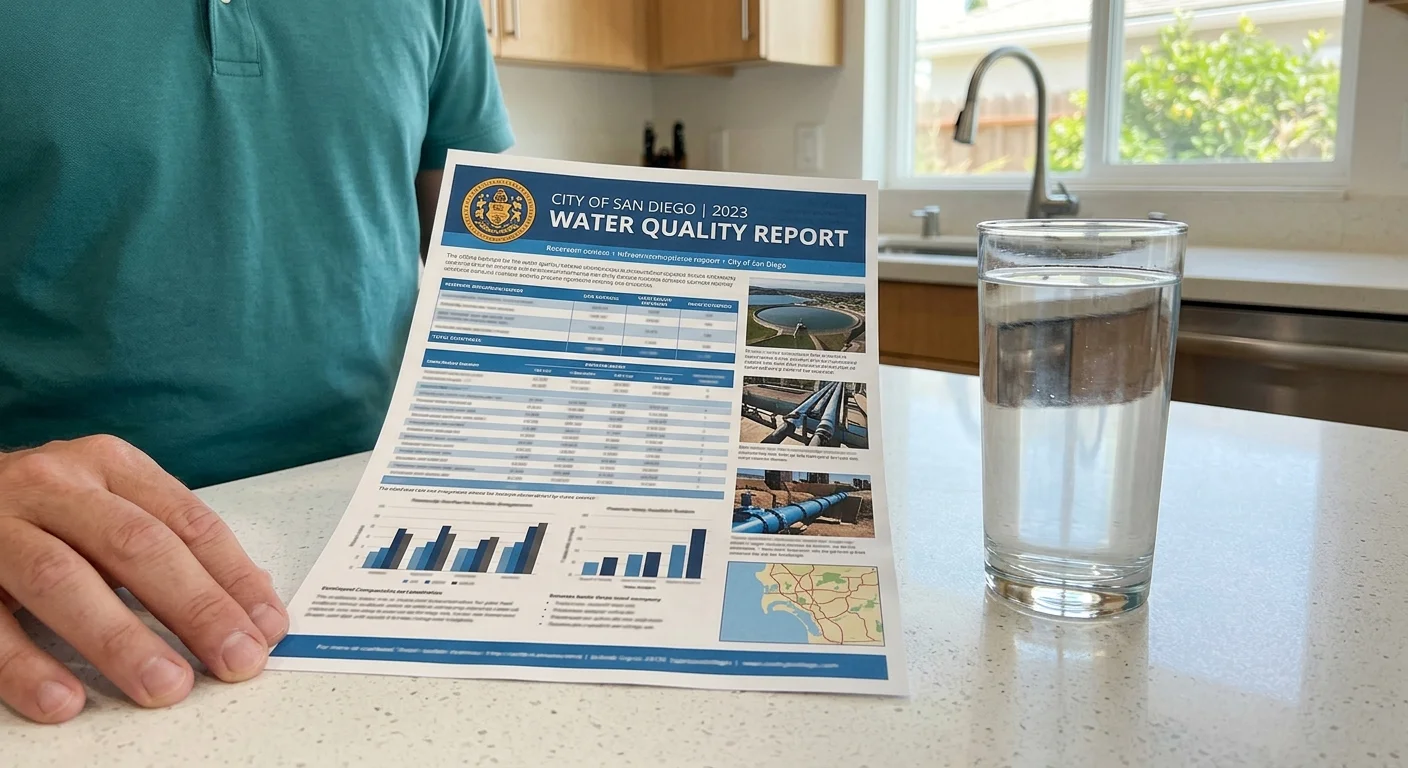
City of San Diego customers want the City of San Diego water quality report from Public Utilities. The 2025 Drinking Water Quality Report is the City CCR for Public Water System 3710020. Start on the City’s water-quality pages at sandiego.gov/public-utilities/water-quality. If a newer year is posted when you open it, use that PDF.
Helix Water District customers, including many homes in La Mesa, El Cajon, and Lemon Grove, use Helix’s own annual report and water-quality FAQs on hwd.com. Olivenhain Municipal Water District, Padre Dam Municipal Water District, Sweetwater Authority, Vista Irrigation District, and the City of Carlsbad each publish a separate Consumer Confidence Report. A search for a San Diego water quality report often surfaces the City file first. Confirm the retailer before you download.
The San Diego County Water Authority sells water to member agencies and explains regional supply. That wholesale picture does not replace the retailer CCR tied to your meter.
Beach and bay bacteria postings are a different program. County ocean sampling answers whether a shoreline is posted for swimming. It is not the drinking-water report for your kitchen.
Private wells have no CCR. A well in Hidden Meadows, Alpine, or similar unincorporated pockets is outside the City and Helix tables. That property needs its own testing path.
Keep last year’s PDF if you still have it. Compare only within the same utility. For a plain-language take on legal limits at the tap, use our page on whether San Diego tap water is safe. This page stays on how to read the report.
Hardness, chloramine, and metals lines explained
Open the tables, not the cover letter. Each row in the City’s 2025 report lists an MCL, a PHG, and the measured average and range where the City reports them. Copy those headers from the PDF in front of you. Do not borrow a number from Helix, Sweetwater, or a well log.
Hardness is the line most San Diego kitchens feel first. A City of San Diego Public Utilities plumbing page says drinking water in the City typically averages about 16 grains per gallon (276 ppm) and, depending on demand and the area of the City, can range from 16 to 18 gr/gal (272 to 284 ppm). That figure is for the City system. It is not a countywide average and it does not describe private wells.
The City’s 2025 Consumer Confidence Report reports total hardness in grains per gallon by plant: Alvarado averaged 13.8 (range 11.9 to 15.8), Miramar 14.1 (11.7 to 16.6), Otay 14.2 (11.7 to 15.8), and purchased treated water 8.5 (3.18 to 13.6). Those plant rows and the plumbing-page typical figure are different City publications covering different measurements. When both appear, treat them that way.
Helix Water District states that water with 10 or more grains of hardness is considered hard, and that imported Colorado River and State Water Project supply averages 14 grains. That is a statement about the imported supply, not about every East County tap. USGS classifies hardness as calcium carbonate: 0 to 60 mg/L soft, 61 to 120 moderately hard, 121 to 180 hard, and over 180 very hard. USGS notes about 17.1 mg/L per grain. That is classification guidance, not a home safety score. For the feel of scale on glass and fixtures, see whether San Diego water is hard.
Look next at the disinfectant residual table. Some reports list free chlorine. Others list chloramine, often as total chlorine. The CDC notes that chlorine-treated water can taste and smell different from chloramine-treated water, and that the report is how you identify the disinfectant, levels, and byproducts that apply. Read your own file. Do not assume a Clairemont tap matches a Carlsbad tap.
Metals sit in their own rows. California’s hexavalent chromium MCL is 0.010 mg/L (10 µg/L), with a PHG of 0.02 µg/L. In the City’s 2025 CCR, Alvarado, Miramar, and Otay reported ND. Purchased treated water averaged 0.1 ppb, range ND to 0.4 ppb, below the 10 ppb MCL. ND means it was not found at or above the listed detection limit in that row, which the City lists as 0.1 for that contaminant. It does not prove a kitchen tap is zero.
The EPA secondary guideline for iron is 0.3 mg/L and is tied to rusty color, sediment, metallic taste, and reddish or orange staining. It is an aesthetic guideline, not a universal health cutoff. Sodium and hardness have no MCLs in the City’s 2025 report. That year’s sodium averages were 87.8 ppm at Alvarado, 86.2 at Miramar, 111 at Otay, and 71.2 for purchased treated water. A City FAQ posted in November 2024 describes a fluoride adjustment target of 0.7 ppm. That is a City target, not a countywide tap concentration. Other retailers blend different supplies. Open their PDFs for their fluoride lines.
If a contaminant you care about is missing from this page, it is missing on purpose. Open the named utility PDF for that MCL. Do not use a number from memory or from another city’s chart.
Why your house can differ from the report
The CCR is a system picture. Your house is a single endpoint.
City of San Diego water can leave Alvarado, Miramar, or Otay, or arrive as purchased treated water. Those 2025 hardness and sodium rows already disagree with each other. A Mission Valley block and an Otay Mesa block can sit on different blends on different days. Demand and area also move the City’s plumbing-page hardness range. Helix’s imported-supply average does not lock a La Mesa kitchen at 14 grains.
The sample points behind a CCR are the utility’s, not your shutoff. Water then travels through mains, a service line, a water heater, and the faucets you actually use. Scale, sediment, and metals can change after the meter. A report that lists ND for a metal at the plant does not measure the brass fitting under your sink.
Apartments, HOAs, and older East County or South Bay plumbing add another step the annual file never sees. A whole-building filter, a softener on bypass, or a neglected fridge cartridge can make one unit taste unlike the unit next door.
Private wells are outside every retailer table. CDC well guidance is to use a state-certified laboratory and to ask local health or environmental authorities which extra tests fit the location. CDC recommends annual testing for total coliform, nitrate, TDS, and pH. Boiling does not remove chemical contamination.
Do not transplant one utility’s data onto another service area. EPA’s home-treatment guidance says to identify goals from the serving utility’s report and from appropriate testing. The City portal points you to the current report and notices for that system. It does not certify every county tap, private well, or building as matching the PDF.
Taste, spotting, and staining at home are clues. They are not a substitute for the tables, and the tables are not a substitute for the tap.
What an in-home test still adds
Water quality testing in San Diego has two honest jobs. The CCR tells you what the retailer measured. A tap test tells you what left your faucet that day.
A free in-home water test is a starting check at the house, arranged through us and performed with a licensed provider. Ask that provider what the visit actually measures. It is not a state-certified laboratory panel, and it does not replace one. For wells, health questions, or a contaminant you need in writing, use a state-certified lab. CDC well guidance is the same idea: match treatment to the identified problem, then test again before you trust the result.
EPA’s home-treatment guide is blunt. No single technology removes every contaminant. Identify the concern first. Point-of-entry systems treat water entering the residence. Point-of-use devices treat a selected tap. Compare the exact model’s certified reduction claim, plus maintenance and replacement-filter cost.
NSF/ANSI 42 covers certified aesthetic reduction claims. NSF/ANSI 53 covers specified health-effect contaminant claims. NSF/ANSI 44 covers ion-exchange softeners that reduce calcium and magnesium hardness. NSF/ANSI 58 covers reverse osmosis systems. A standard is not a ranking, and it does not establish reduction of every contaminant. Verify the exact model.
That sequence is how a San Diego water quality report becomes a filtration decision. If hardness and scale are the issue, a softener conversation follows the grains you measured, not a countywide rumor. If taste or chlorine-family odor is the issue, the disinfectant line in your CCR plus a tap check belong in the same folder. If you want treatment at every fixture, licensed pros we send can discuss whole-house water filtration after those numbers are in hand.
EPA also notes that basic pitchers and tap filters typically cost under $100, RO and distillation systems tend to cost a few hundred dollars and may need professional installation, and point-of-entry systems cost thousands and generally need professional installation. Those are EPA’s broad national categories from its November 2024 guide, not a San Diego quote and not a Clear Water Pros price. A written scope from the provider sets the actual number.
Agencies that publish the real numbers
Federal drinking-water contaminant limits come from EPA under the Safe Drinking Water Act. California adds its own limits through the Division of Drinking Water. San Diego’s Consumer Confidence Report is the authority for the City system’s published hardness and source mix. Other retailers publish their own.
Use this short list when you want the primary file:
- City of San Diego Public Utilities for addresses on the City system, including the 2025 CCR cited above.
- Helix Water District for its FAQs and annual report, including the 10-grain hard-water threshold and the 14-grain imported-supply average.
- Olivenhain, Padre Dam, Sweetwater Authority, Vista Irrigation District, and the City of Carlsbad for their own CCRs.
- San Diego County Water Authority for regional supply context at sdcwa.org.
- California State Water Resources Control Board, Division of Drinking Water, for statewide MCLs such as hexavalent chromium.
If a licensed pro will install treatment, check that license on the CSLB license lookup. We connect you with licensed, insured pros. You contract with the pro directly.
Skip roundup sites that mix beach grades, surf bacteria, and tap water in one chart. The drinking-water number you can defend is the one in the serving utility’s current PDF, plus a tap result from your own house.
When to call us
Call when the CCR and the kitchen disagree, when hardness or metals in the report need a tap check, or when you want a licensed Water Filtration pro to walk a treatment option after the numbers are clear. Call us at (858) 400-4647 to set up a free in-home water test.