The 40-pound bag at the big-box store is not a universal fit. A Mission Valley garage and a Ramona well house can use different salt because the model says so, not because the zip code does. Clear Water Pros SD connects you with a licensed water-treatment pro. The brand does not sell or deliver salt.
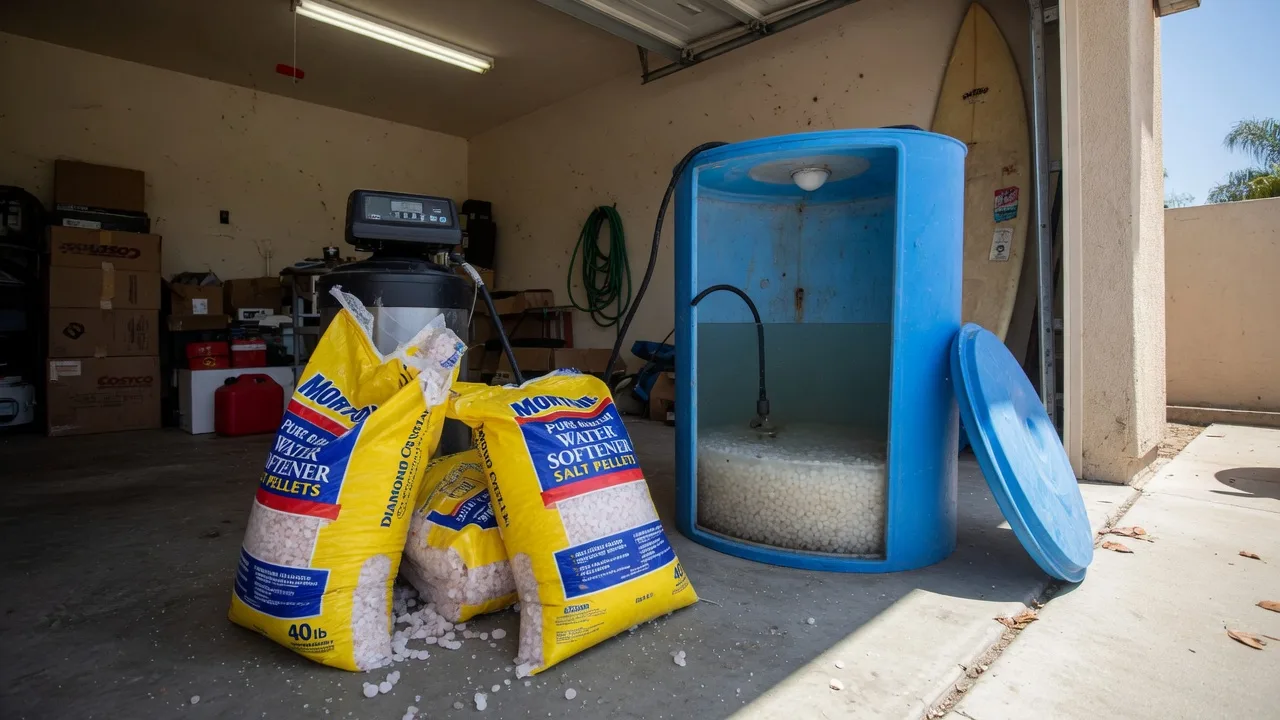
Start with the owner’s guide, not the aisle
Culligan’s salt guide, updated July 8, 2026, says the best salt is the type specified in the system’s owner’s guide. Forms include crystals, pellets, and blocks. The manual controls which product the unit accepts.
Kinetico’s fill guidance is stricter on one point: do not use rock salt. Tablet versus block depends on the model. Do not fill the tank completely. Overfilling can cause bridging. Kinetico’s own fill range is about half to three-quarters full for medium to high use, and about half full for low use. Other brands write other manuals.
The salt type has to match the model manual, not a neighborhood rule of thumb.
The four products people actually buy
Culligan groups residential softener salt this way.
Evaporated salt is a high-purity option that typically leaves less residue. Culligan notes it is often more expensive. We do not publish a bag price.
Solar salt can balance purity and cost, according to Culligan. Depending on the product, it may leave more residue than evaporated salt.
Rock salt typically contains more insoluble minerals and can leave more residue. Culligan says it may not be recommended for all softeners. Check the owner’s guide. Kinetico says not to use it in the brine tank it describes.
Potassium chloride can stand in on some units. Nebraska Extension notes potassium chloride may be used instead of sodium chloride in some units, with professional guidance. Culligan says it works through the same ion-exchange process, typically costs more, and may require a larger amount. Always check the guide before you switch.
Do not use ice-melt or sidewalk salt. Culligan says products not designed for water softening can damage parts.
Why the wrong bag shows up as a service call
Low-quality or incompatible salt can contribute to a salt bridge or to salt mush. A bridge is a crust with a hollow gap. Mush is sludge on the floor of the tank. Both can interfere with brine formation. Then the salt pile may stop dropping and hardness symptoms can return.
The City of San Diego Public Utilities site says drinking water in the City typically averages about 16 grains per gallon. That figure is for the City system only. Helix says water at 10 or more grains is hard, and the imported supply it discusses averages about 14 grains. Do not copy the City 16-grain figure onto La Mesa. A well in Ramona is a different measurement again.
Nebraska Extension estimates about 8 mg/L of sodium added for each grain per gallon of hardness removed. That is an estimate of added sodium, not a tap result. People on restricted sodium diets should talk with a physician. Potassium chloride is the chemistry swap some manuals allow. It is not a medical recommendation from this site.
Frequently asked questions
Can I mix leftover rock salt with new pellets?
Culligan says it is generally better to use one consistent, approved product. Mixing forms or purity levels can change how evenly salt dissolves and may add residue or bridging.
How often should I check the tank?
Culligan’s general check is once a month, and refill when the tank is less than half full. That is Culligan’s check. Follow your model.
Does salt-free conditioning use these bags?
No. EPA’s May 2026 softener guide says salt-free conditioning does not remove hardness ions. Evaluate the exact scale-reduction claim.
Call if the bag and the valve disagree
If the manual is missing, or mush keeps coming back, a separately licensed professional should name the salt the valve can use. Call (858) 400-4647 and Clear Water Pros SD will connect you with an independent local water-treatment professional.