Spotting on a glass shower door in El Cajon is usually hardness, not a dirty tap. Helix Water District serves much of this East County city with imported Colorado River and State Water Project water, and Helix itself calls water at 10 grains or more hard. Your exact grain count still comes from Helix’s current report and a test at the address, not from a coastal page with the city name swapped.
How East County water differs from the coast
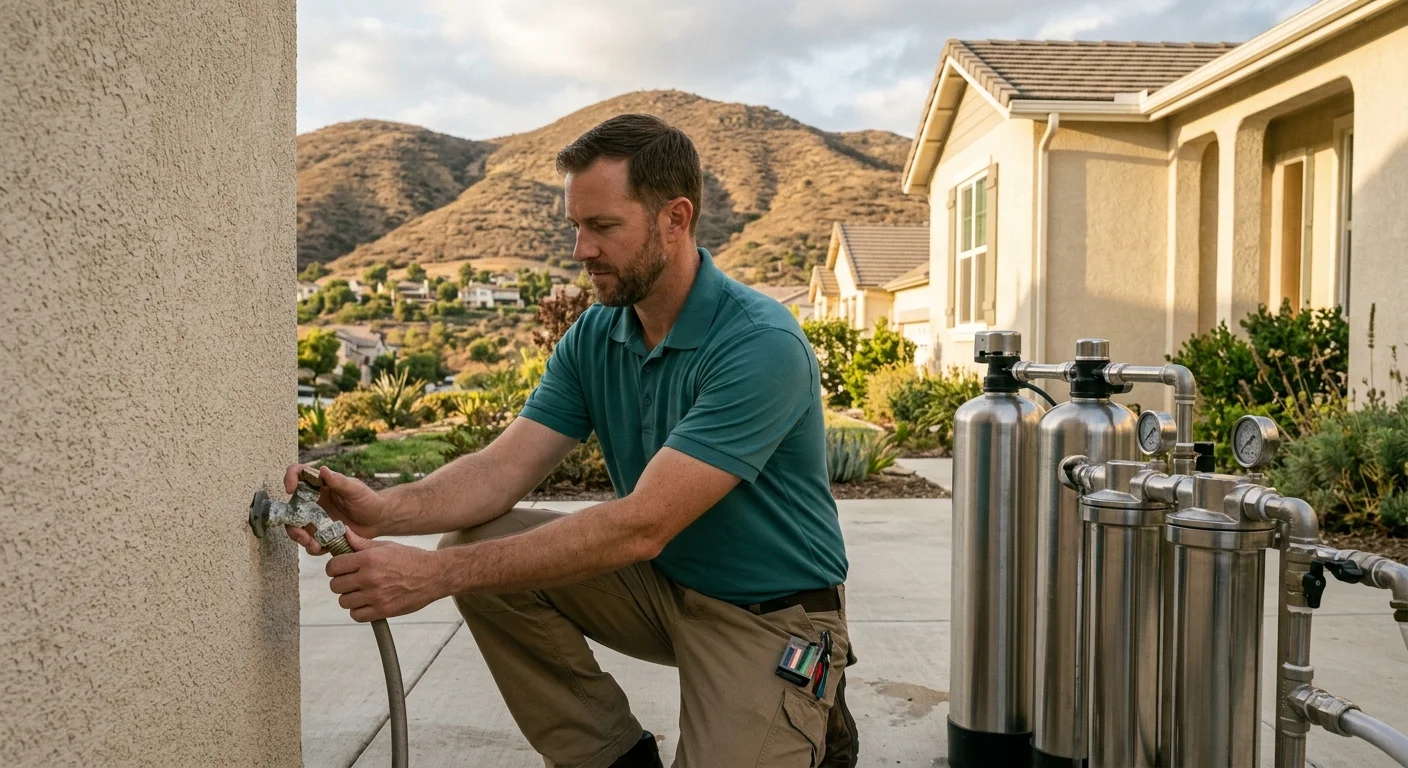
Encinitas and El Cajon do not drink from the same retail system, and they do not live in the same climate. Coastal north county sits in marine air. Glass dries slower. Hose bibs sit in milder sun. El Cajon sits in a hot inland bowl, with dry hills behind the stucco tracts. Water on a patio faucet evaporates fast. White crust on an outdoor bib is part of that weather, not proof that East County water is harder than the coast.
The real local split is who sells you the water. A large share of El Cajon addresses sit in Helix Water District, not the City of San Diego Public Utilities system. Helix also covers La Mesa, Lemon Grove, and nearby unincorporated pockets. Lake Jennings, in the Lakeside area, is Helix’s local reservoir. That still does not make every East County tap a Helix tap. Other retailers serve nearby cities. The name on the water bill is the serving agency. Confirm that name before you treat any City of San Diego figure as yours.
Imported supply is the shared county story. The San Diego County Water Authority buys Colorado River water and State Water Project water for member agencies, including Helix. Helix states that imported water from those sources averages about 14 grains of hardness. That is a statement about the supply the county buys. It is not a reading at your kitchen tap, and it is not a private-well figure.
Do not treat East County as automatically harder than the coast. This site does not have a verified hardness number for El Cajon as a city, and we will not invent one. Helix’s published imported-supply average is about 14 grains. The City of San Diego, a different system, publishes a typical range of about 16 to 18 grains per gallon for its own service area, varying by neighborhood and demand. Those are two agencies, two publications, two territories. For the county-level question, start with is San Diego water hard. Then come back to Helix for an El Cajon bill.
Housing stock still changes how scale shows up. Mid-century El Cajon tracts, Fletcher Hills slopes, and Bostonia ranch homes often carry older heaters, older valves, and hose bibs in full sun. A tankless heater in that heat sees scale as a maintenance issue. Navien’s own manuals say annual flushing of the heat exchanger is part of upkeep, that hard water may need more frequent descaling, and that skipped maintenance can affect that brand’s warranty. Other brands write their own rules. Follow the unit on the wall, not a countywide rumor.
What Helix Water District reports actually cover
A Consumer Confidence Report is an annual drinking-water quality report for a named public water system. It covers regulated contaminants, treatment, and source mix. It is not a hardness reading for every house on the block. It is not a private-well report. It is not last week’s blend at your meter.
Helix’s water-quality FAQ is the source for two statements this page can stand behind. Water with 10 or more grains of hardness is considered hard. Imported water from the Colorado River and the State Water Project averages 14 grains of hardness. That is Helix Water District hardness language about the imported supply. It is not a citywide El Cajon average, and it is not a well.
USGS classifies hardness as calcium carbonate: 0 to 60 mg/L is soft, 61 to 120 is moderately hard, 121 to 180 is hard, and over 180 is very hard. USGS uses about 17.1 mg/L per grain per gallon. Helix’s 10-grain threshold already sits in that hard range. Fourteen grains of imported supply, as Helix describes it, would convert into USGS’s very hard class. Conversion is classification. It is not a lab result from your street.
ZIP-code lookup pages often pin El Cajon at 17 grains, or 300 ppm, and then sell a softener. Seventeen grains is well above Helix’s 10-grain hard line. We could not confirm that El Cajon taps run 17 grains. Treat those lookup pages as advertising. Open Helix’s current report instead.
Tap-water safety is a different question from hardness. Calcium and magnesium are not a federal health maximum contaminant level in the sources this page is allowed to use. They are an aesthetic and plumbing issue. For regulated contaminants, read Helix’s current Consumer Confidence Report and any notices Helix publishes. California limits come from the State Water Board’s Division of Drinking Water. If you want the legal picture for your address, use the serving utility’s current report.
A groundwater solvent plume story in one El Cajon neighborhood is not Helix tap hardness. Those are separate issues, separate agencies, and separate tests. Do not mix a vapor investigation with the mineral content of treated district water.
What the report will not tell you: the condition of the pipes in your building, a private well behind the house, or how Helix blended sources during a hot week. Confirm the source for the address. Then test the tap you actually use.
Scale, skin, and fixtures in El Cajon homes
Hard water leaves calcium and magnesium behind when it dries or when it is heated. In an El Cajon bathroom that means spots on glass, a film on chrome, and a showerhead that slowly chokes. In the kitchen it means cloudy glassware and a dishwasher that never looks quite finished. On the water heater it means scale on heating surfaces. Navien is one manufacturer that ties that buildup to more frequent descaling and to warranty terms if maintenance is skipped. That is a heater-brand rule. It is not a Helix rule.
Soap behaves differently in hard water. Lather is weaker. Rinse feels incomplete. Skin can feel tight after a shower. Hair can feel coated. Those are comfort complaints, not a diagnosis. A 2013 hair-strand experiment found no significant tensile-strength difference between hard-water and distilled-water exposures under its conditions. A 2011 trial of ion-exchange softeners in English hard-water areas found no difference in childhood eczema severity versus usual care. Neither study is a reason to ignore scale on fixtures. Neither is a medical treatment claim. If skin disease is the issue, that is a clinician’s call.
People also ask whether hard water or soft water is healthier to drink. The verified record here does not give hardness a health MCL. Softening is a different chemistry. University of Nebraska–Lincoln Extension estimates that ion-exchange softening adds about 8 mg of sodium per liter for each grain per gallon of hardness removed. That is an estimate of added sodium, not a measured El Cajon tap. People on restricted sodium diets should ask a physician. Many homes take drinking and cooking water from a kitchen cold line that bypasses the softener.
Outdoor fixtures take the East County climate on the chin. A hose bib on a sun-facing stucco wall dries between uses. Scale builds in plain sight. That is why El Cajon hard water is often noticed in the yard first, then in the shower. Hard water solutions start with that pattern: what you see at the tap, what Helix reports, and what you want treated, drinking water, whole house, or both.
No single device removes every contaminant. EPA’s home-treatment guidance is blunt on that point. Match the tool to the problem you actually measured.
Softener vs salt-free in this part of the county
An ion-exchange softener swaps calcium and magnesium for sodium or, on some units, potassium. NSF/ANSI 44 is the standard that covers those softeners when they are certified to reduce hardness. Certification is a claim for the exact model. It is not a ranking, and it is not a promise that every contaminant drops.
EPA’s water-softener guide says to size from measured hardness and household water use, and to leave irrigation out of that math when the landscape should not be softened. Oversizing can waste water. Demand-initiated regeneration follows use and hardness rather than a fixed timer. Compare the model’s NSF/ANSI 44 listing, rated working capacity, and water and salt efficiency. Follow that model’s install, bypass, and maintenance instructions.
Salt-free conditioning does not remove hardness ions. EPA is direct about that. Judge the exact scale-reduction claim, including IAPMO/ANSI Z601 where a maker cites it. Do not buy a salt-free unit expecting softened water. For a side-by-side of those two paths, read water softener vs salt-free conditioner.
If the house is on a septic system, EPA says to check with the septic manufacturer or local service provider before a softener goes in. That is about overload, warranty, and how the septic system performs. It is not a claim that every East County septic property needs a conditioner. A local ordinance restricting softeners in El Cajon could not be confirmed. The City of San Diego lists water-softener installation among Simple No-Plan plumbing work for some properties in that city. That is City of San Diego guidance. It is not an El Cajon permit rule. Confirm the route with the City of El Cajon before anyone cuts pipe.
Water softener installation in this county is licensed plumbing work. The homeowner contracts with, and pays, the licensed pro. Check that license on the CSLB license lookup. Clear Water Pros SD does not pull the permit, own the truck, or do the install.
Point-of-use reverse osmosis is a drinking-water tool, not a whole-house hardness fix. NSF/ANSI 58 covers RO systems. Efficiency and reject water are model-specific. Do not transplant a label number onto every under-sink unit.
How to confirm hardness at your tap
Start with the bill. If Helix is the retailer, open Helix’s current Consumer Confidence Report and its water-quality FAQ. Use those pages for source mix and for Helix’s hardness language. Do not copy a City of San Diego grain figure onto a Helix meter. Do not copy a ZIP-code map that never names its lab.
A strip kit is a screen. It is not a certified laboratory result. USGS notes that conductance can only approximate dissolved solids, and the relation changes with water chemistry. EPA’s secondary TDS guideline of 500 mg/L is an aesthetic and technical marker. It is not a hardness test, and it is not a safety cutoff. If you need a number you can size equipment to, test hardness as hardness.
CDC well-testing guidance applies if the property is actually on a well: use a state-certified laboratory, and ask local health or environmental staff which extra tests fit the location. Most El Cajon addresses in Helix territory are district water, not wells. Confirm that too. Do not treat a neighbor’s well story as your tap.
Clear Water Pros SD can set up a free in-home water test and then connect you with a licensed Water Filtration pro. The test is a starting point. It is not a laboratory clearance, and it is not a promise that every contaminant was measured. Ask the pro what the visit covers before anyone quotes a system.
Once you have a hardness number and a goal, the choice is scope. Whole-house softening or conditioning treats water as it enters. A drinking tap can stay on a separate filter or RO unit. EPA says to identify the concern first, then compare point-of-entry and point-of-use, certified reduction claims, maintenance, and water use. Include replacement-filter cost when you compare ownership. Manufacturer manuals set the service interval. We will not invent a lifespan.
When to call us
Call when scale is showing up on El Cajon fixtures, when a heater manual is asking for descaling, or when you want hardness measured before anyone sizes a system. A licensed Water Filtration pro does the install and the plumbing. Call us at (858) 400-4647 to set up a free in-home water test.