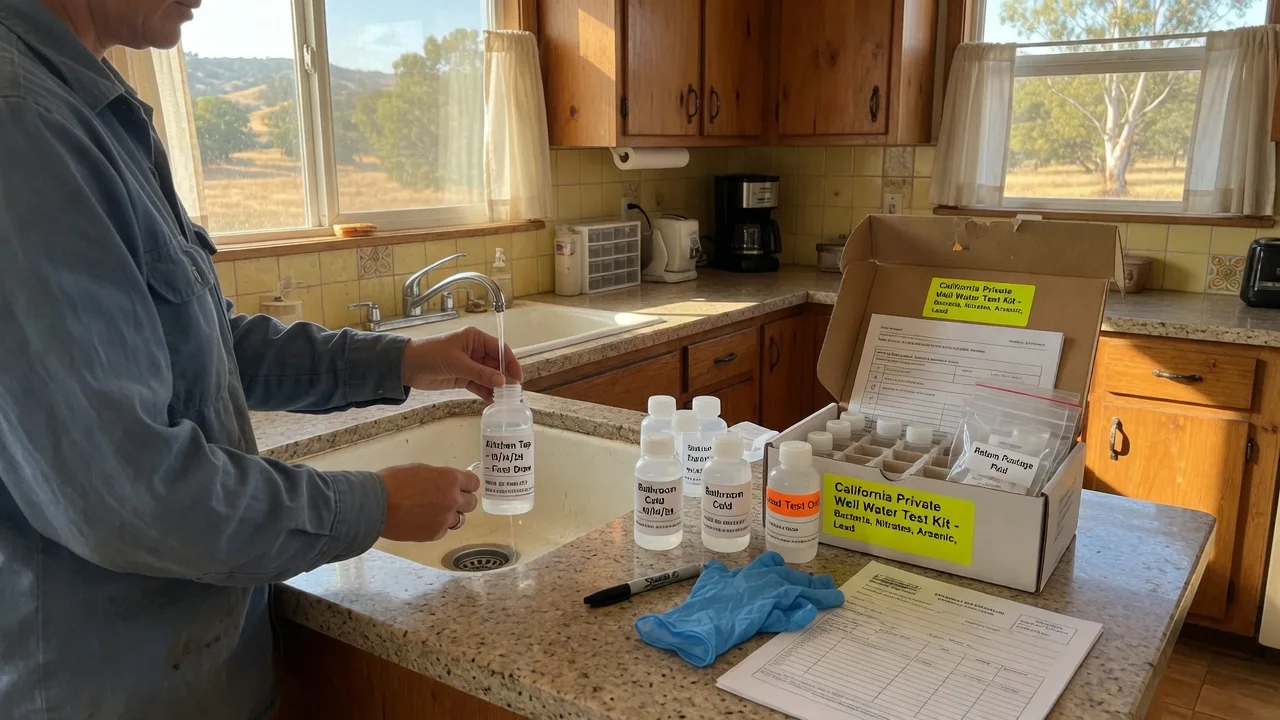
If the house is on a private well, you own the testing. City of San Diego, Helix, and Padre Dam reports do not cover that tap. Clear Water Pros SD books a free in-home water test and connects you with licensed treatment pros. The in-home screen is not a certified well panel. The brand does not operate a laboratory.
Why a well is not a utility tap
EPA rules that protect public drinking-water systems do not apply to privately owned wells. CDC says government officials do not regulate, treat, or monitor tap water from those wells. Your local health or environmental department can still help you get the water tested.
That split is the whole inland map. A Ramona Municipal Water District meter is a public system with a consumer confidence report. A grassland parcel in 92065, a Fallbrook avocado well, or a Hidden Meadows granite well is not. Ramona well water filtration walks that RMWD-versus-well fork. Testing comes first either way.
City of San Diego Public Utilities says drinking water in the City typically averages about 16 grains per gallon, or 276 ppm, and can range from 16 to 18 gr/gal depending on demand and area. That figure is for the City system only. It is not countywide. It does not describe a private well.
The annual panel CDC actually names
CDC, dated July 1, 2024 on its well-testing page, says to test at least once every year for:
- Total coliform bacteria
- Nitrates
- Total dissolved solids
- pH
Use a state-certified laboratory. Ask the health department which other germs or chemicals to add based on where you live. San Diego County Department of Environmental Health and Quality and the State Water Board are the local starting points. EPA’s drinking-water hotline is (800) 426-4791 if you need the federal referral.
CDC also says to test when the taste, color, or smell changes, after flooding or land disturbance, after well repairs, when someone in the house becomes pregnant, or when a child starts living there. Check the well hardware every spring for mechanical problems.
A positive total-coliform result is an indicator. Coliforms live in guts, soil, plants, and surface water. They are easier to test for than every pathogen. Fecal coliform or E. coli points toward feces in the water. CDC notes that an indicator E. coli test does not prove the dangerous types are present. It still means you call the health department.
Nitrates can come from animal waste, septic systems, wastewater, flooded sewers, stormwater, fertilizers, farm runoff, and decaying plants. Local geology matters. CDC says high nitrate is a reason to ask about other chemicals too. Do not invent a San Diego well nitrate rate. We do not have a verified county occurrence number.
TDS tells you how much dissolved “stuff” is in the water. EPA’s secondary guideline for TDS is 500 mg/L. That is an aesthetic and technical line, not a universal safety cutoff. USGS notes that specific conductance can approximate dissolved solids, and the relation varies with water composition. A conductivity pen is not a metals panel.
pH tells you how acidic or basic the water is. CDC says extremes can damage pipes and let metals such as lead into the water. That is a reason to test pH. It is not a diagnosis of a named pipe.
What the in-home test can and cannot say
The brand’s in-home test is a starting look at hardness, TDS, and how the plumbing is behaving. For a private well, pair it with a state-certified well panel before anyone picks UV, iron, sulfur, softening, or sediment stages. EPA’s home-treatment guidance is the same order: identify the goal from the serving utility’s report, or from testing that fits the property. No single technology removes every contaminant.
Handheld strips and refrigerator pitchers do not replace that lab. What TDS means in San Diego water is useful context for a meter reading. It is still not a coliform result.
If the lab finds harmful germs or chemicals, CDC says to drink bottled water or another safe source and contact the local health or environmental department. Then treat, then test again to confirm the treatment worked before you resume use. Boiling kills many germs. Boiling does not remove chemical contamination.
Extra tests that depend on the lot
CDC lists chemicals to ask about: volatile organic compounds, lead, arsenic, mercury, radium, pesticides or herbicides, and other local concerns. Which ones apply depends on well location, region, and whether the lot is rural. A well near fuel tanks or a commercial strip is a VOC question. A shallow well near cropped fields is an agricultural-chemical question. Those are health-department questions for this address. They are not a blog diagnosis.
Iron staining and iron bacteria are separate from the annual panel. EPA’s secondary iron guideline is 0.3 mg/L. Iron bacteria in San Diego County well water covers slime, sheen, and swampy odor. Confirm that with the laboratory too.
Specific Ramona, Fallbrook, or Escondido well numbers for arsenic, nitrate, or iron could not be confirmed in our claims ledger. A neighbor’s story is their sample.
Frequently asked questions
Can I use the City of San Diego water-quality report for my well?
No. That report is for the City public system. A private well needs its own certified lab work.
How often should I test?
CDC’s floor is once a year for total coliform, nitrate, TDS, and pH, plus extra tests the local health department names, and extra tests after changes in taste, color, smell, flooding, or well work.
Who should collect the sample?
Follow the certified lab’s bottle and hold-time instructions. County or state departments often test for nitrates, coliforms, VOCs, and pH, or they can point you to a licensed lab.
Book the screen, then the lab
Clear Water Pros SD can send a licensed pro to look at the well house, the pressure tank, and the indoor plumbing. You still need the certified panel for a well. Call (858) 400-4647 and we will connect you with an independent local water-treatment professional.