The salt in the brine drum has not moved, and the spots are back on the wine glasses. That is the usual fork for a San Diego home: wipe the glass again, or get the unit diagnosed. A licensed pro on site can tell you whether this is a bypass, a salt bridge, or a system that is done.
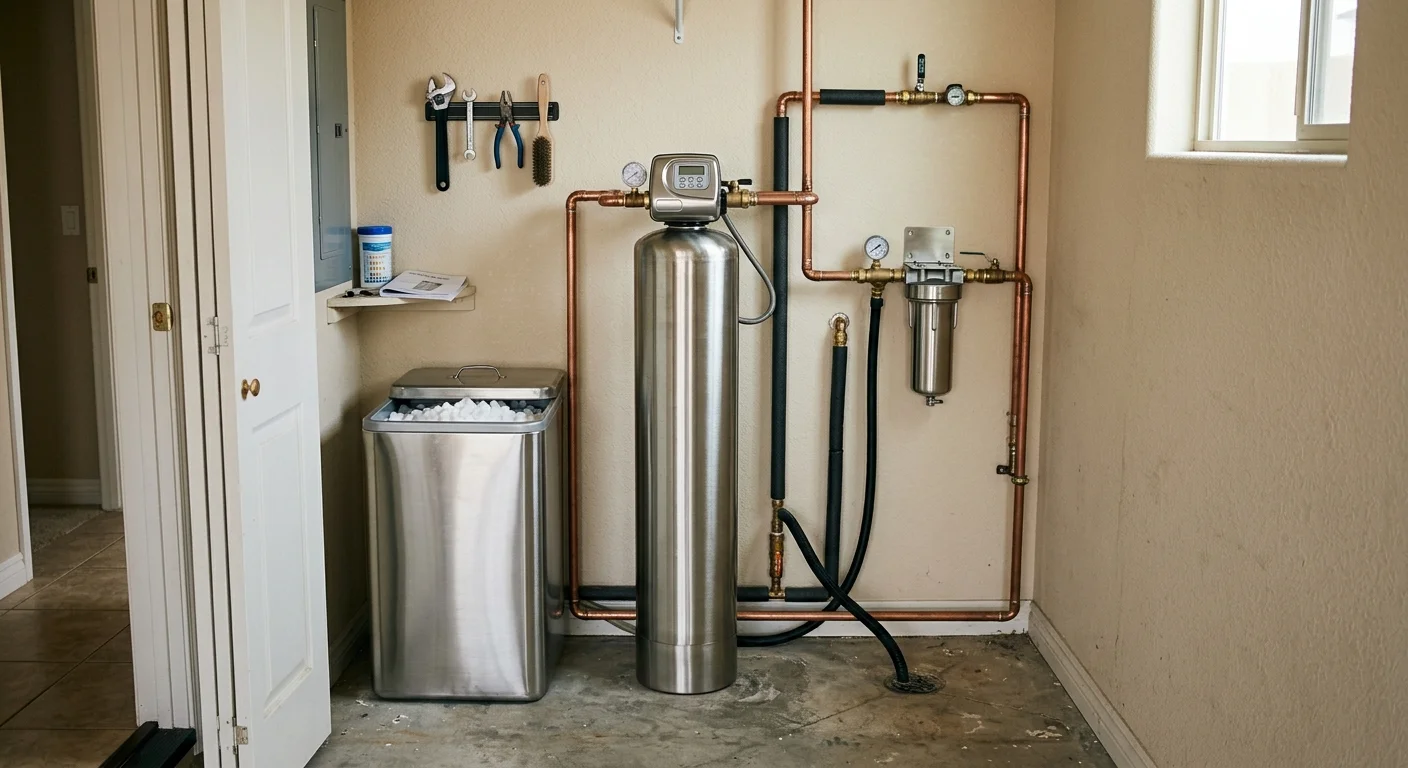
Signs a San Diego softener is actually failing
When a softener is working, calcium and magnesium get swapped off the water before they hit the heater and the glassware. When it is not, City of San Diego taps can feel like the tank was never there.
The City of San Diego Public Utilities site says drinking water in the City typically averages about 16 grains per gallon, or 276 ppm. It can run 16 to 18 grains, or 272 to 284 ppm, depending on demand and where you live in the City. That figure is for the City system only. It is not a countywide number, and it does not describe a private well. Helix Water District, which serves parts of East County including La Mesa, El Cajon, and Lemon Grove, says water at 10 or more grains is considered hard. The imported Colorado River and State Water Project supply it discusses averages about 14 grains. That is a statement about imported supply, not your exact tap.
The City’s 2025 Consumer Confidence Report lists different hardness averages by treatment plant, including Alvarado at 13.8 grains. Those are different City publications covering different measurements. If you are on another retailer, in Carlsbad, Oceanside, Poway, or on a well, pull that agency’s current report. The San Diego County Water Authority is a starting point for who serves the address.
USGS classifies water above 180 mg/L of hardness as very hard. Sixteen grains sits well above that line. A unit that has quietly stopped doing ion exchange shows up fast on dishes, shower glass, and soap.
Watch for these, not just a hard-water week:
The salt level in the brine tank does not drop over weeks of normal use. That can be a salt bridge, a failed regen, or a unit sitting in bypass. Water softener not using salt is the dedicated walkthrough. Water standing in the brine tank after a cycle is a brine-draw fault. Water on the slab is leak isolation.
White scale returns on faucets that used to stay clear. Cloudy glasses come back in the dishwasher.
Water stands around the tank, brine drum, or drain line. Isolate the unit with the bypass or the supply shutoff if you can do that dry, without forcing a stuck handle. Then get a licensed pro on it. Do not open pressurized parts. Stay off wet electrical gear.
The drain line keeps running when the house is quiet. EPA notes that persistent drain flow can mean a malfunction.
Water tastes salty at a tap that should not be on softened water. A bypass left on, a stuck valve, or a regen that will not finish can all do that.
If you are not sure the unit is doing anything, check whether the softener is working at a treated tap and at an untreated hose bib when you have one.
Repair vs replacement in local hard water
This is a repair decision, not a price sheet. For planning ranges, read water softener repair cost in San Diego. HomeGuide publishes a national average repair range of $150 to $600 in a guide dated July 14, 2025. That is general planning context. It is not a Clear Water Pros price, not a San Diego guarantee, and not a quote for your valve. Diagnosis, parts, access, warranty, and the provider’s written scope set the real number.
Repair is often the right call when the tank and resin still take a charge. A salt bridge, a clogged injector, a bad float, a bypass left open, or a control head that still has a sound tank behind it are repair conversations. Those faults look dramatic. They do not always mean the system is spent.
Replacement enters when the resin tank itself is leaking, the bed no longer softens after a proper regen, or the same unit keeps coming back with a new fault. No verified source we hold gives a universal year cutoff. Do not treat a round number like ten years as a rule. Age is one input. The condition of the tank, valve, and resin is the rest.
If the licensed pro recommends a new ion-exchange unit, that work is water softener installation, not a patch. In the City of San Diego, water-softener installation is listed among qualifying Simple No-Plan Plumbing/Gas Permit work for eligible properties. Historic-property rules and scope can change the route. That is City guidance, not a countywide permit rule, and it is not evidence of a softener ban. Other cities set their own rules. Confirm with the building department that covers the address.
A new unit should be sized from measured hardness and household water use. That is how EPA frames selection. Leave irrigation out of the sizing when yard water does not go through the softener. Oversizing can waste water. Compare the exact model’s NSF/ANSI 44 certification, rated working capacity, and water and salt efficiency. NSF/ANSI 44 covers ion-exchange softeners that reduce calcium and magnesium hardness. It is not a ranking. It does not mean the unit reduces every contaminant.
Salt-free conditioning does not remove hardness ions. If the house was sold a conditioner and the spots never left, that is a different product, not a failed softener.
People on a restricted sodium diet should talk with a physician. University of Nebraska–Lincoln Extension estimates ion-exchange softening adds about 8 mg/L of sodium for each grain per gallon of hardness removed. Kitchen cold water is often taken from a line that bypasses the softener. That is an estimate of added sodium, not a measured San Diego tap result, and not medical advice.
What a licensed pro checks on site
Clear Water Pros SD does not roll a brand truck or pull the permit. We answer the phone, set up the free in-home water test, and connect you with a licensed water filtration pro. You contract with that pro and pay them directly. Before work starts, ask to see the license and check it on CSLB.
A plumber may be the right trade for valves, drains, and supply lines. A water-treatment specialist may be the right trade for resin and programming. The card on the truck matters more than the job title in an ad. If the person cannot show a current California license for the work, stop.
On site, a careful visit usually covers the bypass first. Confirm it by running a cold tap. Household water can keep flowing while the unit is isolated. Valve types differ: lever, knobs, a three-valve assembly, or an app. Do not force a stuck handle. Follow the exact model manual.
Then salt. Identify the brine tank, not the resin tank. A hardened crust can leave a gap between salt and water, so the unit cannot make brine. If the manual allows it, breaking a bridge is owner care. A bridge that returns with a valve that will not draw brine is a repair. Do not use rock salt. Do not pack the brine tank to the lid. Overfilling can cause bridging. Other brands follow their own fill marks.
Injector, venturi, and brine line get checked for salt crust and kinks. The drain line gets checked for constant flow or a discharge that is no longer right for the setup. Do not disconnect a drain as a DIY test.
The control valve is next: error codes, meter cable, and whether the unit is on a timer or demand-initiated regeneration. EPA describes demand-initiated regeneration as responding to use and hardness rather than a fixed clock. A clock that is wrong will either waste water or leave you in hard water.
Hardness at a treated tap versus an untreated hose bib belongs on the same visit, plus the serving utility’s current report. Settings should match this house. They should not match a generic county number we do not have.
Leaks get traced before anyone talks parts. Water at the base can originate higher on the unit, at the brine tank, the drain line, a nearby drain, or another appliance. Isolate with the bypass or the supply shutoff. Contact the installer or plumber. Do not treat a cracked tank as a clamp job if the shell is finished.
Treat an in-home test as a starting measurement with the provider. It is not a state-certified lab panel, and it is not a safety clearance. Water softener maintenance is the salt, settings, and bypass check you do between visits. Repair is what happens when those no longer restore soft water.
Brine, resin, and valve failures in this climate
San Diego County is not one climate. A Mira Mesa garage in August is a different box than a shaded La Jolla side yard. Softeners still live in both: resin tank, brine drum, and a valve that has to cycle in heat, dust, and neglected salt.
Brine trouble is the one most owners can see. If water sits above the salt, the tank may need salt or potassium chloride, depending on the model. If the salt looks untouched for a month of showers and laundry, the unit may not be drawing brine at all. Heat in a closed garage makes crusting more likely. That does not give anyone a license to open the valve head.
Resin is the bed that holds calcium and magnesium during service, then releases them during regen. Chlorine in city water, iron, and years of incomplete regens all wear it. EPA’s secondary guideline for iron is 0.3 mg/L. It is tied to rusty color, sediment, metallic taste, and staining. It is not a universal health line. City water and well water are not the same job. Private wells need their own tests through a state-certified lab. CDC recommends annual well tests for total coliform, nitrate, TDS, and pH. A softener is not a pathogen treatment, and boiling does not remove chemical contamination.
Valve heads fail in this climate the same way they fail anywhere. Then heat makes the plastic and the seals less forgiving. Stuck regenerations, no brine draw, and a unit that will not return to service are valve conversations. Model-specific parts matter. A licensed pro matches the valve, not a universal kit from a bin.
If the house also has a tankless heater, a dead softener hands the scale problem to that heater. Navien, for one, says hard water may need more frequent descaling, and some of its warranty language is void for scale from missed maintenance. Other brands write their own terms. That is not a Clear Water Pros warranty.
A working ion-exchange softener is still only a hardness tool. Pairing it with whole-house filtration or drinking-water treatment is a separate decision, made after you know what is in the tap.
What this visit cannot promise
A repair visit cannot promise how soon someone arrives, a set price, or a health outcome. We will not quote a fee here. We will not clock a crew. The homeowner pays the licensed pro. The written scope on that visit is the only number that counts.
A working softener reduces hardness. It does not remove every contaminant. EPA is plain on that. NSF/ANSI 42 covers certified aesthetic reduction claims. NSF/ANSI 53 covers specified health-effect contaminant claims. NSF/ANSI 44 covers ion-exchange softeners. NSF/ANSI 58 covers reverse osmosis. A standard is not a performance ranking. Verify the exact model’s certified reduction claim.
No page here can give a hardness number for a city, district, or well that we have not fetched from that agency’s own report. If we have not fetched it, we will not invent it. Ask the serving utility, and keep the current Consumer Confidence Report with the work order.
A repair also cannot turn a salt-free conditioner into a softener. It cannot empty a heater full of scale in one stop. It cannot certify drinking water as medically safe. Incorrect DIY work on a pressurized valve or a live electrical head can make the next visit larger, not smaller.
If the unit is finished, the honest next step is replacement through a licensed pro, with a permit where the city requires one.
When to call us
Call when scale is back, salt is not moving, the drain will not stop, or you have water on the floor around the tanks. That is water softener repair work for a licensed Water Filtration pro, and you pay that pro directly. Call us at (858) 400-4647 to set up a free in-home water test.