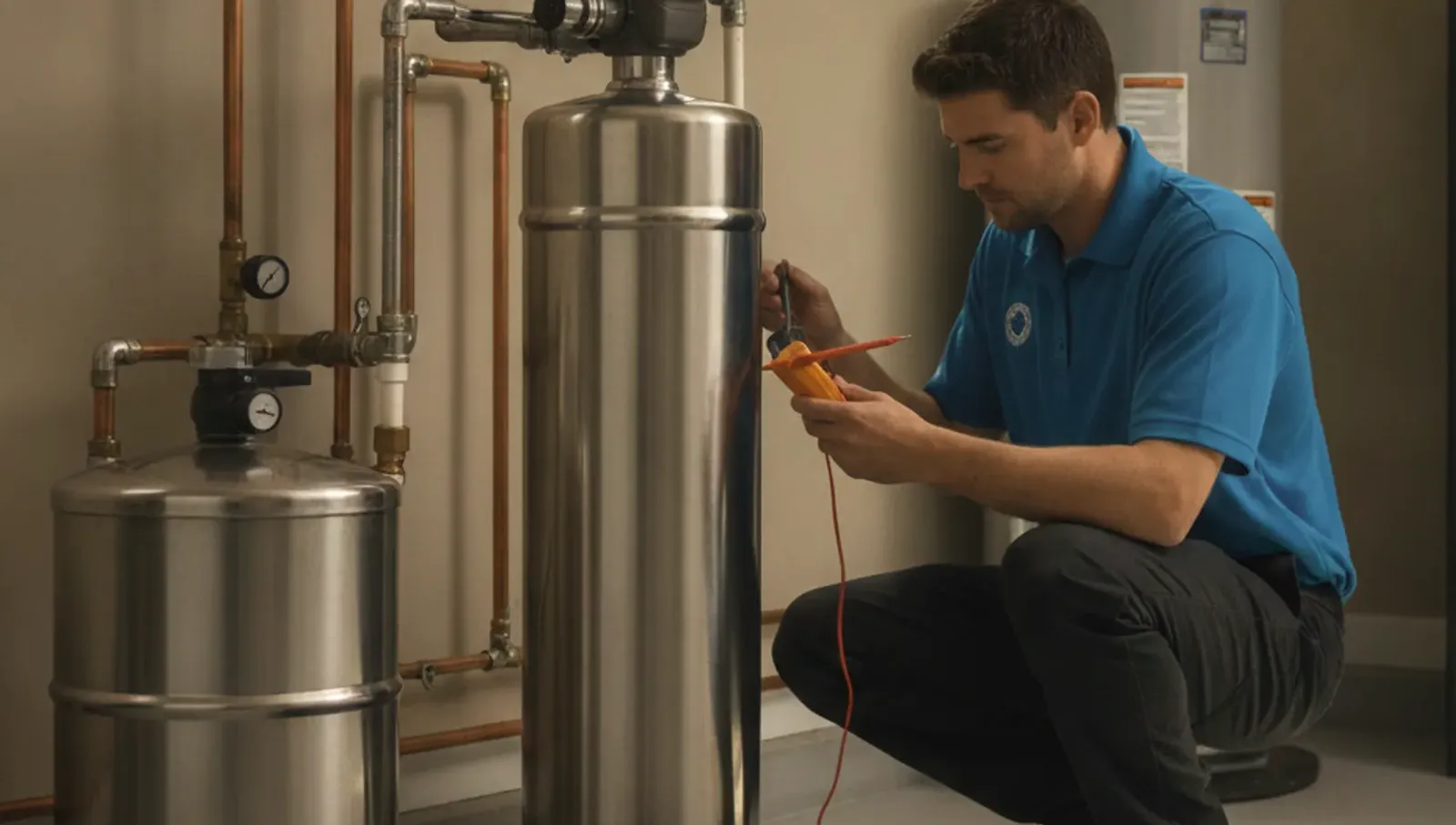
Start with the two quickest fixes
Before you assume the unit has died, rule out the two most common and easily missed causes. First, look at the bypass valve on the softener’s inlet and outlet. That valve redirects flow around the unit during plumbing work or vacations. If someone flipped it during a repair and forgot to switch it back, every tap in the house has been delivering untreated water the whole time. The softener itself may be perfectly fine.
Second, open the brine tank and check the salt. A unit that regenerates on schedule consumes salt steadily with each recharge cycle. If the level has not budged in several weeks while your household kept using water normally, the system likely stopped pulling brine or stopped cycling altogether. That is not a sign you are saving on salt. It is a sign something halted. For step-by-step guidance on topping off the tank, see how to add salt to a water softener.
Run a side-by-side hardness test
Feel and guesswork only get you so far. Grab a basic hardness test strip, or request a free in-home test, and take two readings. Draw the first sample from an outdoor spigot so you capture raw, untreated water. Draw the second from a treated indoor tap. If both numbers land close together in the hard range, the softener is not removing minerals no matter how the water feels on your skin. For the full walkthrough, read how to test water hardness at home.
Also confirm the unit is actually cycling. Most softeners rely on a timer or a metered head that tracks gallons and triggers a recharge automatically. Check the display for the last regeneration date. If it is weeks older than your household usage would suggest, or if an error code is showing, you have found your answer.
What correctly treated water looks and feels like
When a softener is doing its job, the differences are specific and repeatable. Skin comes out of the shower feeling smooth and almost silky rather than tight, because soap is not battling dissolved calcium and magnesium to produce lather. You will notice you need less shampoo and body wash to get the same clean. Glasses and plates exit the dishwasher without a cloudy film. Faucets, showerheads, and the inside of your coffee maker stay free of the crusty mineral deposits that untreated hard water leaves within days. If all of that still matches your experience, the system is likely performing as intended.
Warning signs that point to a real problem
The flip side of every indicator above tells you something has gone wrong. Spotty white residue creeping back onto shower glass and chrome fixtures is usually the first visible clue. Skin and hair turn dry and tight again, particularly right after bathing. Soap refuses to lather the way it used to, so you start using more. Scale accumulates inside the water heater and clogs fixture aerators. Any one of those changes on its own might be minor. Several showing up together mean the softener has stopped removing hardness effectively.
The salt bridge trap
One of the sneakiest reasons a softener appears to quit overnight is a salt bridge. That is a hardened crust that forms above the waterline inside the brine tank, preventing salt below from dissolving. From the outside the tank looks full. In reality the unit has been cycling without brine for an unknown stretch of time. If your salt level appears normal but the water has turned hard again, check for a bridge before you assume a mechanical failure. Our detailed guide on identifying and clearing a salt bridge walks through what to look for and how to break it up safely.
San Diego’s hardness baseline and what to aim for
Raw water across San Diego County sits firmly in the hard range or higher, depending on which neighborhood you are in. A properly functioning softener should bring treated water down to near zero, typically under 1 gpg. That is the number worth testing against rather than relying on a vague sense that things feel a little better. If your treated sample still reads in the double digits, something in the chain is failing: a salt bridge, a stuck bypass, a worn resin bed, or a timer that stopped triggering recharge cycles. Staying on top of routine upkeep helps catch these issues early. Our post on water softener maintenance in San Diego outlines what to inspect on a regular schedule.
Frequently asked questions
How often should I check that my softener is performing?
A quick hardness test every few months covers most households. Run an extra check any time you notice spotting returning, skin drying out, or scale forming on fixtures.
Salt is going down but the water is still hard. What gives?
That pattern usually signals a mechanical fault rather than a salt issue. A worn resin bed, a stuck valve, or a misprogrammed timer head can all cause it. A separately licensed professional should inspect the unit.
Can a softener run fine for years and then just quit?
Yes. Resin beads degrade over time, electronic heads fail, and valves develop leaks or jams. Years of good performance do not guarantee the next year will be trouble-free without upkeep.
Is month-to-month variation in salt use normal?
Some fluctuation tracks with seasonal water use and is expected. A sudden drop to near-zero consumption over several weeks while the household runs water normally, though, is not typical and deserves a closer look.
Getting a professional set of eyes on the problem
If you have verified the salt, ruled out a bridge, confirmed the bypass is closed, and the water still tests hard, the cause is mechanical. At that point a separately licensed water-treatment professional should diagnose the fault before a small issue turns into a full replacement. Clear Water Pros SD connects San Diego County homeowners with independent local pros who handle water softener repair and can pinpoint exactly what stopped working.
Call (858) 400-4647 and Clear Water Pros SD will connect you with an independent local water-treatment professional.