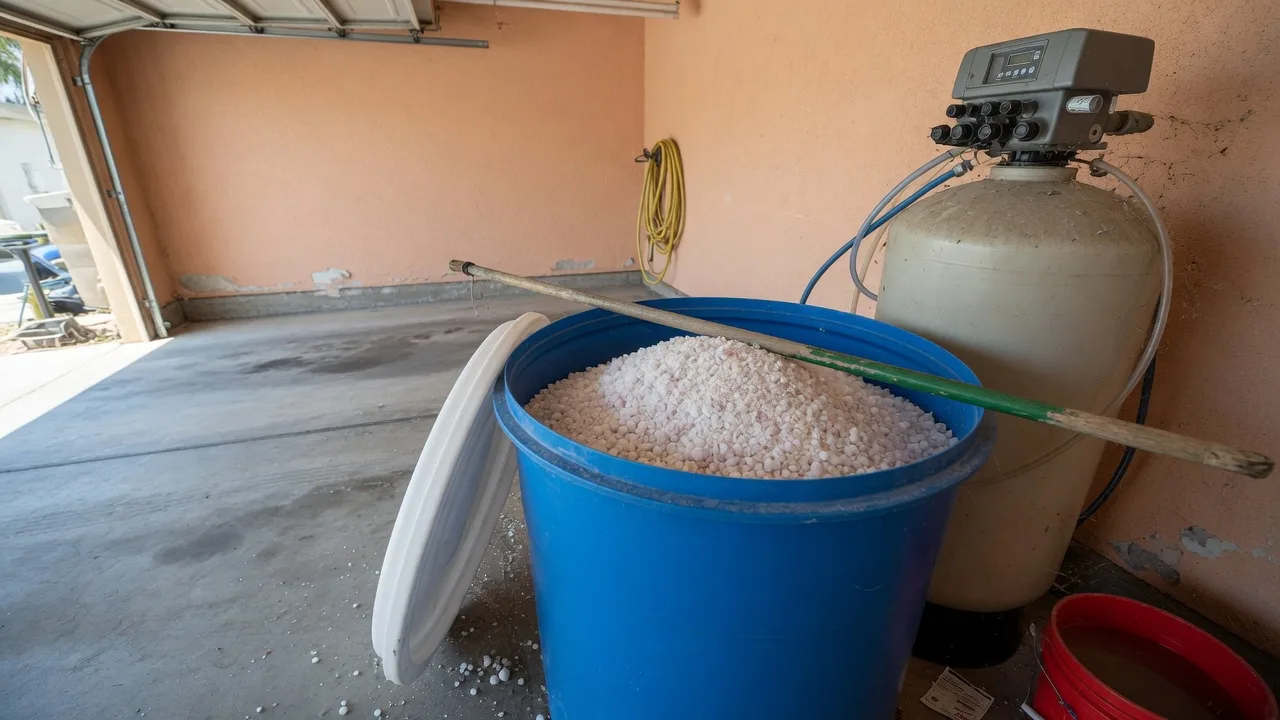
The brine tank still looks full. The wine glasses are spotting again. On a City of San Diego tap, that combination usually means the softener is not drawing salt, not that the City suddenly went soft. Clear Water Pros SD connects you with a licensed water-treatment pro. The brand does not service valves itself.
Why unused salt shows up fast here
When a softener is working, calcium and magnesium leave the water before they hit the heater and the glassware. When it is not, hardness comes back in days, not months.
The City of San Diego Public Utilities site says drinking water in the City typically averages about 16 grains per gallon, or 276 ppm. It can run 16 to 18 grains, or 272 to 284 ppm, depending on demand and where you live in the City. That figure is for the City system only. Helix Water District, which serves parts of East County including La Mesa, El Cajon, and Lemon Grove, says water at 10 or more grains is considered hard. The imported Colorado River and State Water Project supply it discusses averages about 14 grains. That is imported supply, not your exact tap.
USGS classifies water above 180 mg/L of hardness as very hard. Sixteen grains sits well above that line. A unit sitting in bypass, or a brine tank that never makes brine, shows up on dishes quickly.
Three reasons the salt pile never drops
A salt bridge
Rheem’s manufacturer manual describes a hardened salt crust that creates a gap between salt and water. Salt cannot dissolve into brine. Regeneration suffers. From above, the tank still looks full.
Culligan’s troubleshooting page says a salt level that stays the same over time can mean a bridge. Press gently on the top layer with a wooden spoon or similar nonmetal tool. If it feels solid and hollow underneath, you likely have a crust. Do not use sharp or metal objects. They puncture liners and brine wells. Follow the actual model manual before you break anything up. Our salt-bridge notes cover the broom-handle check in more detail.
Kinetico’s salt-fill guidance says not to use rock salt, and not to fill the tank completely, because overfilling can cause bridging. Kinetico’s own fill range is about half to three-quarters full for medium to high use, and about half full for low use. Other brands write other manuals. San Diego garages swing from dry inland heat to coastal marine layer. Humidity shifts help a crust form.
The unit is in bypass
Culligan describes bypass as routing water around the softener so household water continues while the unit is isolated. Valve types differ: lever, knobs, three-valve assembly, app-controlled. Do not force a stuck handle. Confirm bypass by running a cold tap. Always follow the exact model manual.
A bypass left on after a repair, a heater swap, or a whole-house filter change will leave the salt pile untouched. The control head can still light up and look busy.
Regeneration never draws brine
EPA’s May 2026 water-softener guide says demand-initiated regeneration responds to use and hardness rather than a fixed timer. Persistent drain flow can indicate a malfunction. If the drain runs while the house is quiet, that is a different fault from unused salt, and it still needs a licensed pro.
Culligan lists other brine-draw failures: low household pressure, a blocked injector or brine line, a restricted drain, a control-valve problem, or a safety float that is not working. A brine tank full of water is the usual companion symptom. Manual regeneration is a check. If the water level never drops, stop and call.
What to look at before anyone opens a valve
Lift the brine-tank lid, not the resin tank. Kinetico is explicit about that distinction. If water sits above the salt, that page says to add salt or potassium chloride, unless the water is unusually high after a regen. Do not pack the tank to the lid.
Stay off wet electrical gear. Do not open pressurized assemblies. GE’s leak guidance, already on our claims ledger, is isolate with the bypass or the supply shutoff if you can do that dry, then contact the installer or plumber.
How to know if a water softener is working covers lather and scale checks. Unused salt is the inventory clue those pages only mention in passing.
When unused salt means the unit is done
Replacement enters when the resin bed no longer softens after a proper regen, the tank itself is leaking, or the same unit keeps coming back with a new fault. No verified source we hold gives a universal year cutoff. How long a water softener lasts walks that honestly. Age is one input. The condition of the tank, valve, and resin is the rest.
Frequently asked questions
Can I just add more salt?
If the pile is already high and unused, more salt will not fix a bridge, a bypass, or a stuck injector. Adding salt on top of a crust can make the next visit harder.
Is rock salt fine in San Diego?
Kinetico says not to use rock salt in the brine tank it describes. Follow your model. Impurities in cheap salt also feed mush at the bottom of the tank.
Could the water just be softer this month?
City and Helix figures do not swing from very hard to soft because of a warm week. If scale came back and the salt did not move, treat it as a equipment problem.
Call a licensed pro
If the broom-handle check finds a crust, and the model manual allows you to break it, you can try that path. If hardness stays after a regen, or the tank is full of water, a separately licensed professional should inspect the valve and resin. Call (858) 400-4647 and Clear Water Pros SD will connect you with an independent local water-treatment professional.