You lift the salt-tank lid and see a lake. Spots are back on the glasses. That is a brine-draw problem, not a reason to dump the tank into the driveway. Clear Water Pros SD connects San Diego County homeowners with licensed water-treatment pros. The brand does not open control valves.
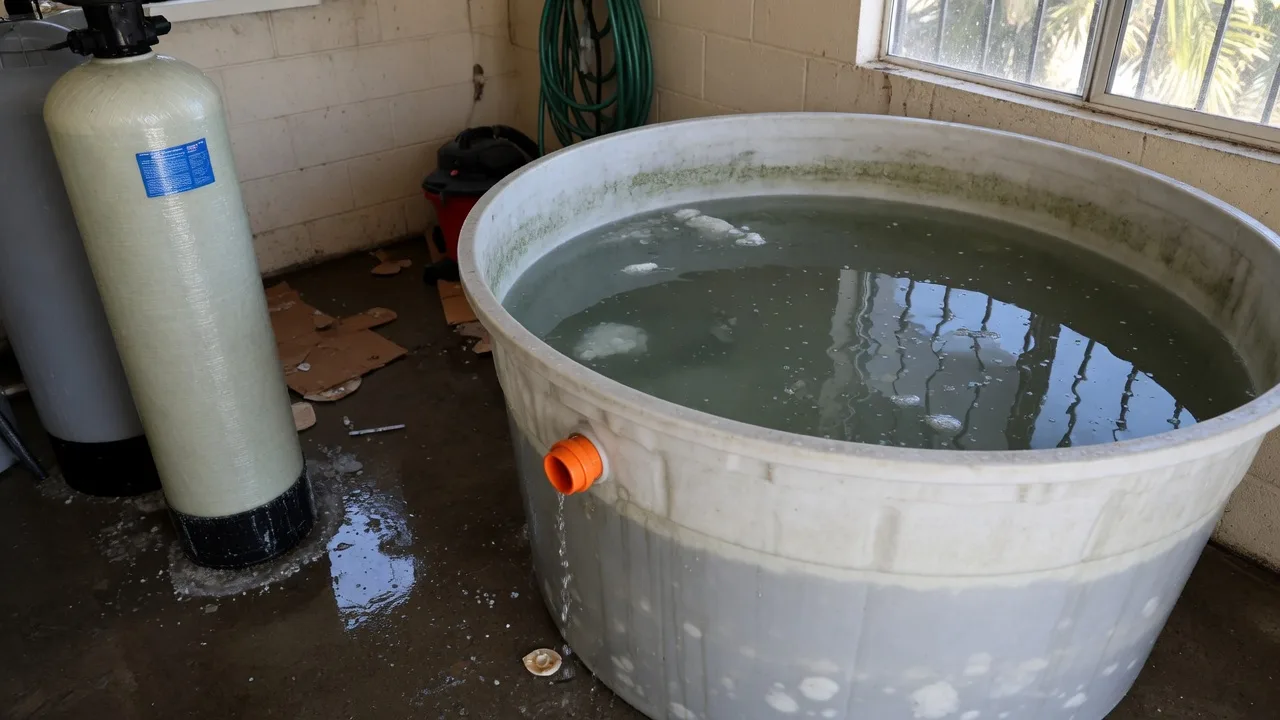
Some water is normal. A full tank after regen is not.
Culligan’s clogged-softener page, updated August 13, 2026, says a working brine tank fills and then stops, often somewhere around a fourth to halfway up at most. Because the salt pile usually sits higher than that, you should not see a lot of water. Seeing some water does not automatically mean you need more salt.
The same manufacturer says a brine tank full of water usually means the system cannot draw brine during regeneration. Culligan’s September 2026 troubleshooting page adds: a modest water level can be normal, but an unusually high level, or a level that does not drop after regeneration, is the fault.
City of San Diego taps run hard on the City’s own publications, about 16 grains per gallon typical on the plumbing page, with a 16 to 18 grain range by area and demand. That is the City system only. A softener that cannot make or draw brine leaves that hardness in the house.
Causes Culligan actually lists
Do not guess a cracked tank first. Culligan lists:
- Restricted or damaged drain line
- Blocked injector or brine line
- Malfunctioning control valve
- Improperly functioning safety float
- Salt bridging or salt mushing
- Household water pressure too low to finish brine draw
A salt bridge is a hardened crust with a gap under it. Salt mush is sludge at the bottom. Both stop brine from forming the way the valve expects. Rheem’s manual already on our ledger defines the crust as a gap between salt and water that impairs regeneration. When a softener is not using salt covers the crust check. This page is about the water that never leaves.
EPA’s May 2026 softener guide notes that persistent drain flow can indicate a malfunction. A drain that runs while the house is quiet is a cousin of this fault. It still is not a DIY valve rebuild.
Safe checks that do not open the valve
Follow the model manual. Stay dry around electrical parts. Do not force a stuck handle.
- Confirm you are looking at the brine tank, the one with the removable lid, not the resin tank.
- Look for a salt crust. Culligan says to tap gently with a broom handle or wooden spoon. Hollow resistance partway down is the crust. Do not use metal tools.
- Look at the brine line between the two tanks and the drain line. Disconnection, a kink, or an obvious clog is worth noting. Culligan says inspect visible obstructions around the float without disassembling or forcing parts.
- Start a manual regeneration if the manual allows it. Culligan says the water level should start to drop within a few minutes. If it stays high, stop.
Kinetico’s fill guidance, for the tanks it describes, is not to use rock salt and not to fill completely. Overfilling can cause bridging. Other brands differ. San Diego garages in El Cajon heat and coastal humidity both help mush and crusts form.
If water is on the floor, that is a leak, not only a full brine tank. Isolate with the bypass or the supply shutoff if you can do that dry. Water softener leaking in San Diego covers that isolation. GE’s manufacturer guidance is the same sequence: isolate, then contact the installer or plumber.
What not to do
Do not siphon the tank into a floor drain and call it fixed. The valve will fill it again. Follow the exact model manual for drain and overflow routing. Do not open the injector or the control head.
City of San Diego Simple No-Plan plumbing-permit language covers eligible water-softener installation work in the City. It does not turn a flooded brine tank into a permit project by itself. Confirm the current City page if the pro is replacing the unit.
Frequently asked questions
Why is my water softener full of water?
Culligan: standing water can be normal in small amounts. Higher-than-usual levels often mean a flow issue, a salt bridge or mush, a blocked injector or brine line, a restricted drain, a control-valve problem, or a safety float that is not working.
Can I keep using the house while the tank is full?
Household water may still run. It may be untreated. If water is overflowing onto the floor, isolate the unit. A licensed pro should inspect before the next regen.
Does a full brine tank mean I need a new softener?
Culligan says a tank that is only full of water, on a unit that had been reliable, is often repairable. Stacked faults, a leaking resin tank, or a bed that will not soften after a proper regen are the replacement conversation. How long a water softener lasts stays away from fake year cutoffs.
Call before the next regen
A separately licensed water-treatment professional should inspect the injector, float, and valve when the water level will not drop. Call (858) 400-4647 and Clear Water Pros SD will connect you with an independent local pro. You contract with that pro directly.