A softener on a City of San Diego main and a softener on a Fallbrook well are not the same job. The well can carry hardness, iron, sediment, bacteria, or none of those. Clear Water Pros SD connects inland well owners with licensed treatment pros. The brand does not drill wells or install equipment itself.
Do not copy City hardness onto the well
City of San Diego Public Utilities says drinking water in the City typically averages about 16 grains per gallon, or 276 ppm, ranging 16 to 18 gr/gal by area and demand. That figure is for the City system only. Helix Water District says water at 10 or more grains is considered hard, and the imported supply it discusses averages about 14 grains. Those statements describe municipal or imported supply. They do not describe a private well in Ramona, Rainbow, Valley Center, or Hidden Meadows.
USGS classifies hardness as calcium carbonate: 0 to 60 mg/L soft, 61 to 120 moderately hard, 121 to 180 hard, over 180 very hard. That is classification guidance. It is not a well result.
EPA’s May 2026 water-softener guide: size from measured hardness and household water use. Exclude irrigation when that water should not be softened. Oversizing can waste water. Compare the exact model’s NSF/ANSI 44 certification, rated working capacity, and water/salt efficiency. Salt-free conditioning does not remove hardness ions. Evaluate the exact scale-reduction claim, including IAPMO/ANSI Z601 where that claim is made.
Test the well first
CDC: use a state-certified laboratory. Annual tests for total coliform, nitrate, TDS, and pH. Ask the County or the State Water Board which extra tests fit the location. Well water testing in San Diego County is the panel. Match treatment to the identified problem. CDC is explicit: no single home treatment type protects against every problem.
A positive indicator needs its own coliform interpretation. A low-pH result needs a test-first pH path. Neither is solved by choosing a larger softener.
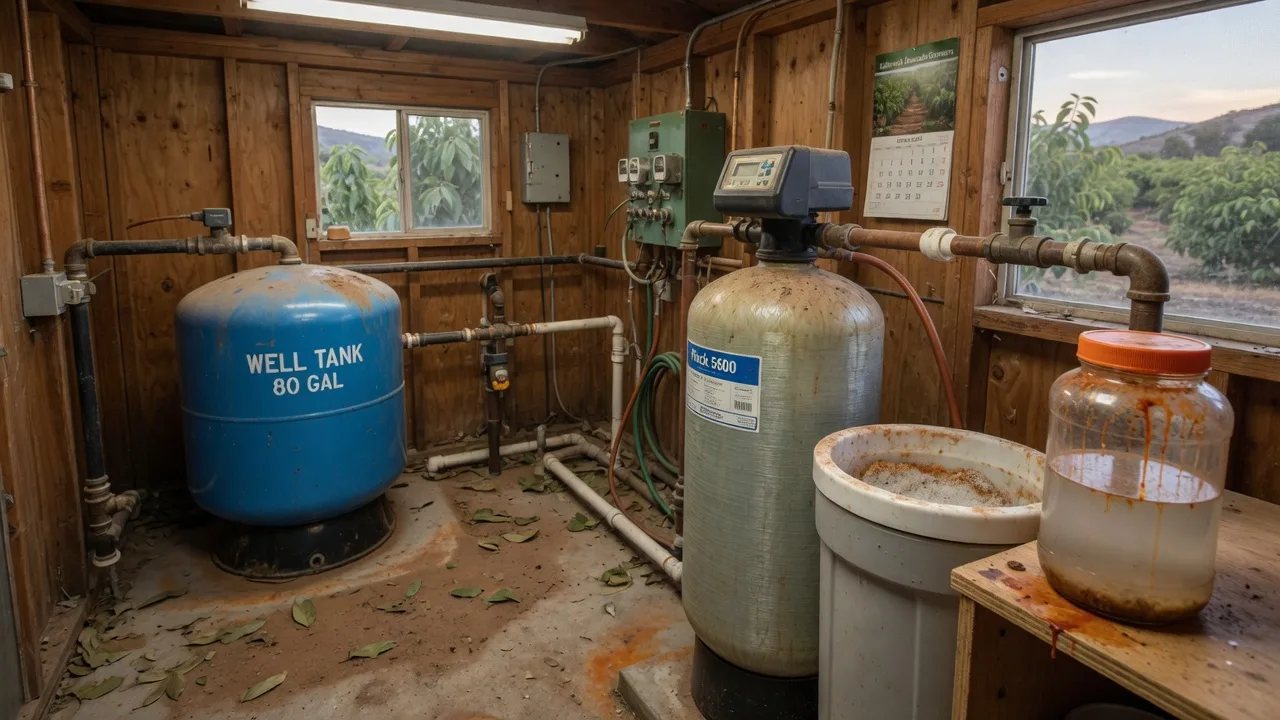
EPA’s secondary iron guideline is 0.3 mg/L, associated with rusty color, sediment, metallic taste, and reddish or orange staining. Iron on a well is not automatically a softener job. Some manufacturer literature discusses limited iron removal on softeners. That is manufacturer-limited, not a universal threshold, and not a chemical-dosing recipe. Iron bacteria is a biological clogging problem. A resin tank does not replace well disinfection by a licensed well contractor.
A sediment filter often sits ahead of a softener on sandy or rusty wells so the resin is not the first strainer.
If the lab or the County says the water is unsafe, CDC says use another safe source, treat, then retest before you drink it. Boiling does not remove chemical contamination.
What a well-side softener does and does not do
Ion exchange swaps hardness ions for sodium or potassium. University of Nebraska-Lincoln Extension NebGuide G1491: sodium is added at about 8 mg/L for each grain per gallon of hardness removed. Their example: 10 gpg hardness yields about 80 mg/L sodium after treatment. People on restricted sodium diets should consult a physician. Drinking and cooking water is often taken from a kitchen cold line that bypasses the softener. Potassium chloride may be used instead of sodium chloride in some units, with professional guidance. That is an estimate of added sodium, not a measured San Diego well result, and not medical advice.
A softener does not make a well bacteriologically safe. It does not remove every metal. It does not fix a rotten-egg odor by itself. Hydrogen sulfide can originate in the well, the plumbing, or the heater. Trace that source first.
For a property with onsite septic, EPA advises checking with the septic manufacturer or local service provider about overload, warranty, and system performance before installing a softener. Our softener-discharge guide keeps the parcel-specific drain decision separate from equipment sizing. Do not infer that every septic lot in the county is banned from softeners. We have not verified a countywide prohibition.
City of San Diego Simple No-Plan plumbing-permit language is City jurisdiction. Unincorporated well properties sit under County rules. Confirm the current permit path for the address.
Layout in the well house
Most inland installs put the sediment stage after the pressure tank, then the softener, then a drinking-water RO at the kitchen if the lab says the kitchen tap needs it. EPA distinguishes point-of-use from whole-house scope. A kitchen RO does not protect the heater. A softener on the domestic line does not treat the orchard.
Ramona well water filtration covers the RMWD-versus-well split on that zip. Fallbrook and Escondido well pages cover those towns. This page is the softening decision once the lab sheet is in hand.
Frequently asked questions
Will a softener clear orange well water?
Not if the problem is iron bacteria or heavy particulate iron. Test first. EPA’s 0.3 mg/L iron figure is an aesthetic guideline, not a treatment prescription.
Can I use City of San Diego grain numbers to size a well softener?
No. Measure this well.
Do you install the softener?
Licensed providers the brand refers do the licensed work. You contract with that provider. Call (858) 400-4647 for a free in-home water test so the pro sees the well house before anyone orders a tank.