A Ramona house on the grasslands can sit on a private well, a Ramona Municipal Water District tap, or a split where the kitchen and the barn use different sources. Filtration has to follow that source, the lab sheet, and the plumbing layout. Clear Water Pros SD connects 92065 homeowners with licensed water-filtration pros after a free in-home water test. The brand does not drill wells, haul tanks, or treat water itself.
Ramona Municipal Water District vs private wells
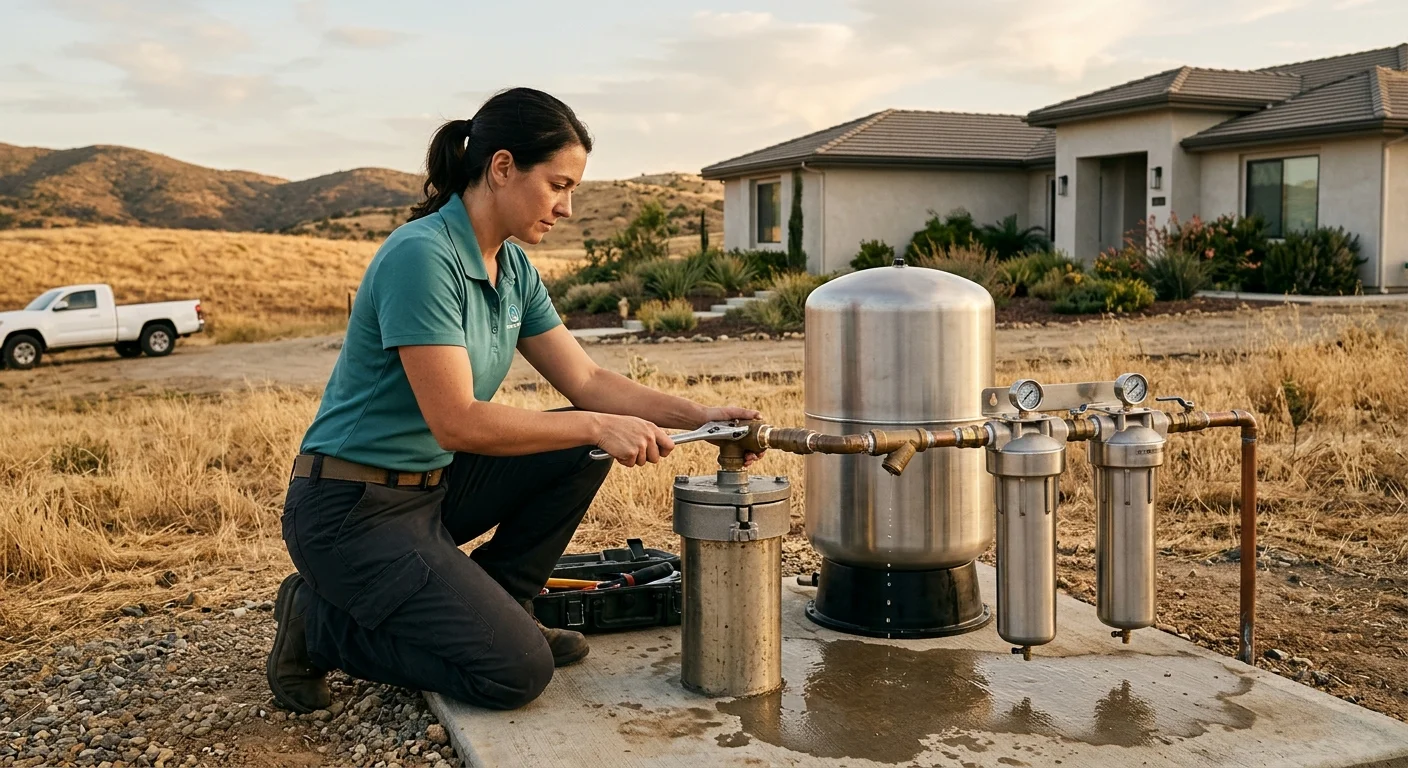
Ramona sits in the inland Santa Maria Valley, east of Escondido and well above the coastal cities. ZIP 92065 covers the town grid, the San Vicente corridor, and hill parcels that never joined a municipal main. Some kitchens drink RMWD water. Some ranches, horse properties, and older grassland homes still pull from a private well, with a pressure tank by the well head and a dusty run of pipe into the garage.
If your bill comes from Ramona Municipal Water District, you are on a regulated public system. RMWD publishes water-quality information for its customers. Federal Safe Drinking Water Act limits and California Division of Drinking Water rules apply to that utility water. Your serving utility’s current consumer confidence report is the document for that tap. City of San Diego hardness figures describe the City system only. They do not describe an RMWD meter, and they do not describe a private well.
If you own the well, you own the testing. San Diego County Department of Environmental Health and Quality runs private-well programs in the unincorporated county. The State Water Board publishes domestic-well guidance. A private well does not get the same routine public-system reporting that RMWD customers receive. Neighboring lots can differ. A well on a 92065 hill parcel can read differently from a well on the valley floor a mile away.
Some Ramona properties mix sources. Irrigation from a well and indoor taps from RMWD is a common split on larger lots along the grasslands and toward San Vicente. Treatment then has to be scoped per line. A whole-house filter on the domestic entry leaves the orchard line alone unless that line is tied in. A barn tap on well water can need sediment and iron stages while the house on RMWD needs a different drinking-water setup.
Confirm the source at the address before anyone sizes a tank. Ask RMWD if the meter is theirs. Ask the County well program if the well is permitted and how to pull records. Clear Water Pros SD can arrange a free in-home water test so a licensed pro sees the actual plumbing, the pressure tank, and which pipes carry which water.
Public water-planning work in the Ramona area has included neighborhoods that still rely on wells. Current project status, who is eligible to connect, and what the district is building belong on RMWD’s own pages. This page will not guess a contamination rate for any tract.
Tests that matter before you treat an inland well
CDC guidance for private wells is to use a state-certified laboratory. CDC recommends annual testing for total coliform, nitrate, total dissolved solids (TDS), and pH. Ask the County or the State Water Board which extra tests fit this location. Geology, septic setbacks, livestock, and irrigated pasture can all change what a lab should look for. That is a local-health question. It is not a blog diagnosis.
Identify the treatment goal from the serving utility’s report, when you are on RMWD, and from appropriate testing, when you are on a well. EPA’s home-treatment guidance is clear on that order. No single technology removes every contaminant. A pitcher that helps with taste on RMWD water can miss what a well actually needs.
Specific Ramona well numbers for arsenic, nitrate, iron, or sulfur could not be confirmed in our verified claims ledger. If a neighbor mentions a reading, treat it as their sample. Pull a current lab report for this well. A handheld strip in the kitchen is a screen. It is not a metals panel and it is not a coliform result.
A positive total-coliform result is an indicator. It does not identify every pathogen. Harmful or suspected contamination is a health-department matter. CDC says to use another safe water source in that case and to follow local guidance. Boiling does not remove chemical contamination.
TDS is an aesthetic and technical reading. EPA’s secondary guideline for TDS is 500 mg/L. That figure addresses taste, color, and technical concerns. It is not a universal drinking-safety cutoff, and it does not prove other contaminants are absent. USGS notes that specific conductance can approximate dissolved solids, and the relation varies with water composition. Conductivity is useful. It still is not a constituent-specific laboratory analysis.
If the well smells like rotten eggs, hydrogen sulfide can originate in the well, the plumbing, or the water heater. Trace the source first. Our rotten-egg well-water notes walk through that triage. Iron staining is a separate aesthetic issue. EPA’s secondary guideline for iron is 0.3 mg/L, tied to rusty color, sediment, metallic taste, and reddish or orange staining. That is an EPA nuisance guideline. It is not a Ramona well measurement.
Bring the lab sheet to the licensed pro. The in-home test the brand offers is a starting look at hardness, TDS, and what the plumbing is doing. For a private well, pair it with a state-certified well panel before anyone picks UV, iron, sulfur, or softening stages. Well water testing in San Diego County is the annual panel. Iron bacteria and a sediment filter for well water are separate decisions after that sheet.
Whole-house options that follow the lab results
Once the lab names the problem, whole-house water filtration treats water at the point of entry. Point-of-use devices treat a selected tap, usually the kitchen cold line. EPA draws that split clearly. A drinking-water reverse-osmosis unit at the sink leaves the shower and the water heater on untreated well water.
NSF/ANSI 42 covers certified aesthetic reduction claims. NSF/ANSI 53 covers specified health-effect contaminant claims. NSF/ANSI 44 covers ion-exchange softeners that reduce calcium and magnesium hardness. NSF/ANSI 58 covers reverse osmosis systems. A standard is not a ranking. It does not mean a model reduces every contaminant. Verify the exact model’s certified reduction claim on the listing for that model.
UV, iron filtration, sulfur treatment, and softening are options a licensed pro sizes after the test. They are choices that follow the lab. Salt-free conditioning does not remove hardness ions. EPA says to evaluate the exact scale-reduction claim, and to look at IAPMO/ANSI Z601 scale-reduction requirements when you are comparing salt-free models. If hardness is on the sheet, USGS classifies hardness as calcium carbonate: 0–60 mg/L soft, 61–120 moderately hard, 121–180 hard, and over 180 very hard. That is classification guidance. It is not a safety certification, and it is not a 92065 tap result.
If a salt-based softener is on the table, EPA’s May 2026 water-softener guide says to size from measured hardness and household water use, and to exclude irrigation demand when that water should stay off the softener. Oversizing can waste water. Demand-initiated regeneration responds to use and hardness rather than a fixed timer. Compare the model’s NSF/ANSI 44 certification, rated working capacity, and water and salt efficiency. For a property with onsite septic, EPA advises checking with the septic manufacturer or local service provider before installing a softener.
Ion-exchange softening adds sodium. University of Nebraska–Lincoln Extension estimates about 8 mg/L of sodium added for each grain per gallon of hardness removed. People on restricted sodium diets should talk with a physician. Drinking and cooking water is often taken from a kitchen cold line that bypasses the softener.
Reverse osmosis at a drinking tap is a different job. An RO system produces treated water and reject water. Performance and efficiency are model-specific. EPA WaterSense discusses labeled point-of-use RO efficiency. That label is a certification criterion, including a stated maximum of 2.3 gallons of reject water per gallon treated under WaterSense conditions. It is not field performance for every unit. CDC notes RO may reduce arsenic on systems whose labels say so. NSF/ANSI 58 treats fluoride reduction as an optional exact-model claim. Distillation leaves many substances behind and does not remove some volatile organic compounds, solvents, or certain pesticides.
City of San Diego plumbing-permit notes about softeners apply inside City jurisdiction. Unincorporated 92065 work follows County permitting. Confirm the permit path with the County before a licensed pro sets tanks. The licensed pro installs. Check that license on the CSLB license lookup. Clear Water Pros SD does not hold the trade license and does not own a yard of tanks.
How Ramona differs from Escondido and Fallbrook wells
Ramona is inland Santa Maria Valley grassland and oak, with San Vicente to the south and hill parcels climbing through 92065. Summer demand on a horse property here is real. So is dust at the well head, long private lines, and the chance that RMWD already serves the house while the well only feeds pasture. That mix is the local problem. Treatment has to respect it.
Escondido and Hidden Meadows sit closer to the I-15 granite belt. Those wells often show a different mineral mix and a different well-depth pattern than a Ramona valley well. We already wrote that split on Escondido and Hidden Meadows well water filtration. Use that page if the well is west of here. Use this one if the well is Ramona, San Vicente, or a 92065 hill lot.
Fallbrook and Rainbow wells sit in north-county ag country, with irrigation demand that can dwarf indoor use. A Ramona ranch can look similar on paper and still need a different bypass, because the house may already be on RMWD. Confirm which pipes carry which water before anyone talks about a whole-house unit. The Fallbrook page stays on that north-county well market. This page stays on Ramona.
Imported Colorado River and State Water Project supply, as Helix Water District describes it, averages about 14 grains of hardness. Helix also states that water at 10 or more grains per gallon is considered hard. That is a statement about imported supply. It is not a Ramona well reading, and it is not every RMWD tap. City of San Diego publishes its own hardness range for the City system, typically about 16 grains per gallon (276 ppm), ranging from 16 to 18 gr/gal (272 to 284 ppm) by area and demand. Those City figures stay on City addresses.
Taste and smell differ with the source. RMWD customers are on disinfected utility water. CDC notes that chlorine and chloramine taste and smell differ from untreated water, and the utility report identifies the disinfectant. A private well is a different job: source protection, lab work, then the right filter train. If the house is on RMWD, the job may be aesthetic reduction at the entry or a drinking-water RO at the sink.
The San Diego County Water Authority describes regional imported supply and member agencies. RMWD is the local retailer for district customers. A well owner is on groundwater at the well head. Those two waters do not get the same filter train by default.
County and RMWD pages to verify
Start with Ramona Municipal Water District if you pay an RMWD bill. Their water-quality pages and the current consumer report are the authority for that tap. Ask the district which supply serves your meter. City of San Diego 2025 plant tables for Alvarado, Miramar, and Otay belong to the City system. Keep them off a Ramona address.
For a private well, use San Diego County Department of Environmental Health and Quality well programs. County pages cover well construction, destruction, and public-health testing contacts. The State Water Board domestic-well pages explain state drinking-water context for household wells. Those agencies set the rules. This brand connects you with licensed pros. It does not replace the County or the Board.
Keep copies of lab results, well logs if you have them, and any County permit numbers. A licensed pro needs those to size sediment pre-filtration, iron or sulfur stages, softening, UV, or RO. Include manufacturer maintenance requirements and replacement-filter costs when you compare ownership cost. EPA’s November 2024 home-treatment guide groups pitcher and tap filters as typically under $100, RO and distillation as tending to cost a few hundred dollars and possibly needing professional installation, and point-of-entry systems as costing thousands and generally needing professional installation. Those are EPA’s broad national categories. They are not a Ramona quote and they are not a Clear Water Pros SD price.
Test after treatment is in, as CDC advises, before you treat the new water as the new normal. Match the equipment to the identified problem. Then confirm it worked with another lab pass on the treated side.
When to call us
Call when the source is confirmed, the well or RMWD tap is in 92065, and you want a licensed water-filtration pro to size treatment from a real sample. Clear Water Pros SD answers the phone, sets up the free in-home water test, and connects you with that pro. You contract with the pro directly. Call us at (858) 400-4647 to set up a free in-home water test.