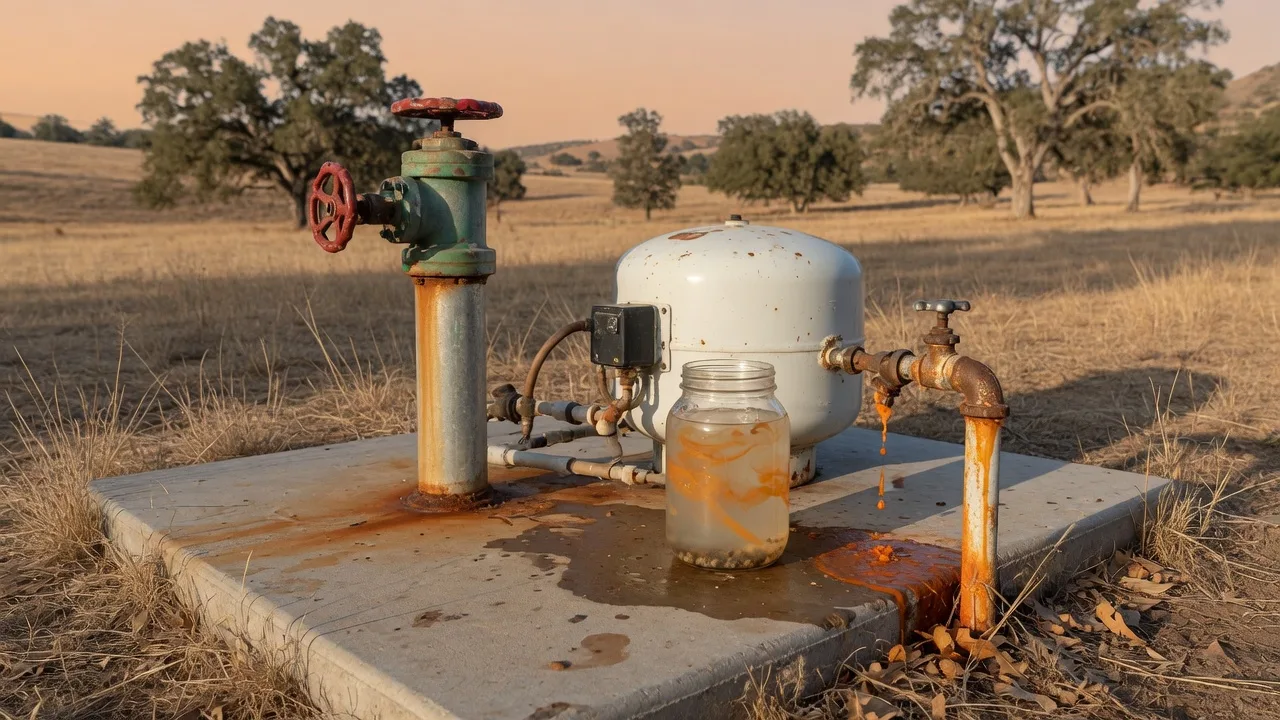
A Ramona, Fallbrook, or Valley Center well can look fine one week and leave orange slime in a toilet tank the next. That pattern is often iron bacteria, not a City of San Diego main. Clear Water Pros SD connects inland well owners with licensed water-treatment and well professionals. The brand does not drill, shock, or chlorinate wells itself.
What iron bacteria actually are
The Minnesota Department of Health describes iron bacteria as small organisms that live in soil, shallow groundwater, and surface water. They combine iron or manganese with oxygen. The result is rust, bacterial cells, and a slimy film that sticks to well pipe, pumps, and fixtures.
MDH says iron bacteria are not known to cause disease. They can still make a well worse. They clog screens and plumbing. They can create conditions where other organisms grow. They can cut how much water the well produces.
That is a mechanism, not a San Diego prevalence number. MDH writes about Minnesota soil. Do not treat any Minnesota well statistic as a local rate. Inland San Diego County wells sit in granite, decomposed granite, and alluvial pockets from Ramona’s grasslands through Fallbrook avocado country. Neighboring lots can differ. The only reading that counts is a lab sheet for this well.
Clues that show up at the tap
MDH lists the sensory clues. Odors can smell swampy, oily or like petroleum, like cucumber, sewage, rotten vegetation, or musty. The smell is often stronger after the well has sat unused. Color can run yellow, orange, red, or brown. A rainbow, oil-like sheen can sit on standing water. Slimy deposits can look rusty, yellow, brown, or grey, sometimes with feathery growths.
Those clues overlap with other well problems. Rotten-egg odor can be hydrogen sulfide in the well, the plumbing, or the heater. Our rotten-egg well-water notes walk that triage. Orange water on a City of San Diego tap is usually plumbing or a main, not iron bacteria. See rusty tap water in San Diego County. EPA’s secondary guideline for iron is 0.3 mg/L, tied to rusty color, sediment, metallic taste, and reddish or orange staining. That is an aesthetic guideline. It is not a diagnosis of bacteria.
MDH says a laboratory test is how you confirm iron bacteria. A jar of orange water on the patio is not that test. Our oil-like sheen guide separates this private-well clue from a public-water fixture or utility question.
Test the well before anyone doses it
CDC guidance for private wells is to use a state-certified laboratory. CDC recommends annual testing for total coliform, nitrate, total dissolved solids, and pH. Ask San Diego County Department of Environmental Health and Quality, or the State Water Board, which extra tests fit the location. Livestock, septic setbacks, and shallow fractured rock change that list. A handheld strip is a screen. It is not a coliform result and it is not an iron-bacteria confirmation.
A positive total-coliform result is an indicator. It does not identify every pathogen. The coliform guide explains the separate total-coliform, fecal-coliform, and E. coli questions. If the lab or the County says the water is unsafe, CDC says to use another safe source and follow local health-department guidance. Boiling does not remove chemical contamination.
Well water testing in San Diego County covers the annual panel. Pair that panel with whatever the lab needs to confirm iron bacteria, then bring both sheets to the licensed pro.
What treatment actually involves
MDH is blunt: eliminating iron bacteria can be difficult and expensive, and treatment may only be partly effective. Contact a licensed well contractor or water-treatment professional. Do not mix chemicals in the well house because a blog listed them.
MDH groups the work this way:
Physical removal usually comes first on a badly infected well. A licensed well contractor removes and cleans pumping equipment and brushes the casing. Chemical treatment often follows. MDH lists three chemical groups: disinfectants (commonly chlorine), surfactants such as phosphates used with a disinfectant, and acids that dissolve deposits. Surfactants and acids belong to trained professionals. Never mix acid and chlorine.
Pasteurization injects steam or hot water to hold the well at 60°C (140°F) for 30 minutes. MDH says it can work and it can be expensive.
MDH describes shock chlorination as a strong chlorine solution, close to but not greater than 200 parts per million, after the well is pumped clear or physically cleaned. That is MDH well-disinfection guidance. It is not a homeowner recipe for a 92065 or 92028 well. MDH does not usually recommend continuous chlorine injection. It can hide other bacterial contamination and cause corrosion.
Clear Water Pros SD will not write a dose. The licensed well contractor who owns the job sets the method against the lab sheet and the well construction.
Keep iron bacteria from coming back in
MDH prevention is construction and hygiene, not a filter catalog. Never put lake or pond water into a well for drilling, repair, or priming. Keep the casing capped, watertight, and at least one foot above ground. Do not set pumps, well pipe, or equipment on the ground during repairs. Disinfect after repairs.
A sediment filter on well water can catch rust flakes after the well is cleaned. It does not replace disinfection of the well itself. A water softener on well water addresses hardness ions. It is not an iron-bacteria treatment.
City of San Diego hardness figures describe the City system only. They do not describe a private well in Ramona, Fallbrook, Rainbow, or Hidden Meadows.
Frequently asked questions
Are iron bacteria dangerous to drink?
MDH says they are not known to cause disease. They can still clog the well and support other growth. Test for nitrate and coliform, and confirm construction, location, and maintenance.
Can a whole-house filter fix the slime by itself?
A filter can catch particles after the well is addressed. MDH treatment starts with physical cleaning of the well, then chemical work or pasteurization by a licensed contractor. A cartridge in the garage does not replace that.
Should I pour bleach down the well tonight?
No. Follow the licensed well contractor and the model of disinfection they use. MDH warns against mixing acid and chlorine, and against continuous chlorine injection as a usual practice.
Getting a licensed pro on the well
Bring the lab sheet, photos of the slime or sheen, and notes on whether the odor is worse after the house sits idle. Clear Water Pros SD can arrange a free in-home water test so a licensed pro sees the pressure tank, the well house, and the plumbing. You contract with that pro directly.
Call (858) 400-4647 and we will connect you with an independent local water-treatment professional.