A house on City of Escondido water and a house on a Hidden Meadows well are not on the same supply. Copying a neighbor’s tanks, or a coastal San Diego setup, can miss what your well actually carries. Start with the serving source, then a lab panel, then equipment sized to those results.
City water vs private wells around Escondido
Escondido water filtration is two problems that share a ZIP code. Inside the city, most addresses drink treated municipal water. The City of Escondido publishes water-quality information for that system. Read that report for the address, not a countywide average.
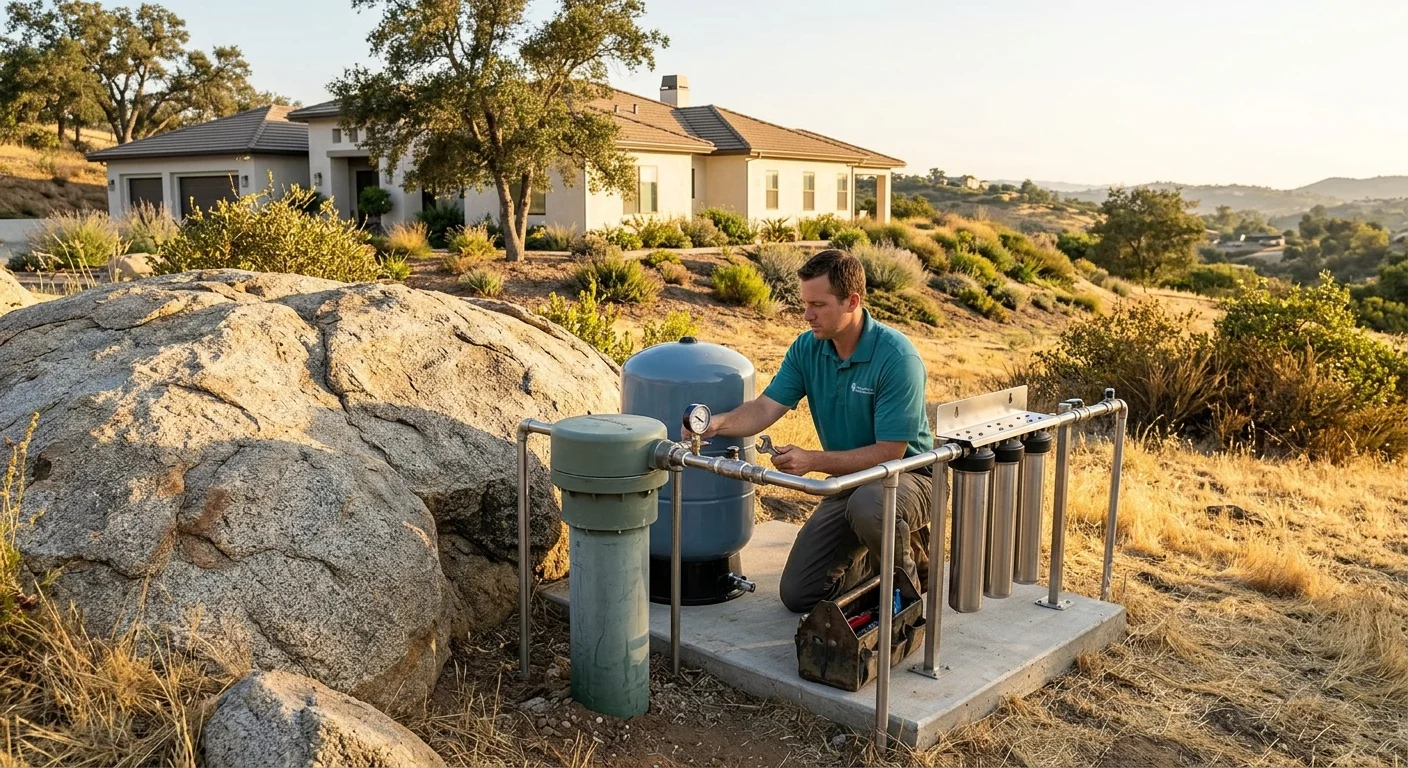
North and east of those mains, a lot of homes sit on private wells. Hidden Meadows well water is the usual example: hillside lots, a well head, a pressure tank, and no city Consumer Confidence Report. Valley Center and Harmony Grove have the same split. One street can be city water. The next canyon can be a domestic well.
Do not borrow hardness numbers from another agency. The City of San Diego Public Utilities site says drinking water in that city typically averages about 16 grains per gallon, or 276 ppm, and can range from 16 to 18 gr/gal (272 to 284 ppm) by area and demand. That figure is for the City of San Diego system only. It does not describe Escondido city water, and it does not describe a private well.
Helix Water District, which serves East County cities such as La Mesa and El Cajon, publishes that water at 10 or more grains per gallon is considered hard, and that imported Colorado River and State Water Project supply averages about 14 grains. That is a statement about imported supply, not about an Escondido tap and not about a Hidden Meadows well. A countywide “typical” hardness number is not verified here, and it would be the wrong tool anyway. Hardness varies by service area and season. Wells vary by borehole.
If the bill says City of Escondido, start with the city’s current water-quality page. If the property has a well cap and a pressure tank, you are the water system. The State Water Board and San Diego County Department of Environmental Health treat that as a domestic well, not as city water with a filter bolted on. Well water treatment in Escondido only works when that distinction is the first decision, not a footnote.
Clear Water Pros SD does not run the city plant and does not operate the well. The brand connects homeowners with licensed Water Filtration pros. You contract with that pro directly.
Common well issues in Hidden Meadows granite
Hidden Meadows sits in granite boulder country inland of the I-15 corridor. That landscape is why so many lots never tied into city mains. It is not a lab result. Granite outcrops do not tell you the iron, sulfur, nitrate, or bacteria number at your tap. No verified arsenic, nitrate, or iron concentration for Hidden Meadows, Valley Center, or Harmony Grove appears in our claims ledger. If a page quotes a local well average, ask where that number was measured.
What you can plan for is the short list of well problems that show up in plumbing, not in marketing.
Staining and metallic taste can point toward iron. The EPA secondary drinking water guideline for iron is 0.3 mg/L. That figure is tied to rusty color, sediment, metallic taste, and reddish or orange staining. It is an aesthetic guideline, not a health threshold and not a Hidden Meadows occurrence rate. Confirm iron with a lab, not with a stained sink alone.
A rotten-egg odor can be hydrogen sulfide in the well, the plumbing, or the water heater. Minnesota health guidance, used here only as a general mechanism, says to note whether the smell is on hot water, cold water, or both, then test for coliform and nitrate while you hunt the source. It does not establish how common sulfur is in San Diego County. If the smell is the reason you searched, read our note on rotten-egg smell in well water and still run the lab panel. Smell is a clue. It is not a treatment spec.
Nitrate is a well test, not a guess from the view. The CDC lists animal waste, septic systems, wastewater, flooded sewers, polluted stormwater, fertilizers, farm runoff, and decaying plants as possible nitrate sources. Local geology also affects whether a well has nitrate. Valley Center agriculture and rural septic lots around Harmony Grove make those sources worth asking about. They do not prove the cause or the concentration in any one well.
Bacteria work the same way. A total-coliform result is an indicator. It does not name every pathogen. The CDC says harmful or suspected contamination means another safe water source and health-department guidance. Boiling does not remove chemical contamination.
USGS classifies hardness as calcium carbonate: 0–60 mg/L soft, 61–120 moderately hard, 121–180 hard, and over 180 very hard. That is classification guidance. It is not a safety rating, and it is not a prediction of what a Hidden Meadows well will cost to treat.
Two wells on the same granite ridge can disagree. Treat the property in front of you.
Tests that matter before you treat
EPA’s home-treatment guidance is blunt. Identify treatment goals from the serving utility’s report and from appropriate testing. No single technology removes every contaminant. On a well, there is no utility report. The lab is the report.
The CDC recommends a state-certified laboratory, and annual testing for total coliform, nitrate, TDS, and pH. Ask San Diego County environmental health which extra tests fit the location. Do not build a Valley Center well water filter from a hardware-store strip and a neighbor’s tank photo.
TDS is easy to overread. The EPA secondary guideline for TDS is 500 mg/L. It addresses taste and technical concerns. It is not a drinking-safety cutoff. You cannot infer that contaminants are absent from a TDS number. USGS notes that specific conductance can approximate dissolved solids, and that the relation varies with water composition. A conductivity pen is not a metals panel.
Match treatment to the identified problem. Test again to confirm it worked before you rely on the water. That CDC sequence is the whole method: identify, treat, verify.
A free in-home water test is how we start many inland North County visits. It is a screening visit with the licensed pro, not a substitute for a state-certified well panel. Ask what the visit actually measures. Do not treat it as medical clearance, a full contaminant list, or a promise that the well is safe. If the well has never had a certified lab sample, schedule that work first or in parallel.
People on sodium-restricted diets should know what a softener does if hardness is later in the plan. University of Nebraska–Lincoln Extension estimates sodium is added at about 8 mg/L for each grain per gallon of hardness removed. That is an estimate of added sodium, not a measured Escondido tap result, and not medical advice. Kitchen cold water is often taken from a line that bypasses the softener.
If the well is out, use another safe source until the lab and the health department say otherwise. Filtration does not make an untested well into city water.
Whole-house options that follow the lab results
Once the lab names the problem, the licensed pro sizes point-of-entry and point-of-use gear to that list. Whole-house water filtration treats water as it enters the house. A kitchen reverse-osmosis tap treats what you drink. EPA draws that same line. Scope is a decision, not a bundle you buy by default.
NSF/ANSI 42 covers certified aesthetic reduction claims. NSF/ANSI 53 covers specified health-effect contaminant claims. NSF/ANSI 44 covers ion-exchange softeners that reduce calcium and magnesium hardness. NSF/ANSI 58 covers reverse osmosis systems. A standard is not a ranking. It does not mean the unit reduces every contaminant. Check the exact model’s certified reduction claim.
If hardness is the lab result, a salt-based softener is the ion-exchange path under NSF/ANSI 44. EPA says to size from measured hardness and household water use, and to exclude irrigation demand when that water should stay untreated. Oversizing can waste water. Demand-initiated regeneration follows use and hardness rather than a fixed timer. Salt-free conditioning does not remove hardness ions. Judge the exact scale-reduction claim. Do not treat it as softened water.
If iron is confirmed, some softeners have limited iron-removal claims and can clog when the load is wrong. Oxidation plus filtration is a separate path. There is no universal dosing recipe in our ledger. The model label and the lab number control the choice.
If coliform or another microbial flag is the issue, UV is an option the licensed pro sizes after the test, usually after sediment is already under control. It is not a DIY medical device and not a chemical dump into the well. Clear Water Pros SD does not drill, haul tanks, chlorinate wells, or treat the borehole itself.
Sulfur odor still follows the source. A carbon tank, an oxidizer, or a heater flush only makes sense after you know whether the smell is the well, the heater, or the plumbing.
RO belongs at the tap for drinking and cooking when the lab supports it. EPA notes that an RO system produces treated water and reject water. Performance and efficiency are model-specific. NSF/ANSI 58 fluoride reduction is an optional claim on the exact model, not a category promise.
EPA’s November 2024 home-treatment guide puts pitcher and tap filters as typically under $100, RO and distillation as tending to cost a few hundred dollars and possibly needing professional installation, and point-of-entry systems as costing thousands and generally needing professional installation. That is EPA’s broad category language. It is not a San Diego quote and not a Clear Water Pros price. Maintenance, replacement filters, and install scope belong in the provider’s written bid.
Rural Harmony Grove and Hidden Meadows lots often sit on septic. EPA advises checking with the septic manufacturer or service provider about overload, warranty, and performance before a softener goes in. That check is part of the design, not an afterthought.
City of San Diego lists water-softener installation among Simple No-Plan plumbing work for some eligible city properties. That is City of San Diego guidance. It is not an Escondido rule and not a countywide permit map. Confirm the permit path with the city or with the county for unincorporated Hidden Meadows and Valley Center. A local ordinance restricting softeners could not be confirmed here.
County and state pages to verify
Before you buy tanks, read the agencies that actually regulate the water.
City customers: the City of Escondido water-quality page and the current Consumer Confidence Report for that system. Do not paste City of San Diego plant tables onto an Escondido address. The City of San Diego 2025 report (Public Water System 3710020) is a different utility.
Well owners: San Diego County Department of Environmental Health private-well programs, and the State Water Board domestic-well pages. Those offices set testing expectations and well construction rules. This page could not confirm a single published nitrate, arsenic, or iron figure for Hidden Meadows wells. The county and the lab are where those numbers come from.
Imported-supply context for the region sits with the San Diego County Water Authority. That is useful background for city blends. It still is not your well log.
The licensed pro who installs treatment should show a current California license. Check it on the CSLB license lookup. Clear Water Pros SD is the referral desk. The pro you contract with is the licensee.
EPA’s home-treatment and water-softener guides are the federal selection method used above: name the goal, compare certified claims, count maintenance, and do not transplant one utility’s data onto another service area. Bring those PDFs to the visit if you want a shared checklist.
Keep the paper. A well without a recent certified lab report is a guess with plumbing attached.
When to call us
Call when the house is on a well in Hidden Meadows, Valley Center, Harmony Grove, or the Escondido fringe, and you want treatment sized to a real test instead of a copied tank set. A licensed Water Filtration pro reads the lab, sets point-of-entry and point-of-use scope, and installs the equipment. You pay that pro directly. Call us at (858) 400-4647 to set up a free in-home water test.