Scale on a Grossmont shower door is usually the first hard-water clue in La Mesa. A licensed pro sets a whole-house softener at the main so Helix hardness is treated before it hits the heater, the glass, and the laundry. Fridge pitchers never do that work.
Helix supply in La Mesa vs El Cajon next door
La Mesa and El Cajon sit next to each other on Helix Water District. Most addresses in both cities drink the same imported blend Helix buys from the Colorado River and the State Water Project. Helix’s water-quality FAQ says water with 10 or more grains of hardness is considered hard, and that imported supply averages about 14 grains. That is a supply figure. It is not a reading from a 91941 kitchen or a Grossmont laundry room.
Treat the two cities as neighbors on one district, not as two hardness maps. The El Cajon Helix hard water page already covers how that imported supply behaves. This page is the install side for La Mesa, Grossmont, and the 91941 and 91942 tracts. Confirm the retailer on the bill before anyone sizes a tank. Edge parcels can sit on a different agency. Helix’s average does not describe private wells, and it does not lock in a grain count for every street.
USGS classifies hardness as calcium carbonate. Over 180 mg/L is very hard on that scale. Helix’s 10-grain threshold is the local rule of thumb to use with a pro. Size from a measured hardness at the house and from indoor water use. EPA’s May 2026 softener guide says to leave irrigation out of that math when the yard should stay on untreated water. Oversizing can waste water. A demand-initiated unit regenerates from use and hardness, not a fixed timer.
Fletcher Parkway, the village on La Mesa Boulevard, and the Grossmont Center side of I-8 all still need that address-level check. Helix publishes current quality notes on its Water Quality FAQs. The San Diego County Water Authority covers the regional imported supply. Your Consumer Confidence Report is still the document for the meter in front of the house.
Grossmont hard water complaints often start as spots on glass and scale on a tankless heater. Those are aesthetic and equipment issues. They are not a diagnosis of every contaminant. Identify the concern first, then match treatment to it.
What a licensed pro does on install day
Clear Water Pros SD does not install the equipment. We set up the free in-home water test and connect you with a licensed water-filtration pro. You contract with that pro, and you pay that pro. Check the license on the CSLB license lookup before work starts.
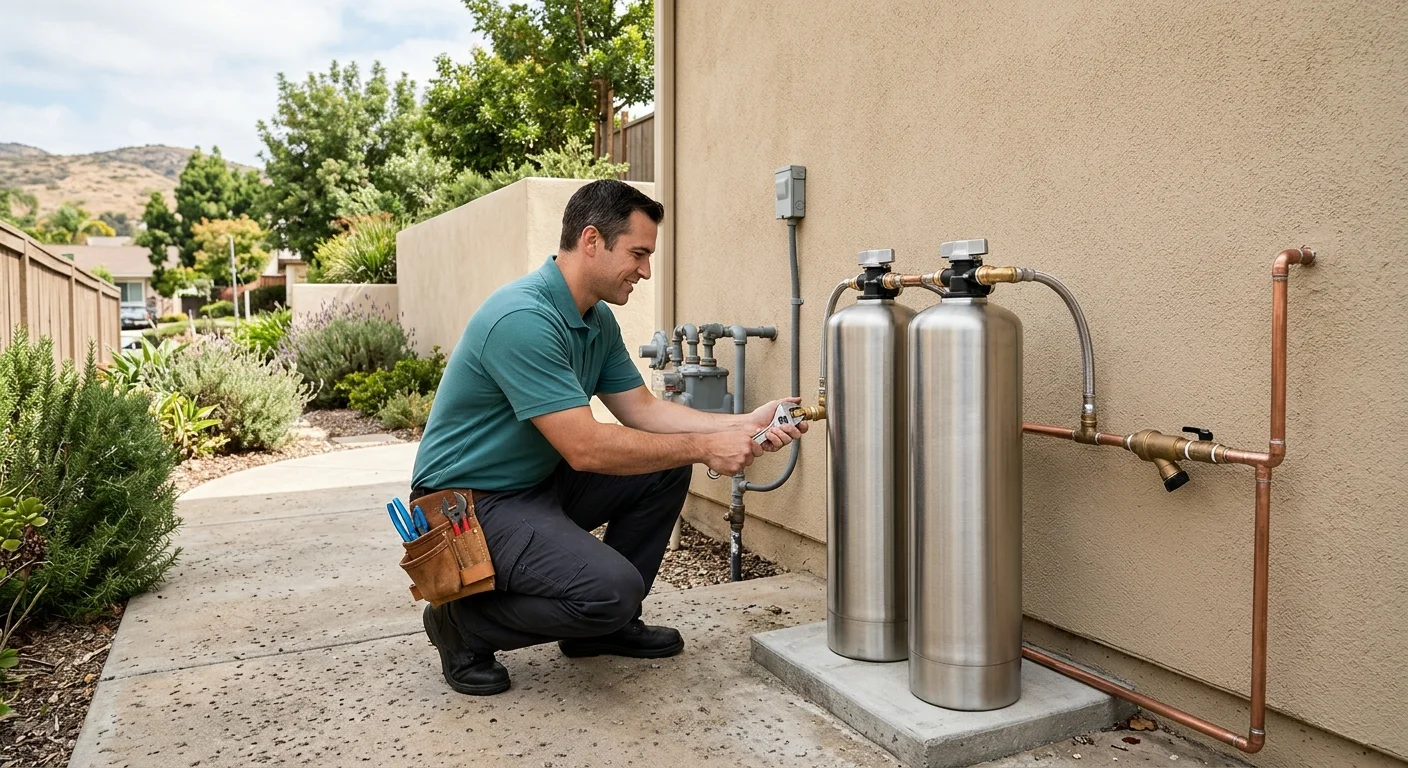
On install day the pro is working the point of entry. That is the line after the meter, before the rest of the house. A typical water softener installation includes the resin tank, the brine tank, a bypass, and a drain for regeneration water. Bypass routes water around the unit so the house can keep running while the softener is isolated. Valve styles differ: lever, knobs, a three-valve assembly, or an app-controlled head. Do not force a stuck handle. Confirm bypass by running a cold tap. Follow the exact model manual.
NSF/ANSI 44 is the standard that covers ion-exchange softeners that reduce calcium and magnesium hardness. Certification is not a ranking, and it does not prove reduction of every contaminant. Compare the exact model’s certified reduction claim, rated working capacity, and water and salt efficiency. EPA also flags manufacturer maintenance and salt or media cost when you compare ownership cost.
The pro should set the unit on a firm, level pad with room to add salt and service the valve. Drain routing has to match the model instructions. Persistent drain flow after startup can mean a malfunction. Stay off wet electrical parts, and leave pressurized assemblies closed. Irrigation, a hose bib, or a kitchen cold line can be left untreated on purpose.
University of Nebraska–Lincoln Extension notes that ion-exchange softening adds about 8 mg of sodium per liter for each grain per gallon of hardness removed. People on a restricted sodium diet should talk with a physician. Drinking and cooking water is often taken from a kitchen cold line that bypasses the softener. Potassium chloride is an option on some units, with professional guidance. That sodium figure is an estimate of what the process adds. It is not a measured La Mesa tap result.
EPA’s November 2024 home-treatment guide puts point-of-entry systems in the thousands and generally calls for professional installation. That is a national category. It is not a La Mesa quote and not a Clear Water Pros price. Diagnosis, parts, labor, access, and the written scope set the actual number.
Older 91941 plumbing and space constraints
The 91941 side of La Mesa is the older East County stock: stucco tracts off University Avenue, Baltimore Drive, and the village, plus the hills toward Mount Helix. Garages are tight. The water heater already occupies the pad you wanted. A resin tank plus a brine drum needs floor space that a mid-century garage does not always have.
The licensed pro has to see the actual main, the shutoff, and the drain path. Older copper, galvanized, and mixed repairs show up in these houses. That is a reason to measure before anyone orders a tank. A cabinet that fits a coastal new-build can fail here because the door swing and the heater already fight for the same wall.
Grossmont-area homes and many 91942 condos have a different squeeze: shared walls, little exterior yard, and association rules. We have not confirmed a La Mesa-wide HOA policy. Ask the association in writing if you live in a common-interest building. Interior closets need a legal drain and enough clearance to service the valve. If the only drain is a laundry standpipe, the installer has to confirm that the model and the local inspector will accept that connection.
Leave outdoor irrigation off the softener when the yard should stay on untreated water. That also keeps the unit smaller. EPA warns that oversizing wastes water. In East County, landscape demand can dwarf indoor use, so that exclusion matters on hillside lots and larger Grossmont lots alike.
If a dead or bypassed softener is already in the garage, new work starts with isolation and removal. Trace the wet spot without tearing the valve apart. Water at the base may have come from higher on the unit, the brine tank, the drain line, or another appliance. Isolate with the bypass or the supply shutoff, then call the installer. Model-specific handle positions belong in the manual, not in a generic how-to.
Permit and drain questions to confirm locally
A La Mesa permit path could not be confirmed from the claims we are allowed to publish. City of San Diego lists water-softener installation among Simple No-Plan plumbing work for some eligible properties inside that city. La Mesa is a different jurisdiction. Do not copy downtown San Diego’s route onto a Helix address.
Ask the City of La Mesa Building Division three things, in writing if you can. First, whether a plumbing permit is required for a residential softener at your address. Second, how regeneration water may be discharged: sanitary sewer, laundry standpipe, or another approved receptor. Third, whether a historic property, ADU, or hillside site changes the review. A brine-discharge ordinance, a fee, and a local softener ban were not verified for La Mesa. If a clerk cannot point to a current handout, get the answer before the tank is set.
Helix Water District is the water retailer for most of this city. Helix is not the building department. Discharge rules, if they exist, sit with the city or the sewer agency, not with a hardness FAQ. Our water softener permit guide for San Diego County walks the county-level questions. Use it as a checklist, then confirm La Mesa.
Septic is uncommon in central La Mesa, but some hillside lots still have onsite systems. EPA advises checking with the septic manufacturer or a local service provider about overload, warranty, and performance before a softener goes in. That check is about the tank in the yard. It is not evidence of a citywide ban.
The licensed pro, not this brand, is the party who pulls a permit when one is required. Scope and historic-property rules change the route. Get that in the written proposal, with the CSLB number on it.
Softener vs salt-free in this Helix city
A salt-based ion-exchange softener removes calcium and magnesium. NSF/ANSI 44 is the certification to look up for that claim. Salt-free conditioning does not remove hardness ions. EPA says to evaluate the exact scale-reduction claim, including IAPMO/ANSI Z601 where it applies, and not to treat the unit as softened water.
On Helix supply averaging about 14 grains at the import, many La Mesa homeowners still want true softening for heaters, glass, and laundry. That is a household preference. It is not a medical claim. A 2011 trial in English hard-water areas found no between-group difference in childhood eczema severity with an ion-exchange softener plus usual care. Hair-strand work from 2013 found no significant tensile-strength difference under its conditions. Buy a tank for scale and soap, not as a skin treatment.
Salt-free water conditioning can make sense when you cannot place a brine tank, cannot confirm a legal drain, or want to avoid added sodium. It is a different job. Pairing a conditioner with a point-of-use reverse osmosis tap is a common split: whole-house scale control in one form, drinking water at the kitchen. NSF/ANSI 58 covers RO. No single technology removes every contaminant. Identify the concern first, then match the device.
Compare maintenance in writing. Softeners need salt, a clean brine tank, and regeneration that actually finishes. A salt bridge is a hardened crust that leaves a gap so salt cannot dissolve. Follow the model manual. Conditioners have their own media and flush schedules. EPA’s home-treatment guide says pitcher and tap filters typically sit under $100, RO and distillation tend to cost a few hundred dollars, and point-of-entry systems cost thousands and generally need a pro. Those are national categories, not operator quotes.
If the goal is hardness removal at every fixture, the licensed path is a sized, certified softener with a bypass and a confirmed drain. If the goal is lighter scale without salt, say that out loud so the pro does not sell the wrong tank. Navien and other heater makers treat scale buildup as a maintenance and warranty issue on their own terms. Other brands write their own manuals. There is no universal descaling interval we can publish.
When to call us
Call when scale is showing on fixtures, when a heater is due, or when a dead softener is sitting in bypass in a La Mesa garage. A licensed water-filtration pro should measure hardness, check space and drain, and confirm the City of La Mesa permit path before anyone sets a tank. Call us at (858) 400-4647 to set up a free in-home water test.