Understanding your hard water options
San Diego County homes often deal with mineral buildup in pipes. Homeowners usually compare two main treatment categories. One category removes hardness minerals entirely from the supply. The other category alters those minerals without removing them. Knowing this distinction shapes every purchasing decision you make.
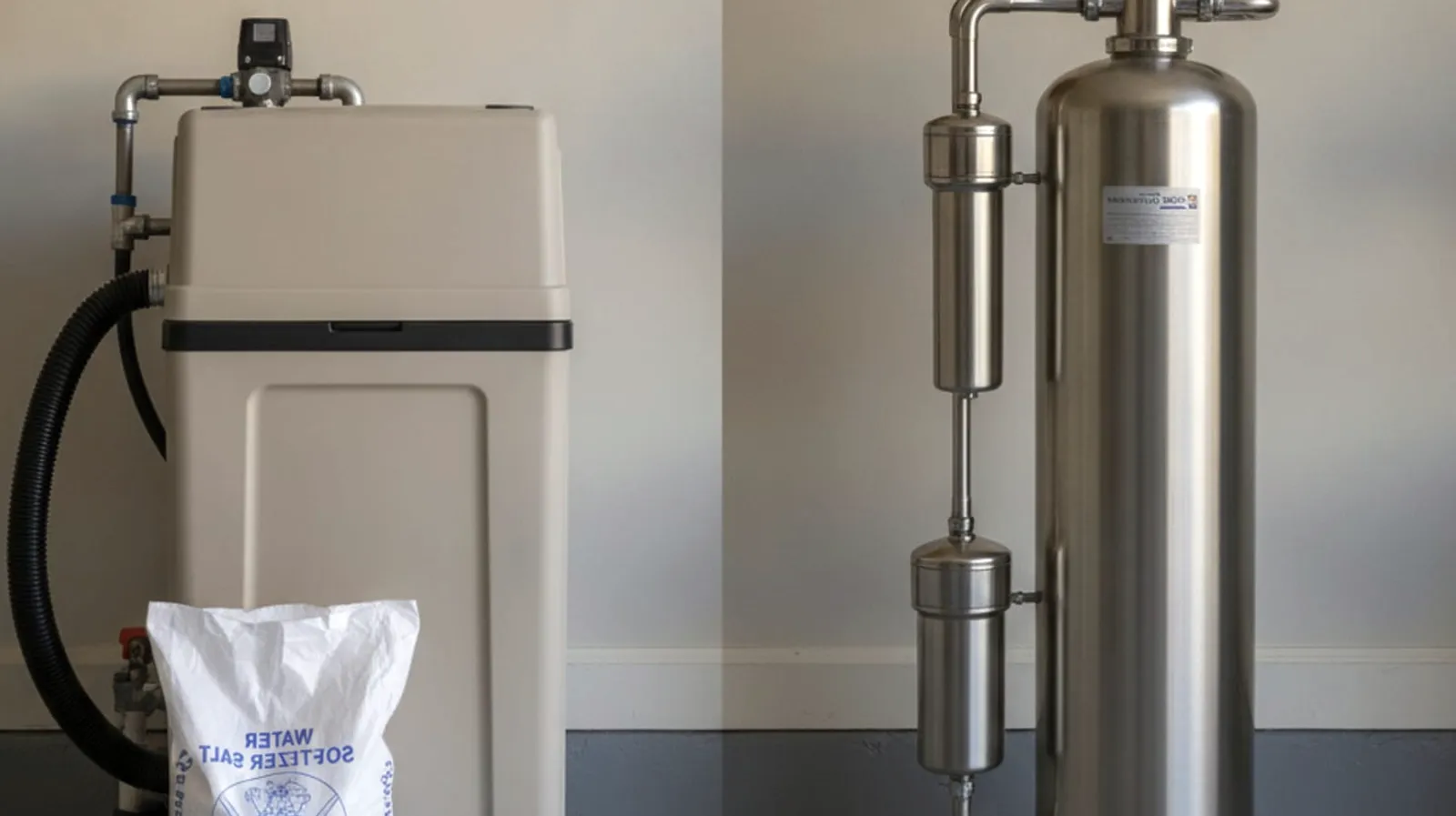
Choosing between a water softener vs salt free conditioning depends on your goals. If you want actual calcium removal, ion exchange is the path. If you prefer avoiding salt and drain discharge, conditioners deserve a look. Neither approach automatically fixes unrelated drinking water problems like lead or bacteria.
You should always review current testing data before buying any equipment. A licensed professional can help interpret those results accurately. Clear Water Pros SD connects homeowners across San Diego County with independent local experts. These separately licensed professionals handle all testing, installation, and maintenance work directly.
How ion exchange systems work
An ion exchange softener passes water through a specialized resin bed. That resin trades sodium or potassium ions for calcium and magnesium. Once the resin reaches its working capacity, the unit must regenerate. This regeneration process uses brine and sends wastewater to a drain.
The output is genuinely softened water because the hardness minerals are gone. This reduction limits scale buildup, soap scum, and spotting on glassware. You will also use less soap during laundry and bathing. Performance relies heavily on proper sizing and accurate hardness measurements.
Demand initiated regeneration offers better efficiency than older timer based models. EPA guidance recommends this approach because it responds to actual household usage. Always compare the specific model’s salt and water efficiency at proposed settings. Generic claims do not guarantee real world performance in your home.
Learn more about water softener installation and how independent professionals size these units correctly.
What salt free conditioners actually do
A salt free conditioner never removes calcium or magnesium from water. It does not produce softened water by any technical definition. Instead, it uses a scale control process to alter mineral behavior. The goal is making those minerals less likely to form solid deposits.
These systems operate without brine tanks or salt refills. There is no ion exchange regeneration cycle sending water down a drain. This appeals to homeowners wanting lower routine involvement with their equipment. Drain and discharge limitations sometimes make conditioners the only practical choice.
Understanding the limits prevents disappointment after purchase. Your water will still test positive for hardness after treatment. Do not expect the slippery feel associated with true ion exchange softening. Ask which test standard applies to the exact conditioner being proposed. EPA points consumers toward IAPMO/ANSI Z601 for scale reduction devices. Marketing terms like TAC cannot replace verified performance documentation for a specific model.
Explore salt free water conditioning to see how independent professionals evaluate these alternatives.
Comparing the two approaches directly
| Decision factor | Ion exchange softener | Salt free conditioner |
|---|---|---|
| Main objective | Eliminate calcium and magnesium hardness | Limit scale formation while keeping minerals |
| Delivers softened water | Yes | No |
| Requires salt or potassium | Yes | No |
| Discharges water during operation | Yes | No ion exchange regeneration occurs |
| Needs a drain connection | Usually required for backwashing | Varies by specific equipment design |
| Homeowner upkeep tasks | Refilling salt plus periodic cleaning | Inspecting media or components per manual |
| Relevant testing standard | NSF/ANSI 44 | IAPMO/ANSI Z601 for scale reduction |
| Proof of performance | Capacity ratings at proposed settings | Verified scale reduction claim for that model |
This table outlines general category differences rather than specific product guarantees. Individual models within either group perform differently. Always verify claims against the exact unit being proposed for your property.
Matching the solution to your goal
Write down your specific water complaints before shopping for equipment. Choose hardness removal when you need calcium gone from the entire plumbing system. Be prepared for salt handling, regeneration cycles, and ongoing maintenance duties. Choose scale control when keeping the minerals is acceptable to you. Ensure the exact conditioner has documented proof for your desired outcome.
Taste issues, odors, PFAS, nitrate, and bacteria require completely different treatments. A softener versus conditioner debate will not solve those concerns. Start with your serving utility’s current water quality report. Order appropriate laboratory testing if you rely on a private well. EPA notes that no single home technology removes every possible contaminant. Match each certified reduction claim to your specific water problem.
Read our guide on hard water solutions to understand how professionals match systems to symptoms.
Using local water data properly
The City of San Diego reports its system averages about 16 grains per gallon. Depending on demand and location, readings range from 16 to 18 grains per gallon. Other municipal providers and private wells have entirely different profiles. Never apply city figures to properties outside that specific service area.
Proper softener sizing requires testing hardness at your actual property. Review your indoor water consumption patterns carefully. Exclude outdoor irrigation from those calculations whenever possible. Compare your findings against the specific model’s rated working capacity. Avoid generic sizing charts based solely on the number of bathrooms.
Conditioner buyers also benefit from knowing their measured hardness levels. Those numbers define the operating environment for the equipment. Request documentation showing the model performs under your specific conditions. Verify it handles your home’s peak flow requirements adequately.
Use our water hardness calculator to better understand your property’s starting point.
Permit rules and physical setup needs
Ion exchange units need proper placement near the main water line. They require bypass valves, electrical access, and adequate drain arrangements. Conditioners might have fewer utility demands but still need correct orientation. Service clearance and flow direction matter according to the manufacturer manual.
Never accept blanket statements about countywide softener regulations. Rules vary significantly between jurisdictions within San Diego County. Confirm current permit and discharge requirements with the applicable authority. The City of San Diego currently lists eligible installations under its Simple No Plan plumbing permit process. That program carries specific rules and exceptions you must follow.
Homes using septic systems require extra diligence before adding a softener. Provide the septic manufacturer with exact discharge volume and equipment details. EPA recommends verifying whether a softener could overload or affect the system. Septic presence alone does not automatically disqualify softeners or approve conditioners. A licensed installer evaluates your specific property constraints.
Check if your city has unique rules, like those covering water softener permits in San Diego County.
Ongoing upkeep expectations
Softener owners must regularly check and refill the appropriate salt type. Watch for salt bridging or mushing inside the brine tank. Clean the resin and tank as the manufacturer directs over time. Reset programming after power outages to maintain proper regeneration schedules. Monitor the system for unexpected leaks or continuous drain running.
Salt free conditioners carry their own specific maintenance requirements. Ask the provider when internal media or components need replacement. Find out who performs that service and what it typically costs. Determine how you will verify the unit still delivers its claimed results. Lacking salt does not mean lacking long term upkeep responsibilities.
Review our water softener repair resource to understand common service needs handled by professionals.
Details to request in writing
Before approving any installation, ask the provider to document several specifics. Request the exact water problem the proposed system intends to solve. Require the hardness reading, testing method, and usage assumptions used. Note the precise manufacturer name and model number being offered.
For softeners, demand written working capacity and regeneration setting details. For conditioners, request exact scale reduction evidence for that model. Ask for applicable certification records and links verifying those claims. Document expected flow rates and any potential pressure impacts on fixtures.
Clarify plumbing, drain, electrical, bypass, and permit responsibilities in advance. Break down equipment, installation, supplies, and future service charges separately. Define warranty terms and identify who handles future repairs. Specify the post installation verification process used to confirm proper operation.
Be skeptical of proposals promising total scale prevention without conditions. Equally question softeners marketed as complete contaminant removal systems. Demand exact claims, defined scopes, and verifiable evidence for everything.
Getting expert guidance locally
Clear Water Pros SD operates as an independent referral network for homeowners. We connect residents with separately licensed local water treatment professionals. Those independent contractors perform all testing, sales, and installation work. You contract directly with the chosen professional for your project.
Consider arranging a free in home water test to gather baseline data. Hardness results support proper sizing for whichever system fits your goals. Utility reports and laboratory analysis guide separate contaminant treatment decisions.
If your water shows unusual spots, persistent scaling, or changes in taste, a separately licensed professional should evaluate the situation. Proper diagnosis prevents spending money on equipment that misses the actual problem. Call (858) 400-4647 and Clear Water Pros SD will connect you with an independent local water-treatment professional.
Frequently asked questions
Will a salt free unit remove my hardness?
No, it leaves calcium and magnesium in your water supply. These systems aim to reduce scale formation rather than eliminate minerals. Evaluate them based on verified scale reduction claims for your conditions.
Does ion exchange stop all scale buildup?
Removing hardness minerals significantly reduces scale related plumbing issues. Actual results depend on proper sizing, correct settings, and consistent maintenance. Poorly maintained softeners can still allow scale to develop over time.
Which system wastes less water overall?
Traditional softeners consume water during their regular regeneration cycles. Salt free conditioners skip that specific ion exchange backwashing process. Compare the full operating requirements of the exact models you consider.
How much upkeep does each option require?
Both categories demand attention according to their specific manufacturer instructions. Softeners need regular salt additions and occasional tank cleaning. Conditioners require periodic media inspections or component replacements to keep working.
Can either device filter out every contaminant?
Neither system functions as a universal purifier for all water issues. Treatment capabilities are specific to individual models and their certifications. Identify your exact concerns and match them to verified reduction claims.