Many San Diego houses need two treatments at once: scale in the plumbing, plus drinking water that still needs its own treatment at the kitchen. A water softener reverse osmosis pair splits that work, with ion exchange for the house and a treated faucet for cooking and drinking. The two jobs don’t overlap, so a lot of addresses end up with both.
What each system actually treats
A water softener targets calcium and magnesium. NSF/ANSI 44 covers ion-exchange softeners that reduce those hardness minerals. Resin takes hardness ions and releases sodium or potassium. That process is not a drinking-water filter for every dissolved substance.
Helix Water District’s water-quality FAQ draws a hard line at 10 grains. Water at 10 or more grains per gallon is considered hard. Helix also says imported Colorado River and State Water Project supply averages about 14 grains. That describes imported supply the region buys. It is not your kitchen tap.
City of San Diego customers should read the City’s own numbers. The home-plumbing page says drinking water typically averages about 16 grains per gallon, or 276 ppm, and can range from 16 to 18 grains (272 to 284 ppm) depending on demand and the area of the City. The City’s 2025 Consumer Confidence Report lists plant averages of 13.8 grains at Alvarado, 14.1 at Miramar, 14.2 at Otay, and 8.5 for purchased treated water. Those are two City publications covering different measurements. They are not countywide. They do not describe a private well. Confirm the source for the address.
The U.S. Geological Survey classifies hardness as calcium carbonate. Over 180 mg/L is very hard. The City’s 276 ppm typical figure sits in that class. That is classification guidance, not a safety rating and not a ranking against other cities.
Reverse osmosis drinking water is the other job. NSF/ANSI 58 covers reverse osmosis systems. NSF/ANSI 42 covers certified aesthetic reduction claims. NSF/ANSI 53 covers specified health-effect contaminant claims. A standard is not a ranking. It does not establish reduction of every contaminant. Verify the exact model’s certified reduction claim.
Reverse osmosis can reduce some dissolved hardness at the treated faucet. It does not soften the water heater, showers, or laundry. It does not use ion-exchange resin, and it does not regenerate with brine. A softener does not replace an RO membrane for the substances that membrane is certified to reduce. EPA’s home treatment guide says no single technology removes every contaminant. Match treatment to the utility report and the right tests.
If you are still choosing one system, start with water softener vs reverse osmosis. This page is for the house that needs a water softener and reverse osmosis together.
Why many San Diego homes use both
San Diego County is not one tap. City of San Diego water, Helix territory in La Mesa, El Cajon, and Lemon Grove, other retail agencies, and private wells are different supplies. Hardness also shifts with demand and season inside a single system. A countywide average would be wrong, so we don’t use one.
You need a water softener and reverse osmosis when hardness is a whole-house plumbing problem and the kitchen still needs documented drinking-water treatment. Scale on fixtures, spotting on glass, and mineral buildup in a water heater point at the softener. Taste, odor, or dissolved solids at the cooking tap point at RO. Those can both be true on the same street.
Ion-exchange softening adds sodium. University of Nebraska–Lincoln Extension estimates about 8 mg/L of sodium for each grain per gallon of hardness removed. Their example: 10 grains yields about 80 mg/L of added sodium. That is an estimate of sodium added by softening, not a measured San Diego tap result. People on restricted sodium diets should talk with a physician. Many houses take drinking and cooking water from a kitchen cold line. Ask how that line and the RO feed are piped.
RO after a softener is also a layout choice. Hardness minerals can scale a membrane. Feeding softened water to the under-sink unit means the membrane is not doing whole-house hardness work. Do not treat that as a lifespan guarantee. Follow the model’s maintenance rules.
Taste and odor still belong to the drinking-water side. CDC notes that chlorine and chloramine can taste and smell different. The serving utility’s current report is where you confirm the disinfectant in use. Don’t guess from a neighbor’s tap in another district. For dissolved solids, EPA’s secondary guideline for TDS is 500 mg/L. That is an aesthetic and technical guideline, not a universal safety cutoff.
Some households also want a kitchen system with a listed reduction claim for a specific contaminant. PFAS is one example people ask about. Verify the exact model’s NSF/ANSI 53 or 58 claim. Do not assume every RO unit carries the same listing.
The City of San Diego’s November 2024 water-quality FAQ describes a fluoride target of 0.7 ppm. That is a City target, not a countywide tap reading. CDC says RO may reduce fluoride. NSF/ANSI 58 treats fluoride reduction as an optional exact-model claim. If you want that City target at the RO faucet, read the spec sheet. EPA also notes that RO can lower treated-water pH in treatment applications. Actual household output depends on the unit, the feedwater, and upkeep.
Salt-free conditioning does not remove hardness ions. If the goal is softened water, evaluate the scale-reduction claim on that product. Don’t buy it as a stand-in for a documented softener-plus-RO plan.
Point-of-entry vs under-sink layout
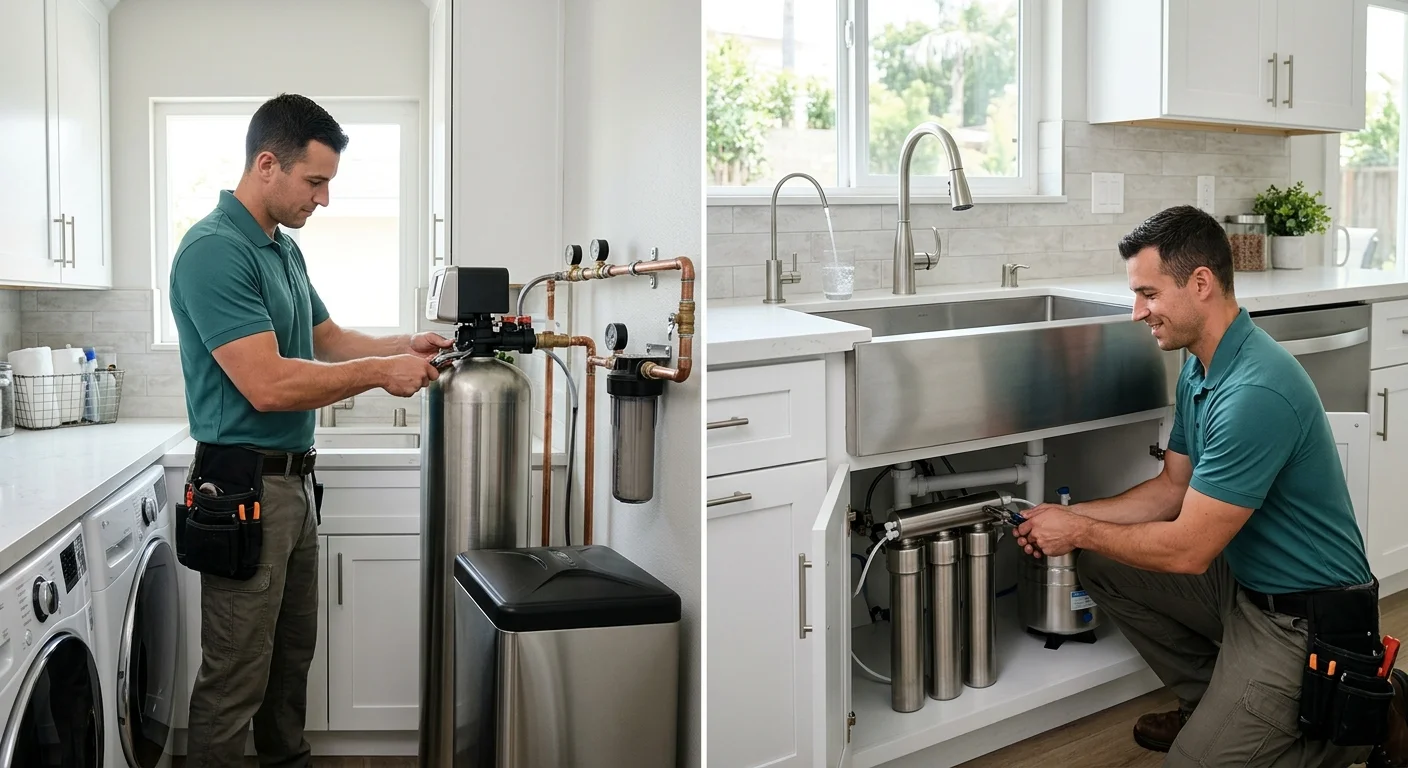
EPA splits home treatment by where it sits. Point-of-entry systems treat water entering the residence. Point-of-use devices treat a selected tap. In this combo, the softener is the entry unit. The RO is usually the kitchen unit.
That is why a water softener with reverse osmosis shows up in a laundry room and under a kitchen sink in the same house. The softener sits on the main after the meter, often before the water heater. Irrigation is often left off the softener so you are not sizing for lawn water. EPA’s softener guide says size from measured hardness and household use, and exclude irrigation when that fits the property. Oversizing can waste water. Demand-initiated regeneration follows use and hardness instead of a fixed timer.
The RO sits under the kitchen sink with a dedicated faucet, a storage tank, and a drain line for reject water. Some homes add a fridge line. That is still point-of-use. It does not treat showers.
Whole-house reverse osmosis is a different project. RO produces treated water and reject water. EPA WaterSense describes efficiency as treated water divided by incoming water. Labeled WaterSense units demonstrate at most 2.3 gallons of reject water per gallon treated under the label criteria. That is a label criterion, not every system’s field result. EPA also gives national examples of five or more reject gallons per treated gallon, and up to ten for some inefficient units. Those are national examples, not a promise for a San Diego install. Sending that reject stream through every fixture is why most houses keep RO at one tap. For the whole-house filter question, see reverse osmosis vs whole-house filtration.
What to confirm before you buy
Do the homework before anyone orders tanks. Pull the current Consumer Confidence Report from the retailer that serves the address. The San Diego County Water Authority is the wholesaler for much of the county. The retailer’s report is still the one that matches the tap. Private wells need their own tests. CDC recommends annual well testing for total coliform, nitrate, TDS, and pH, through a state-certified lab. A free in-home water test is how we start the conversation. Confirm with the provider what that visit actually measures.
Match each unit to a documented claim. For the softener, compare NSF/ANSI 44, rated working capacity, and water and salt efficiency. For RO, compare the exact NSF/ANSI 58 reduction claims, plus any 42 or 53 claims on the same stack. Include replacement-filter cost and the manufacturer’s maintenance schedule when you compare ownership cost.
City of San Diego lists water-softener installation among Simple No-Plan Plumbing/Gas Permit work for eligible properties. Scope and historic-property rules change the permit route. That is City guidance, not a countywide rule. Other cities and the County have their own counters. A local ban on softeners has not been confirmed here, so don’t plan around a rumor.
EPA’s November 2024 home-treatment guide groups costs in broad categories: basic pitchers and tap filters typically under $100, RO and distillation systems tending to cost a few hundred dollars and possibly needing professional installation, and point-of-entry systems costing thousands and generally needing professional installation. Those are EPA’s national categories, not a San Diego quote and not a Clear Water Pros price. For local planning context, read reverse osmosis cost in San Diego and the matching water softener cost post. Confirm the current number with the licensed pro who will write the scope.
If the property uses a septic system, EPA says check with the septic manufacturer or local service provider before installing a softener. On a sodium-restricted diet, talk with a physician before you choose salt or potassium chloride.
Check the pro’s license on the CSLB license lookup. Clear Water Pros SD connects you with licensed Water Filtration pros. The homeowner contracts with that pro directly.
How the two systems share plumbing
The common water softener with reverse osmosis layout is sequential. Softened water feeds the house. A cold line under the kitchen sink feeds the RO. Outdoor hose bibs and irrigation often stay on a bypass so you are not watering with softened water.
The softener needs a drain for regeneration and a brine tank that is not packed to the lid. Overfilling can cause bridging. The RO needs its own drain for reject water, a storage tank, and a drain connection that matches the model and local plumbing rules. Do not tie those drains together on a guess. The licensed pro sizes the tees, valves, and drain fittings to the two manuals.
A bypass on the softener keeps household water on if the unit is isolated for service. Valve styles differ: a lever, knobs, a three-valve assembly, or an app-controlled valve. Confirm bypass by running a cold tap. Don’t force a stuck handle. Follow the exact model manual.
Feed pressure, tank precharge, and which parts a homeowner may service are model-specific. One manufacturer discusses a 35 to 60 PSI window and an empty-tank air charge around 7 PSI. Treat those as that maker’s guidance, not a universal spec.
Leave outdoor spigots, the water heater drain, and electrical connections alone if you are not the installer. Persistent drain flow on a softener can mean a malfunction. Isolate with the bypass or supply shutoff and call the installer. Don’t open pressurized tanks. Don’t handle wet electrical equipment.
The brand does not pull the permit, cut the main, or set the tanks. The licensed pro who contracts with you does that work. Ask them to show the softener-to-RO feed, the kitchen bypass, and the two drain paths before they close the cabinet.
When to call us
Call when hardness at the plumbing and drinking-water treatment at the kitchen both show up on the same test, or when you already have one system and want the second piped correctly. A licensed Water Filtration pro sizes the softener, sets the under-sink RO, and writes the permit path for the address. Call us at (858) 400-4647 to set up a free in-home water test.