Most San Marcos homes sit on Vallecitos Water District, including San Elijo Hills, Lake San Marcos, Discovery Hills, and the Double Peak tracts. Some streets still bill Vista Irrigation District or Olivenhain Municipal Water District. Hard-water scale on faucets and glass is common on this inland stretch, and the right system starts with the name on your bill.
Vallecitos Water District vs Vista Irrigation District next door
San Marcos city limits are not a water-system boundary. Vallecitos Water District serves most of the city. Vista Irrigation District sits next door in Vista and can show up on a San Marcos bill along the north and west edges. Olivenhain Municipal Water District can show up on a few southern or eastern streets. Read the agency name on the bill. A city welcome sign does not name your water.
If the account is Vista Irrigation District, use our Vista Irrigation District hard water page for that system. Mixing two agencies’ reports will size the wrong equipment.
Vallecitos buys imported water through the San Diego County Water Authority, as many North County retailers do. Helix Water District publishes two facts about that imported supply. Water with 10 or more grains of hardness is considered hard. Imported water from the Colorado River and the State Water Project averages 14 grains. Those lines describe the imported supply, not a tap in San Elijo Hills or Lake San Marcos.
A Vallecitos Water District hardness number in grains per gallon could not be confirmed from the sources this page is allowed to cite. The district’s current Consumer Confidence Report is where Vallecitos states what it measured for the reporting year.
The City of San Diego’s plumbing page says drinking water in San Diego averages about 16 grains per gallon (276 ppm) and can range from 16 to 18 grains (272 to 284 ppm) by area and by water demand. That figure is for the City of San Diego system only. It is not a countywide average, not Vallecitos, and not a well.
USGS classifies hardness as calcium carbonate: 0 to 60 mg/L is soft, 61 to 120 is moderately hard, 121 to 180 is hard, and over 180 is very hard. About 17.1 mg/L equals one grain per gallon. Helix’s 10-grain line sits at the very-hard end of that scale. For county context, read whether San Diego water is hard, then open your own report.
Hard water signs in San Elijo Hills and Lake San Marcos
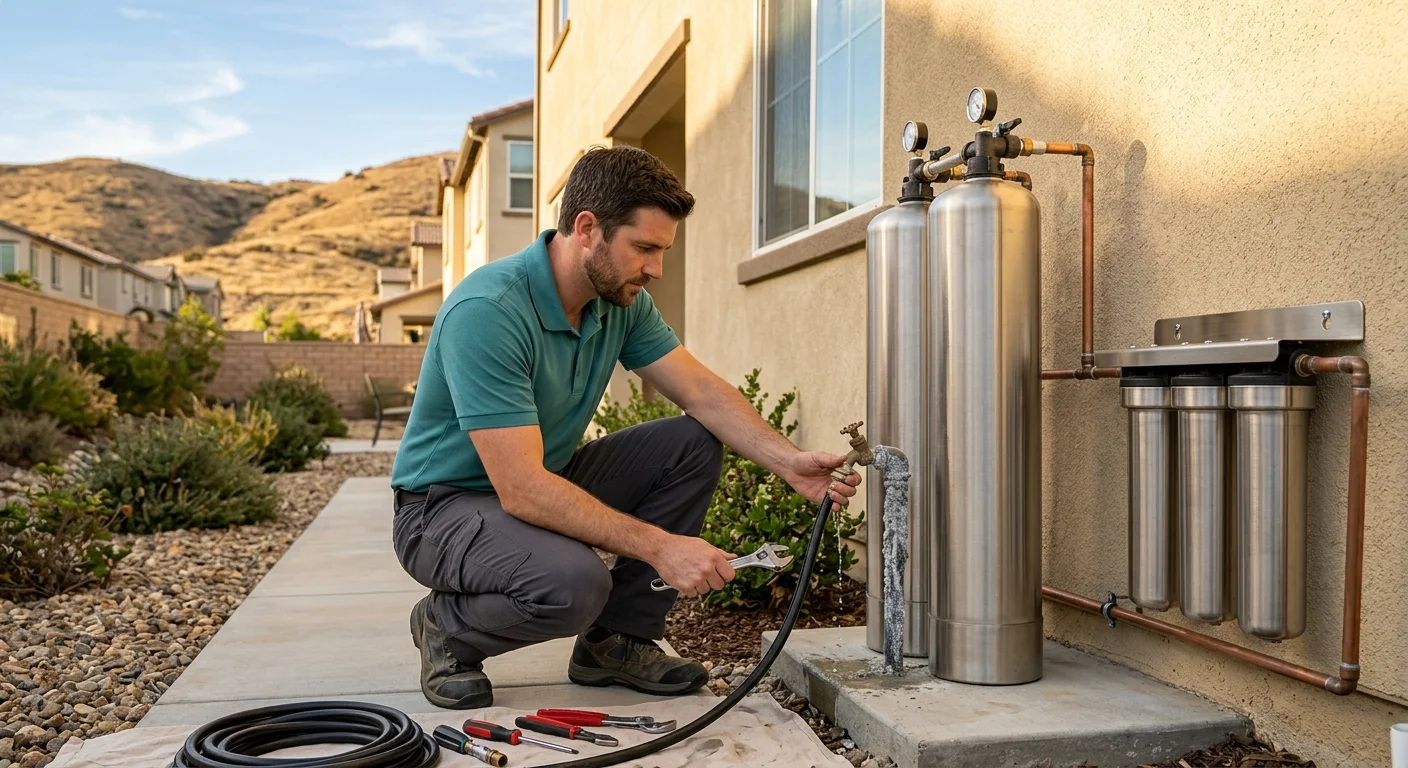
Walk a San Elijo Hills patio in late afternoon and the hose bib often tells the story first. White crust forms on the threads. Drip emitters clog. A dark car spots after a driveway wash. Inside, shower glass films over within a few days of cleaning. Faucet aerators choke down. Soap lathers poorly. Glasses leave the dishwasher cloudy. Towels dry stiff.
Lake San Marcos is an older lakeside neighborhood with later infill around the water. Discovery Hills and the Double Peak side of town are newer hillside tracts. Many of those newer homes use tankless water heaters. Navien, one tankless manufacturer, says annual maintenance includes flushing and descaling the heat exchanger, and that hard water may call for more frequent service. Other brands publish their own manuals. Skipping the manual’s maintenance can void that brand’s warranty. That is Navien’s term. It is not a universal schedule, and it is not a Clear Water Pros promise.
Those signs explain the search for San Marcos hard water. They still are not a grain count. A refrigerator filter treats one drinking tap. It does not protect the shower, the washer, or the heater. Point-of-use devices treat a selected tap. Point-of-entry water filtration and softening treat water as it enters the house.
Orange or rusty staining can be iron, not hardness. EPA’s secondary guideline for iron is 0.3 mg/L, tied to rusty color, sediment, metallic taste, and reddish or orange staining. It is an aesthetic guideline. Test before anyone sizes an iron filter.
A few properties on the unincorporated fringe use private wells. A Vallecitos report does not describe well water. CDC recommends annual well testing for total coliform, nitrate, TDS, and pH through a state-certified laboratory, plus any extra tests the county health department names for the location.
Softener vs salt-free on this inland stretch
EPA’s home-treatment guide starts with the goal. Use the serving utility’s report and a tap test. No single device removes every contaminant.
When the goal is less calcium and magnesium, NSF/ANSI 44 covers ion-exchange softeners that reduce that hardness. Licensed pros handle water softener installation on the main line when that is the match. Compare the exact model’s NSF/ANSI 44 mark, rated working capacity, and water and salt efficiency. Size from measured hardness and indoor household use. Leave irrigation off the softener when the yard should stay untreated. Oversizing can waste water. Demand-initiated regeneration follows actual use and hardness instead of a timer.
Salt-free conditioning does not remove hardness ions. EPA says to judge those units against IAPMO/ANSI Z601 scale-reduction requirements. Read the model’s scale-reduction claim. Salt-free water conditioning is a scale strategy. It is not softened water.
Hard water solutions can combine whole-house treatment with a drinking-water tap. NSF/ANSI 42 covers certified aesthetic claims such as chlorine taste and odor. NSF/ANSI 53 covers specified health-effect contaminant claims. NSF/ANSI 58 covers reverse osmosis. A standard is not a performance ranking. Verify the exact model’s certified reduction claim.
A kitchen reverse osmosis unit is point-of-use. EPA notes RO produces treated water and reject water. Performance and efficiency are model-specific. EPA WaterSense labeled point-of-use RO units demonstrate at most 2.3 gallons of reject water per gallon treated under that label’s criteria. That is a lab criterion, not a promise for every install.
Ion-exchange softening adds sodium. University of Nebraska–Lincoln Extension puts the added sodium at about 8 mg/L for each grain per gallon of hardness removed. People on a restricted sodium diet should talk with a physician. Many homes take drinking water from a kitchen cold line that bypasses the softener. Some units can run potassium chloride instead of sodium chloride, with professional guidance.
If the lot has an onsite septic system, EPA says to check with the septic manufacturer or service provider before a softener goes in. A San Marcos softener ban could not be confirmed. Confirm current rules with the city.
How to confirm your provider and current report
Open the bill. Match the retailer. Vallecitos Water District customers need the Vallecitos Consumer Confidence Report. Vista Irrigation District and Olivenhain customers need those reports. The tables are not interchangeable.
How to read a San Diego water quality report walks through year, units, and the difference between a legal limit and a public health goal. Hardness may show as grains per gallon or as milligrams per liter. Convert with about 17.1 mg/L per grain. Sodium, disinfectant residual, and any public notices live in the same packet.
The City of San Diego 2025 Consumer Confidence Report is a different system, Public Water System 3710020. In that 2025 report, total hardness averaged 13.8 grains at Alvarado, 14.1 at Miramar, and 14.2 at Otay, with purchased treated water averaging 8.5 grains. Those rows stay with the City. They are not Vallecitos numbers and they are not a San Marcos tap result.
EPA sets federal drinking-water limits under the Safe Drinking Water Act. California’s Division of Drinking Water adds its own. Your serving utility’s current report is still the local document. If hardness is missing, call Vallecitos and ask how they report it this year.
A free in-home water test measures what is coming out of your own fixtures. It is not a state-certified lab panel. It is not a contaminant-safety clearance. For wells, use a state-certified laboratory. For district water, pair the current CCR with a tap test before anyone sizes a system.
What to ask before a licensed pro installs
Clear Water Pros SD answers the phone, arranges the test, and connects you with licensed Water Filtration pros. You contract with that pro and pay that pro. Confirm the license on the CSLB license lookup.
Ask for the exact model and the certified reduction claim in writing. Ask where the bypass is and how you isolate the unit. Bypass routes water around the softener so the house still has water while the unit is offline. Handles, knobs, and three-valve assemblies all exist. Leave a stuck handle alone. Confirm bypass by running a cold tap. Follow the model manual.
Ask how they sized it: measured hardness, people in the home, and whether irrigation is excluded. Ask which salt the manual wants. One manufacturer’s brine-tank guidance says to skip rock salt and to avoid filling the tank completely, because overfilling can cause a salt bridge, a hardened crust that keeps salt from dissolving. Other brands write other manuals.
Ask about the permit path before work starts. The City of San Diego lists water-softener installation among Simple No-Plan Plumbing/Gas Permit work for eligible properties in that city. San Marcos is a separate city. A San Marcos permit fee and a San Marcos permit route could not be confirmed from the sources this page uses. Have the licensed pro ask City of San Marcos Development Services. Our water softener permit guide for San Diego County is county context, not a San Marcos quote.
Ask who services a leak. If water shows up at the base of a unit, isolate it with the bypass or the supply shutoff and call the installer. Water at the base may have come from higher on the unit, the brine tank, the drain line, or another appliance. Leave pressurized parts closed. Stay away from wet electrical equipment.
Get the scope in writing. Maintenance, filter changes, and salt are part of ownership cost. EPA says to include manufacturer maintenance and replacement-filter costs when you compare.
When to call us
When scale shows up on San Elijo Hills glass, Lake San Marcos fixtures, or a Double Peak heater, a licensed Water Filtration pro should test the tap and match the equipment to that result. Call us at (858) 400-4647 to set up a free in-home water test.