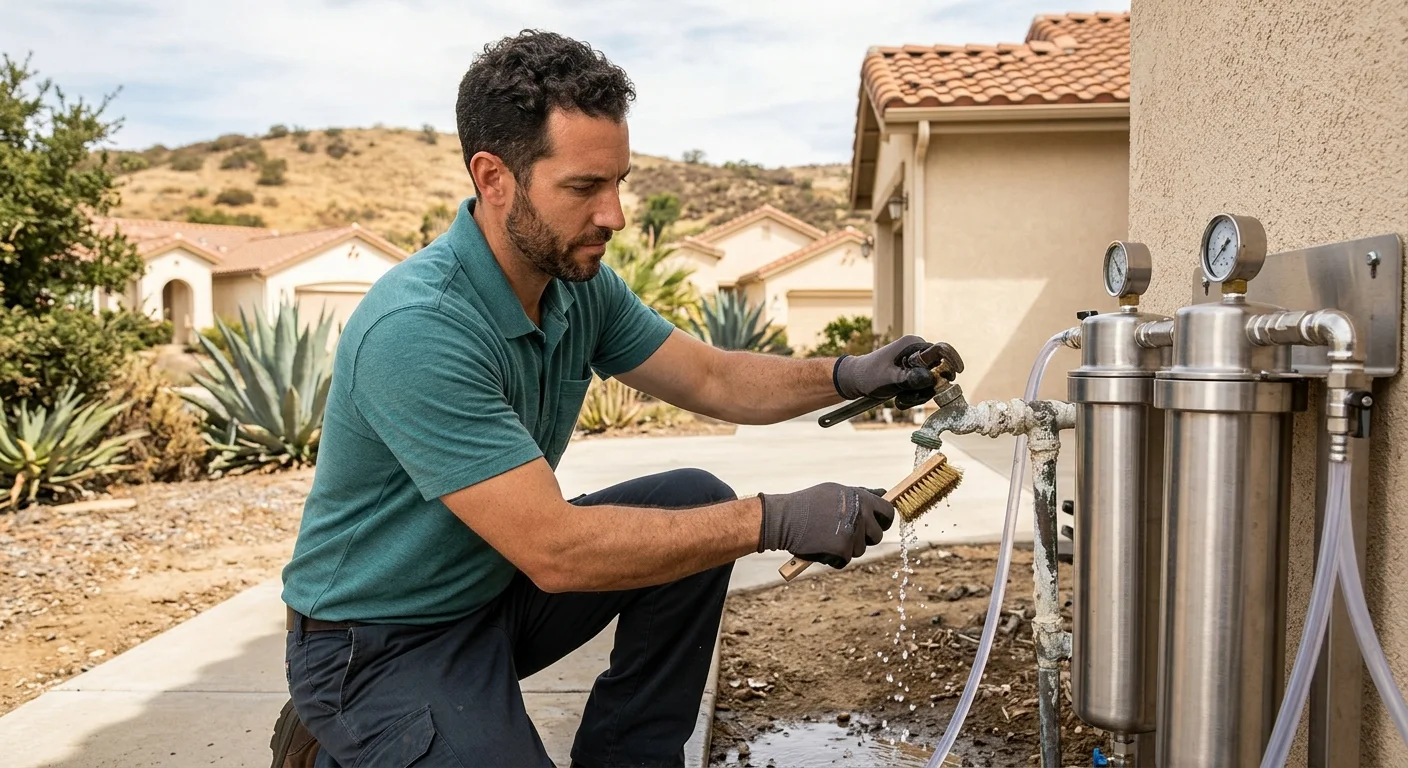
White crust on a Pomerado Road hose bib is calcium and magnesium that also spots glass in a Green Valley dishwasher. City of Poway water is its own utility, with its own annual report. The salt vs salt-free call on an HOA lot starts there, plus a test at your tap.
City of Poway supply vs nearby districts
Poway sits inland, east of I-15, north of Rancho Penasquitos, and west of the Ramona hills. Addresses inside the city limits are on City of Poway water. They are not on Helix Water District. They are not on the City of San Diego system that feeds the Alvarado, Miramar, and Otay plants.
That split matters because hardness is not one county number. Helix Water District says water with 10 or more grains per gallon is considered hard. Helix also says the imported Colorado River and State Water Project supply the county buys averages about 14 grains. That is a statement about the imported supply, attributed to Helix. It is not a reading from a Poway kitchen tap.
The City of San Diego Public Utilities page says drinking water in the City of San Diego typically averages about 16 grains per gallon, or 276 ppm. It can range from 16 to 18 grains, or 272 to 284 ppm, by area and by demand. The City of San Diego 2025 Consumer Confidence Report also lists plant-level total hardness for Alvarado, Miramar, Otay, and purchased treated water. None of those figures describe City of Poway taps. None of them describe a private well.
The San Diego County Water Authority is the regional wholesaler that imports Colorado River and State Water Project water for member agencies. Confirm how the City of Poway currently blends and treats what it delivers by reading this year’s City of Poway water quality report. That report is the city of Poway water quality document for city taps. Do not copy a hardness grain count from a neighboring district, a blog, or a sales sheet. A Poway water hardness number that is not in that report has not been confirmed here, and it should not drive a purchase.
Some inland lots still use private wells. This page cannot say how many Poway properties do. Well water is not the city report. If you are on a well, the city CCR does not apply to your tap.
Why scale still shows up in Poway plumbing
A treatment plant can meet federal and state drinking-water limits and still send calcium and magnesium into the house. Those minerals are hardness. They are not stripped out just because the water is legal to drink. Helix’s published line is 10 grains and above. The U.S. Geological Survey classifies water over 180 mg/L as calcium carbonate as very hard. Those are classification tools. They are not a City of Poway tap result, and they are not a ranking of which California city is hardest.
In a tile-roof tract off Pomerado, Espola, or Green Valley, the signs are ordinary. White crust on an outdoor faucet. A showerhead that sprays sideways. Spots on glass that vinegar only slows down. Soap that does not lather well. A tankless heater whose manufacturer, such as Navien, tells owners that hard water may mean more frequent flushing, and that skipped descaling can void that brand’s warranty. Other brands write their own manuals. None of that is a medical claim. None of it is a promise that untreated water will fail a heater on a set schedule.
Scale is why people search poway hard water. The imported blend can also change from year to year, so a number you found for a past report may not match this week’s tap. EPA’s home-treatment guidance is direct: identify the goal from the serving utility’s report and from testing. Do not transplant another city’s data onto your address.
Irrigation is a separate loop on many Poway lots. Indoor treatment should be sized on indoor use. EPA notes that oversizing a softener can waste water, and that irrigation demand should be left out when that water does not go through the unit.
Salt-based vs salt-free when an HOA is in play
Many Poway homes sit in planned tracts along Pomerado, Green Valley, and similar HOA streets. An association can write its own rules about equipment, drains, and what sits outside. This page does not quote CC&Rs. Those documents are private, and they change by tract. Read yours. Ask the management company in writing. Clear Water Pros SD does not install equipment and does not lobby an HOA. The licensed pro you contract with can speak to drain, bypass, and footprint. The association still decides what it allows.
A poway water softener in the salt-based sense uses ion exchange. NSF/ANSI 44 is the standard that covers certified softeners that reduce calcium and magnesium hardness. A certification is not a ranking. It does not mean every contaminant is reduced. University of Nebraska–Lincoln Extension estimates sodium is added at about 8 mg/L for each grain per gallon of hardness removed. People on a restricted sodium diet should talk with a physician. Drinking and cooking water is often taken from a kitchen cold line that bypasses the softener. Potassium chloride is an option on some units, with professional guidance.
Those units also discharge brine during regeneration. Whether a given city or HOA restricts that discharge is a local rule. A countywide ban could not be confirmed in our claims review. Our separate guide on whether salt-based water softeners are restricted in San Diego covers what was and was not verified. Do not assume Poway copied the City of San Diego’s plumbing-permit path. The City of San Diego lists water-softener installation among Simple No-Plan plumbing work for eligible properties. That is City of San Diego guidance only.
Salt-free water conditioning is the usual HOA conversation when brine, salt storage, or a drain is the sticking point. EPA is clear: salt-free conditioning does not remove hardness ions. Judge the exact scale-reduction claim, including IAPMO/ANSI Z601 where that is the stated test. Do not treat it as a promise of softened water. NSF/ANSI 42 covers certified aesthetic reduction claims. Compare that path with a true softener in water softener vs salt-free conditioner. If the lot is on septic, EPA says check with the septic maker or service provider before adding a softener.
How to confirm hardness and local rules
Start with the City of Poway water quality report, the Consumer Confidence Report. It is the document for city taps this year. Hardness, source notes, and disinfectant residual belong there. If a figure is not in that report, treat internet grain counts as unverified. The current disinfectant is whatever that report lists. This page does not guess chlorine versus chloramine.
Then test the tap. A hardware-store strip is a screen, not a lab. For city water, a licensed pro can measure hardness on site as part of a free in-home water test. Confirm the scope with the provider. It is not a state-certified laboratory panel. It is not a safety clearance. For a private well, CDC points you to a state-certified laboratory and to local health or environmental staff for extra tests that fit the location. CDC’s annual well list is total coliform, nitrate, TDS, and pH. A city CCR does not stand in for that work.
Rules sit in two public offices. City of Poway Building Division handles plumbing permits inside the city. We could not confirm a Poway-specific softener permit fee, brine-discharge ban, or salt-free exemption from a primary source in our ledger. Call Building Division and ask for the current path before anyone cuts pipe. Check the licensed contractor on the CSLB license lookup. The homeowner contracts with that pro directly. The pros we connect you with are licensed and insured.
HOA architectural rules are a third gate. Get written approval if the CC&Rs require it. County-level restriction questions stay on the San Diego guide linked above. They are not invented Poway ordinances.
What a licensed pro sizes after a test
After hardness and household use are measured, a licensed Water Filtration pro sizes the unit to those numbers. EPA’s May 2026 water-softener guide says size from measured hardness and indoor water use. Leave irrigation out when that water does not go through the system. Oversizing can waste water. Demand-initiated regeneration follows use and hardness instead of a fixed timer.
If the choice is ion exchange, compare the exact model’s NSF/ANSI 44 certification, rated working capacity, and water and salt efficiency. Follow that model’s install, bypass, and maintenance instructions. Persistent drain flow can mean a malfunction. If the choice is a salt free water conditioner Poway homeowners are weighing for HOA reasons, compare the stated scale-reduction claim. Do not shop it as softened water.
Hard water solutions can also include point-of-use gear. NSF/ANSI 58 covers reverse osmosis. An RO system makes treated water and reject water. Efficiency is model-specific. EPA’s WaterSense label, where it applies, is a criterion under test conditions, not a field guarantee. No single device removes every contaminant. Point-of-entry treats water entering the house. Point-of-use treats one tap. EPA’s November 2024 home-treatment guide groups pitcher and tap filters as typically under $100, RO and distillation as tending to cost a few hundred dollars and possibly needing professional install, and point-of-entry systems as costing thousands and generally needing a pro. Those are EPA’s broad categories. They are not a Poway quote and not a Clear Water Pros price.
Include manufacturer maintenance and replacement-filter cost when you compare ownership. The pro you hire writes the scope. Clear Water Pros SD arranges the test and the introduction. We do not pull the permit, own the truck, or set the price the installer bills you.
When to call us
White scale, an HOA letter, or a heater that keeps scaling are the moments to get a real hardness reading. A licensed Water Filtration pro sizes salt-free or salt-based equipment to that test, your indoor use, and the rules that actually apply to the lot. Call us at (858) 400-4647 to set up a free in-home water test.