White spots on shower glass can make Otay Ranch hard water feel obvious. The harder question is whether Otay Water District supplies your address and which treatment fits the actual water. Your bill and current water-quality report should guide that decision.
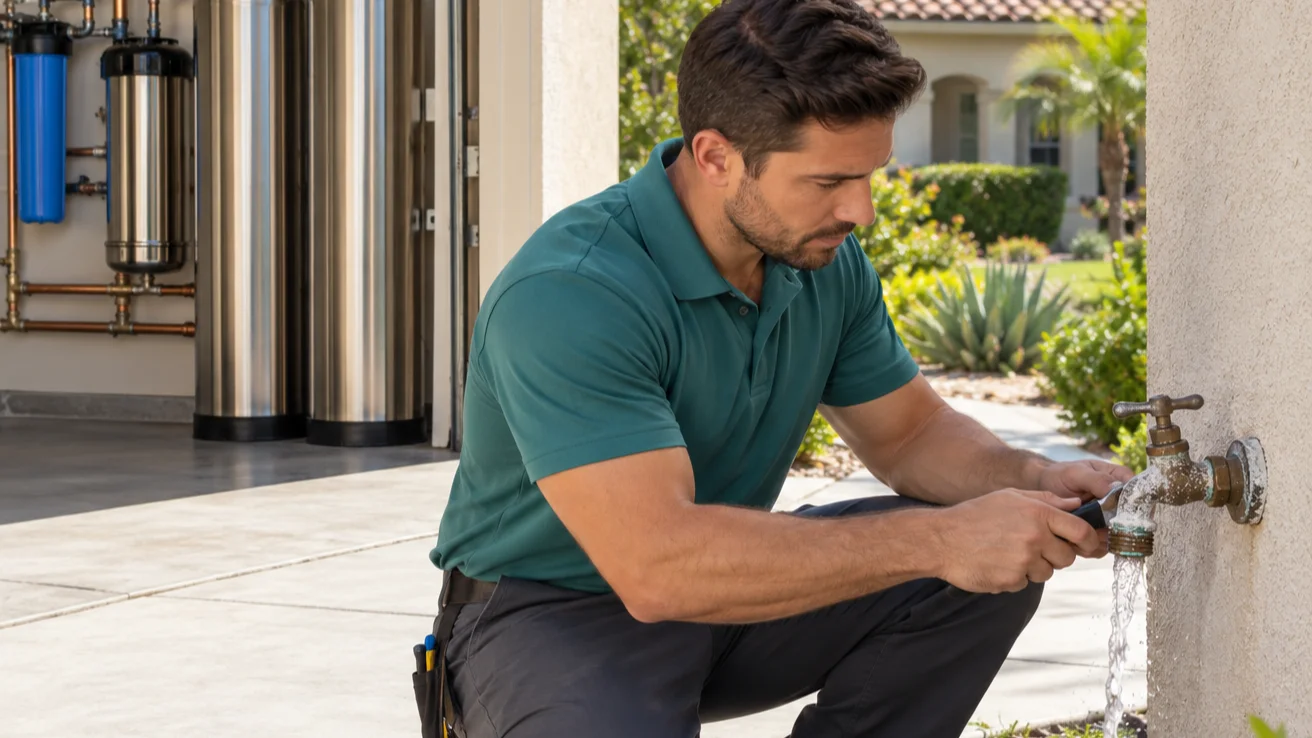
Otay Water District vs Sweetwater next door
Chula Vista isn’t served by one water provider everywhere. Otay Ranch, Eastlake, and nearby eastern neighborhoods may be associated with Otay Water District. Other Chula Vista addresses may have a different provider, including Sweetwater Authority.
Don’t choose equipment using a citywide hardness claim. A figure taken from Sweetwater’s report doesn’t describe an Otay account. The same caution applies in reverse. Water sources, blends, and reported measurements can differ between providers.
Start with the provider name printed on your current water bill. If a landlord or homeowners association manages the account, request a copy of the bill. You can also ask the property manager to identify the retail water provider.
Next, find that provider’s latest Consumer Confidence Report. Look for the reporting year, service-area description, source information, and hardness data. If hardness isn’t listed, ask the provider whether it publishes a current range or can identify the supply serving the address.
We couldn’t confirm an approved Otay Water District hardness figure from the available evidence. That means a specific grains-per-gallon claim shouldn’t guide your purchase. Check Otay Water District’s current report and notices instead. The San Diego County Water Authority can also help readers understand the regional supply system, but its information doesn’t replace the retail provider’s report.
Our guide to San Diego water hardness explains why one countywide number is misleading. If your bill names Sweetwater, use our separate National City and Sweetwater filtration guide for that system.
Scale and taste in Otay Ranch and Eastlake
Hardness describes dissolved calcium and magnesium. USGS classifies water above 180 milligrams per liter as calcium carbonate as very hard. That classification doesn’t tell us the current result at an Otay Ranch tap.
Around an Otay Ranch or Eastlake home, hardness may show up as white spotting on shower glass, crust around faucet aerators, or deposits inside a kettle. Soap may also behave differently. Those signs can justify a hardness test, but they don’t identify every substance in the water.
Taste and odor need separate attention. A mineral taste, disinfectant smell, or change after plumbing work shouldn’t automatically be blamed on hardness. Treatment technologies solve different problems. No single home system removes every contaminant.
Start with the latest utility report. It provides system-level information for a reporting period. It doesn’t test the plumbing inside one house. If the concern is specific to your tap, testing should match that concern. Ask what the test measures, whether it is a screening test or laboratory analysis, and how the result will affect equipment selection.
Hardness itself also shouldn’t be used as a shortcut for drinking-water safety. EPA sets federal contaminant limits under the Safe Drinking Water Act. California adds its own limits through the Division of Drinking Water. A utility report and current notices are the right places to check regulatory results.
Claims about the cleanest city or California’s hardest city don’t help with an Eastlake address. We don’t have approved evidence for either ranking. A measured result and provider report are more useful than a national comparison table.
For mineral residue and scale concerns, review the available hard water solutions before deciding whether you need treatment at one tap or throughout the house.
Softener vs salt-free on this South Bay supply
An ion-exchange softener and a salt-free conditioner don’t produce the same result. The right choice depends on your measured hardness, household water use, plumbing, maintenance preferences, and treatment goal.
A conventional ion-exchange softener reduces calcium and magnesium hardness. NSF/ANSI 44 covers ion-exchange softeners certified for that purpose. Certification isn’t a performance ranking. Check the exact model’s certified claim, rated working capacity, and water and salt efficiency.
EPA advises sizing a softener from measured hardness and household water use. Irrigation demand may need to be excluded. Oversizing can waste water. Demand-initiated regeneration responds to actual use and hardness instead of relying only on a fixed timer.
Ion exchange also adds sodium to treated water. University of Nebraska–Lincoln Extension estimates about 8 milligrams per liter of sodium for each grain per gallon of hardness removed. That’s an estimate, not an Otay Ranch tap result. People on sodium-restricted diets should consult their physician. A licensed pro can discuss whether a kitchen cold line should bypass the softener.
Salt-free conditioning doesn’t remove hardness ions. Its purpose and claims are different. EPA advises comparing the exact scale-reduction claim, including applicable IAPMO/ANSI Z601 information. Don’t accept a promise that conditioned water is chemically softened.
The practical choice usually looks like this:
- Choose softening when the goal is reducing measured calcium and magnesium hardness.
- Consider conditioning when scale management is the goal and retained minerals are acceptable.
- Use a separate drinking-water treatment only when it matches a defined drinking-water concern.
- Compare maintenance, replacement parts, water use, salt use, and certified claims before buying.
Our water softener installation service connects homeowners with licensed providers. The homeowner contracts with and pays the provider directly.
How to confirm your bill and current report
Begin with the newest bill for the property. Confirm the provider name, service address, and account period. Don’t rely only on the words “Chula Vista” or “Otay Ranch” in a mailing address.
Then locate the provider’s current Consumer Confidence Report. Confirm the year before using any measurement. Water reports describe a system and reporting period. They aren’t a permanent result for every tap.
Use this short process:
- Match the report to the provider printed on the bill.
- Confirm that the report covers the current service area.
- Find hardness reported in milligrams per liter or grains per gallon.
- Note whether the figure is an average, range, or source-specific result.
- Review current notices separately from the annual report.
- Ask the provider about any term or missing measurement.
If the Otay Water District report doesn’t publish hardness, ask the district where current hardness information can be found. Don’t substitute Sweetwater data, a seller’s city average, or an old search result. We couldn’t confirm an approved Otay-specific hardness number for this page.
The State Water Board’s drinking-water resources can help identify regulated public systems and available compliance information. Still, system-level records don’t diagnose plumbing inside a particular Eastlake house.
A basic in-home hardness measurement can help size treatment. It shouldn’t be presented as laboratory clearance for regulated contaminants. For a health-related or contaminant-specific concern, ask the utility or an appropriate state-certified laboratory which test fits the issue.
Private wells require a different process. CDC recommends annual well testing for total coliform, nitrate, total dissolved solids, and pH through a state-certified laboratory. Public-water reports shouldn’t be applied to a private well.
Keep copies of the bill, report, test result, and proposed equipment specification. Those documents make competing proposals easier to compare.
What to ask before a licensed pro installs
A good proposal should connect each piece of equipment to a measured concern. Ask the provider to explain what the system changes, what it doesn’t change, and how that conclusion follows from your water information.
Before approving installation, ask:
- Which hardness result was used for sizing?
- Is the result from the utility report or an address-specific test?
- Is the system point-of-entry or point-of-use?
- What exact model and treatment technology are proposed?
- Which NSF or other certification applies to that exact model?
- Which certified reduction or hardness claim should you verify?
- How much water does the system consume during operation?
- What salt, filters, or replacement parts will it require?
- What maintenance does the manufacturer require?
- Will irrigation or a drinking-water line bypass the unit?
- What written scope, equipment details, and warranty terms apply?
- Who handles any required permit for this address?
For City of San Diego properties, the City lists eligible water-softener work under its Simple No-Plan plumbing permit route. That guidance doesn’t establish the permit process for Otay Ranch or other Chula Vista properties. The provider should confirm the correct jurisdiction and current requirements before work begins.
Check the installer’s license through the California Contractors State License Board. Match the business name and license information to the written proposal. Clear Water Pros SD is a referral service, not the installing contractor.
Don’t compare proposals only by tank size or sales language. Compare treatment scope, exact-model claims, operating requirements, installation details, and ownership cost. The provider should also explain the bypass arrangement and show where the unit can be isolated according to its manual.
When to call us
Call when scale keeps returning, you’re comparing softening with salt-free conditioning, or an Otay District report leaves you unsure what to treat. Clear Water Pros SD can arrange testing and connect you with a licensed Water Filtration pro. Call us at (858) 400-4647 to set up a free in-home water test.