Kitchen taps in National City run on Sweetwater Authority water. They do not run on the City of San Diego plants that most countywide filter pages quote. National city water filtration starts with that utility split, then with what older 91950 plumbing adds after the meter.
Sweetwater Authority vs City of San Diego water
National City is a Sweetwater Authority city. A large share of western Chula Vista is too. The City of San Diego’s Alvarado, Miramar, and Otay treatment plants do not treat the water in a glass on Highland Avenue. If a filter page quotes those plants, it is writing about a different retail system.
That split is why this page exists. The City of San Diego Public Utilities site says drinking water in that city typically averages about 16 grains per gallon, or 276 ppm, and can range from 16 to 18 gr/gal, or 272 to 284 ppm, depending on water demand and the area of the City. That sentence is a City of San Diego figure, with the area-and-demand qualifier. It is not a 91950 result. It is not countywide. It does not describe private wells.
The City’s 2025 Consumer Confidence Report, Public Water System 3710020, reports total hardness in grains per gallon by plant. Alvarado averaged 13.8, range 11.9 to 15.8. Miramar averaged 14.1, range 11.7 to 16.6. Otay averaged 14.2, range 11.7 to 15.8. Purchased treated water averaged 8.5, range 3.18 to 13.6. Those rows are 2025 City of San Diego plant and purchased-treated results. They show that even one agency’s number moves by plant and by year. They still do not describe Sweetwater Authority taps.
Imported water the region buys from the Colorado River and the State Water Project is a separate fact. Helix Water District says water with 10 or more grains of hardness is considered hard, and that imported water from those two sources averages 14 grains. That is a statement about the imported supply. It is not a hardness reading for a National City kitchen.
Sweetwater Authority uses local surface storage, including Sweetwater Reservoir in the Sweetwater River valley east of the city, plus water purchased through the regional system. The blend at the meter changes with demand, season, and which sources are running. The document that states current treated-water results for this utility is Sweetwater Authority’s own water quality report. Open that report for the year you care about.
The San Diego County Water Authority is the regional wholesaler for much of the county’s imported water. Retail treatment, testing, and the report that matches your bill still sit with Sweetwater Authority.
For a plain walkthrough of CCR tables, read how to read a San Diego water quality report. For treated municipal water and drinking-water rules, see whether San Diego tap water is safe. Both still send you back to the serving utility. In 91950, that utility is Sweetwater Authority.
Taste, hardness, and older plumbing in 91950
The 91950 grid is older South Bay housing: stucco bungalows, postwar tracts, and infill along National City Boulevard, Highland Avenue, and Eighth Street. West of Interstate 5 you sit closer to the bay and the shipyard corridor. East, the land rises toward Paradise Hills and the Sweetwater valley. Those streets do not share one plumbing age.
Taste at the tap is often disinfectant, not dirt from the reservoir. The CDC notes that water treated with chlorine can taste and smell different from untreated water, or from water treated with chloramine. The serving utility’s report is where you confirm which disinfectant is in use and at what reported levels. Sweetwater Authority’s current disinfectant choice is not in this site’s verified claims ledger. Check the Authority’s latest report. Do not assume the City of San Diego’s practice.
Hardness is calcium and magnesium. USGS classifies hardness as calcium carbonate: 0 to 60 mg/L soft, 61 to 120 moderately hard, 121 to 180 hard, and over 180 very hard. Helix’s 10-grain line is the local imported-supply threshold for hard water. None of that lets this page publish a National City hardness number. Sweetwater Authority has not had a hardness figure fetched into the claims ledger. If another site quotes 16 grains for your block, that is the City of San Diego plumbing-page figure, applied to the wrong city.
Older 91950 galvanized or copper lines can add their own issues after the meter: rust-colored sediment, metallic taste, or staining on fixtures. The EPA secondary drinking water guideline for iron is 0.3 mg/L, tied to rusty color, sediment, metallic taste, and reddish or orange staining. That is an aesthetic guideline, not a health MCL, and not a diagnosis of your pipes. A City plant table will not show what a decades-old service line is shedding.
Private wells are a different problem. This ledger does not establish how many National City properties use wells. Confirm the source for the address. Most street-facing 91950 homes are on Sweetwater Authority retail service. Treat a well as its own case, with state-certified lab testing, not as a Sweetwater CCR.
You do not need a filter as a legal condition of using city water. Treated municipal water is regulated under the Safe Drinking Water Act by EPA, with California adding limits through the Division of Drinking Water. A filter is a household choice: taste, hardness effects on fixtures, or a specific certified reduction claim you actually want. Match the device to that choice.
Under-sink vs whole-house options for this city
EPA’s home treatment guidance is blunt. Identify the water concern first, using the serving utility’s report and appropriate testing. No single technology removes every contaminant.
Point-of-use devices treat a selected tap. Point-of-entry systems treat water entering the residence. For a National City kitchen, that split is the real decision.
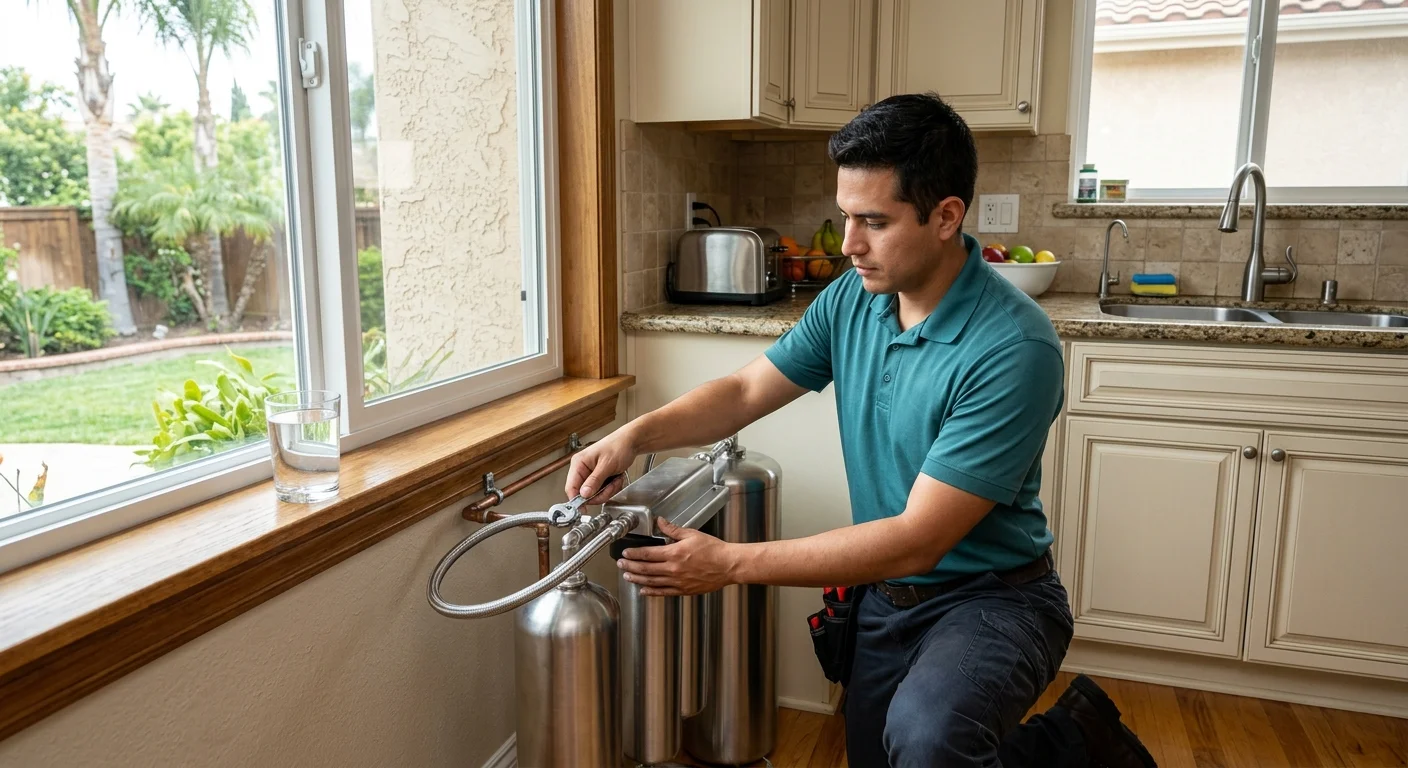
Under-sink drinking water filtration sits at the cook’s tap. NSF/ANSI 42 covers certified aesthetic reduction claims such as chlorine taste and odor. NSF/ANSI 53 covers specified health-effect contaminant claims. A standard is not a ranking, and certification does not mean the filter reduces every contaminant. Verify the exact model’s certified reduction claim on the NSF listing before anyone orders it.
Reverse osmosis drinking water is a point-of-use option when the goal is a broader dissolved-solids reduction at one tap. NSF/ANSI 58 covers reverse osmosis systems. An RO unit produces treated water and reject water. EPA’s WaterSense consumer page states that labeled units demonstrate at most 2.3 gallons of reject water per gallon treated under its criteria. That is a label criterion, not field performance for every system. EPA also gives national examples of typical point-of-use RO using five or more reject gallons per treated gallon, and up to ten for some inefficient units. Those are national examples, not a promise for a 91950 install. Compare the exact model at EPA WaterSense. CDC home-treatment guidance says RO may reduce fluoride. NSF/ANSI 58 treats fluoride reduction as an optional exact-model claim. Do not assume a percentage, and do not paste the City of San Diego’s 0.7 ppm fluoride target onto a Sweetwater tap.
Whole-house water filtration treats every tap, including showers and laundry. It is the right scope when the complaint is house-wide taste, sediment, or disinfectant at every fixture. It is the wrong scope if you only want a better drinking glass and you do not want to maintain a large point-of-entry unit. NSF roles still apply by component. Whole-house RO is a heavier design than under-sink RO, with its own drain, pressure, and maintenance load.
EPA’s November 2024 guide to selecting home treatment describes basic pitchers and tap filters as typically under $100, RO and distillation systems as tending to cost a few hundred dollars and possibly requiring professional installation, and point-of-entry systems as costing thousands and generally requiring professional installation. Those are EPA’s broad categories, not a Clear Water Pros quote and not a National City installed price. Replacement filters and the written scope from a licensed pro set the real ownership cost.
Salt-based softening is NSF/ANSI 44 when the unit is an ion-exchange softener that reduces calcium and magnesium. Salt-free conditioning does not remove hardness ions. Evaluate the exact scale-reduction claim. A National City permit path for a softener was not confirmed in the claims ledger. The City of San Diego lists water-softener installation among Simple No-Plan plumbing work for eligible City properties. That is City of San Diego guidance, not a National City rule. Confirm the current permit route with National City before a licensed pro starts work.
There is no best system in the abstract. The fit is the unit whose certified claims match the Sweetwater report and a test at your tap.
What an in-home test still adds
A Consumer Confidence Report is water leaving the treatment plant, averaged over a reporting year. It is not a sample from the kitchen of a 1920s bungalow on A Avenue. Building plumbing, a water heater, a refrigerator line, and an old meter setter all sit between the plant and the glass.
Clear Water Pros SD arranges a free in-home water test and connects you with a licensed Water Filtration pro. You contract with that pro directly. The test is a starting point for treatment scope. It is not a laboratory clearance that every contaminant is gone, and it is not a medical result. Ask the pro which measurements they will take, and compare those to Sweetwater Authority’s current report.
Do not treat a handheld TDS meter as a contaminant-by-contaminant lab analysis. USGS notes that specific conductance can approximate dissolved solids, and that the relation varies with water composition. EPA’s secondary TDS guideline is 500 mg/L for aesthetic and technical concerns. It is not a universal drinking-safety cutoff.
If the home is on a private well, CDC recommends annual testing for total coliform, nitrate, TDS, and pH, using a state-certified laboratory, plus local health-department guidance on extra tests. Harmful or suspected contamination calls for another safe water source while you get health-department direction. Boiling does not remove chemical contamination. Most street-facing 91950 homes are municipal. Confirm yours.
An in-home visit also shows cabinet space, drain access, and whether an under-sink unit or a garage point-of-entry unit even fits. Older South Bay kitchens are tight. That is a layout fact, not a water-quality fact, and it still decides the job.
Sweetwater Authority pages to verify
Before you buy a filter, open these, in this order.
First, Sweetwater Authority’s current water quality report, often titled as a Consumer Confidence Report. Confirm the reporting year. Look for the disinfectant in use, hardness if they publish it, and any notices for the period. This site has not fetched a Sweetwater hardness number or contaminant table into its claims ledger, so this page will not invent one. The Authority’s own report is the source.
Second, any current water-quality notice on the Authority’s site. A CCR is annual. A boil-water or treatment notice is not.
Third, the San Diego County Water Authority water-quality pages at sdcwa.org for regional imported-supply context. They do not replace the retail report.
Fourth, California’s Division of Drinking Water and EPA Safe Drinking Water Act pages if you want the rule behind a line in the report. California’s hexavalent chromium MCL is 0.010 mg/L (10 µg/L). That is a statewide limit, not a National City occurrence number. The City of San Diego 2025 CCR showed purchased treated water averaging 0.1 ppb hexavalent chromium, range ND to 0.4, below that MCL. That City row still does not stand in for Sweetwater. Read Sweetwater’s own chromium lines.
Fifth, NSF’s listings for the exact model you are considering. Confirm NSF/ANSI 42, 53, 44, or 58 as applicable, and the specific reduction claim.
If you are hiring the installer, check the contractor on the CSLB license lookup. Clear Water Pros SD is a referral brand. The licensed pro you contract with is the one who should appear in that database.
Setting up new water service in National City is a utility-account task with Sweetwater Authority, not a filtration task. Start with the Authority’s customer-service pages for deposits, hours, and start-service rules. Those figures were not verified here, so take them from the utility, not from this post.
When to call us
Call when the Sweetwater report and your own tap do not match, when you want a licensed pro to size under-sink or whole-house treatment for a 91950 house, or when you want the free in-home water test explained before anyone orders equipment. Call us at (858) 400-4647 to set up a free in-home water test.