You closed on a San Diego house and nobody pointed out a water tank. The last owner may have left a brine drum in the garage, or they may have pulled the unit and left the bypass plumbing. Walk the cold-water line from the heater outward and you can usually tell whether a softener is already on the house.
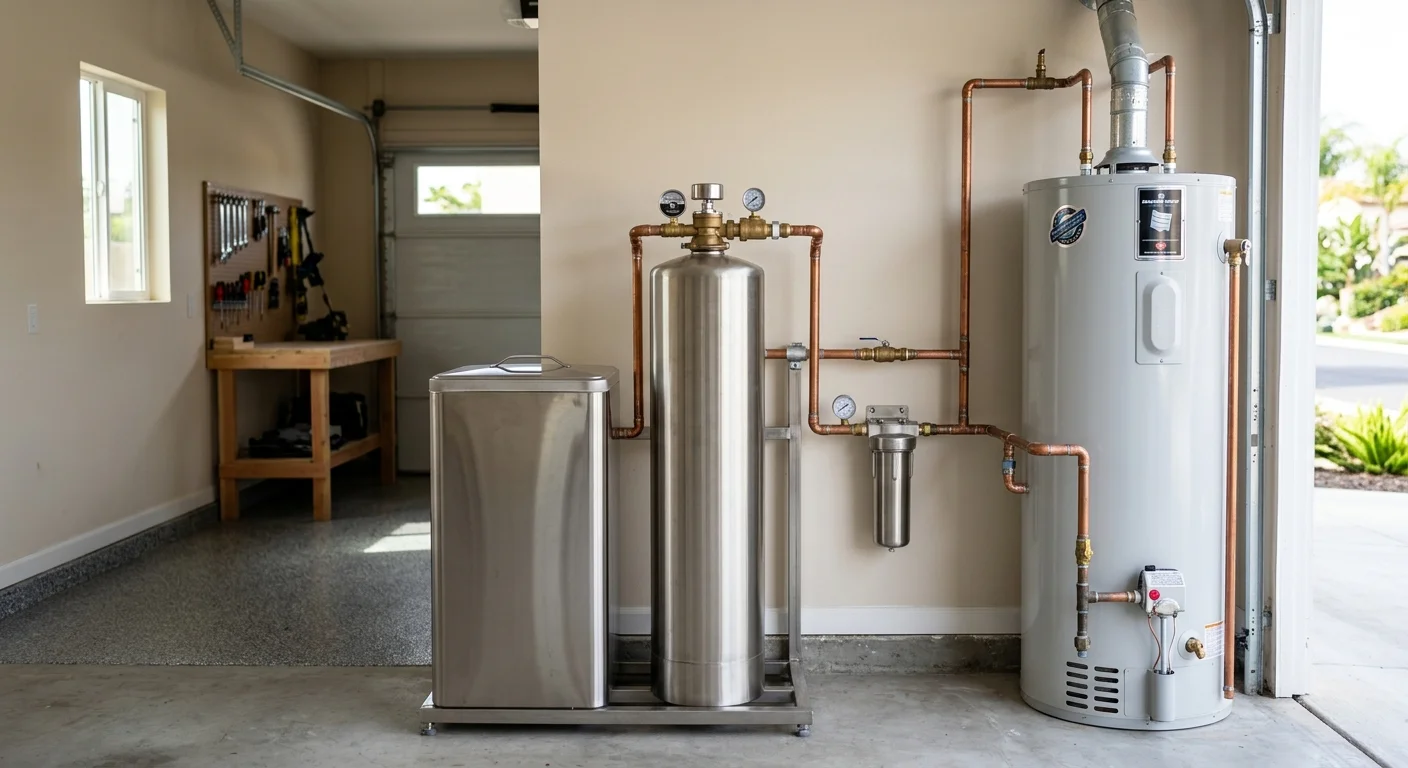
Signs a San Diego home already has a softener
Start with hardware, not with how the water feels. A salt-based softener in this county is almost always two vessels. The taller tank has a control head on top and holds the resin. The shorter, wider tank has a lift-off lid and holds salt. That second tank is the brine tank. Kinetico’s owner guidance, read for this site’s claims ledger, says to identify the brine tank and not confuse it with the resin tank.
Look for a drain line leaving the control head. It usually drops to a floor drain, a standpipe, or a laundry tub. Look for a bypass on the plumbing next to the tanks. Culligan describes that bypass as a way to route water around the softener so the house still has water while the unit is isolated. Valve styles differ. Some use a lever, some use knobs, some use a three-valve assembly. Do not force a stuck handle.
Leftover bags of pellet salt in the garage are a clue, not proof. An empty brine tank still counts as equipment on the house. A loop of copper or PEX with extra unions near the heater is another clue. That loop is often where a tank used to sit.
Do not treat soap lather, slippery skin, or spot-free glasses as proof that a tank exists. Those are signs of how the water behaves. They can show up with a working softener, with a salt-free conditioner, or with no treatment at all. They can also fail when a real tank is sitting on bypass. If you already found a unit and you want to know whether it still softens, that is a different check. Use our guide on how to know if a water softener is working.
Hardness still matters once you know what you are looking at. Helix Water District says water at 10 or more grains per gallon is considered hard, and that the imported Colorado River and State Water Project supply averages about 14 grains. That is a statement about imported supply, not about any given tap. The City of San Diego Public Utilities page says City drinking water typically averages about 16 grains per gallon, or 276 ppm, and can range from 16 to 18 grains, or 272 to 284 ppm, depending on demand and the area of the City. That figure is for the City system only. It is not a countywide number and it does not describe private wells. Confirm the serving utility for the address.
A whole-house tank in the garage does not mean every tap is softened. Some kitchens keep a cold line that bypasses the softener for drinking and cooking. University of Nebraska–Lincoln Extension notes that pattern in its ion-exchange guide. Look at the plumbing, not at one faucet.
Softener vs salt-free tank vs whole-house filter
San Diego garages mix these three, and they are not the same job. A salt-based softener uses ion exchange. NSF/ANSI 44 is the standard that covers ion-exchange softeners that reduce calcium and magnesium hardness. Certification is not a ranking, and it does not mean every contaminant is reduced. Check the exact model’s certified reduction claim.
A salt-based unit needs salt, a brine tank, and a drain. EPA’s May 2026 water-softener guide says salt-free conditioning does not remove hardness ions. Evaluate the exact scale-reduction claim. Do not treat a salt-free tank as softened water. Many of those units are a single media tank with no brine drum and no regeneration drain. If you are staring at one tank and no salt, read our comparison of a water softener vs salt-free conditioner before you buy anything.
A whole-house filter is a different device again. NSF/ANSI 42 covers certified aesthetic reduction claims, such as taste and odor. NSF/ANSI 53 covers specified health-effect contaminant claims. A carbon tank on the main line can change chlorine taste without touching hardness. EPA’s November 2024 home-treatment guide says to identify treatment goals from the serving utility’s report and appropriate testing, and that no single technology removes every contaminant. Point-of-entry systems treat water entering the residence. Point-of-use devices treat a selected tap.
Reverse osmosis is usually under the kitchen sink, not in the garage. NSF/ANSI 58 covers reverse osmosis systems. If you only found a small canister under the sink, that is not a whole-house softener.
EPA’s same 2024 guide describes pitcher and tap filters as typically under $100, reverse osmosis and distillation as tending to cost a few hundred dollars, and point-of-entry systems as costing thousands and generally requiring professional installation. That is an attributed national category from the guide. It is not a Clear Water Pros price, not a San Diego installed quote, and not a reason to skip a written scope from the licensed pro you hire.
If the tank is a conditioner rather than a softener, salt-free water conditioning is the matching service path. If it is a true ion-exchange unit, or if the house has none, water softener installation is the path to talk through with a licensed pro.
Where to look in garages and side yards
Most detached houses in this county put the water heater in the garage. Start there. Follow the cold inlet into the heater. The treatment tanks, if they exist, usually sit on that line, a few feet away, against the same wall.
In Clairemont, Linda Vista, and Mira Mesa, that corner is often a tight strip between the heater and the side door. Look low. Brine tanks get shoved under a shelf of paint cans. In North Park and older central-city bungalows, the heater may sit in an interior closet. The softener, if there is one, may be one room away, still on the incoming cold line.
Carlsbad and other coastal north-county tracts often hide equipment in an outdoor closet on the side yard. Stucco, a louvered door, and a concrete pad are the usual tell. Open that door if you own the house. You may find the heater, a filter tank, a softener pair, or all three. East County stucco tracts in El Cajon, La Mesa, Lemon Grove, and Santee use the same outdoor-closet pattern along a gated side walkway. The tank is easy to miss from the street.
South Bay garages in Chula Vista and National City follow the heater-in-garage layout more often than a street-facing closet. Inland north county, including Escondido, San Marcos, and Vista, is mixed. Some properties on private wells add extra tanks for sediment or iron. This ledger does not establish how many homes in any region use wells. Confirm the source for that address. Hidden Meadows and similar well areas need a different test path than City water.
Condos and townhomes downtown and in Little Italy often have no room for a point-of-entry tank. The heater closet may hold only the heater. A missing garage tank in a stacked unit is normal. It does not tell you anything about the water.
Work from the meter inward if the garage is empty. The main shutoff and the first treatment device are usually close together. Look for a bypass cluster even if the tanks are gone. Abandoned unions and a capped drain stub mean a unit used to be there.
Stay on your own property. Do not open a locked HOA room. Do not climb into a neighbor’s side yard to compare tanks.
What to do if you find a tank that sits idle
Finding a tank is not the same as having soft water. An idle unit can sit on bypass for years. Culligan’s bypass overview says to confirm bypass by running a cold tap, and always to follow the exact model manual. If the handle will not move, stop. Do not force it.
Lift the brine-tank lid. If the tank is empty and dry, the unit has not been regenerating. If you see a hard crust with a gap under it, that can be a salt bridge. Rheem’s manufacturer manual describes a hardened salt crust that creates a gap between salt and water, so salt cannot dissolve into brine and regeneration suffers. That is a definition, not a DIY repair script. Follow the actual model manual.
Kinetico’s salt-fill guidance, for its own units, says that if water is visible above the salt, add salt or potassium chloride, do not use rock salt, and do not fill the tank completely because overfilling can cause bridging. Other brands follow their own manuals. Do not copy one brand’s fill line onto a different tank.
Do not pour bleach or any other chemical into the brine tank unless the exact model manual tells you to. CDC well-treatment guidance says to match treatment to an identified problem and not to prescribe generic chemical dosing. A garage tank on City water is not a well, and a random bottle of bleach is not a service plan.
If the tank is wet on the floor, isolate it. GE’s softener-leak guidance recommends using the bypass or the supply shutoff and contacting the installer or plumber. Manufacturer pages differ on valve positions. Do not treat any one handle direction as universal. Do not touch wet electrical parts. Do not open pressurized assemblies.
An unplugged control head is another idle clue. Plug nothing in if the area is wet. A licensed pro can say whether the resin tank, valve, and drain can return to service, or whether the house needs a different system. Idle equipment is not a reason to assume water softener repair or a full replacement until someone who holds the license looks at it.
EPA’s November 2024 guide also says to include manufacturer maintenance requirements and replacement-filter costs when you compare ownership. Ask the pro for that in writing. Do not guess a salt budget or a filter interval from this page.
When a licensed pro should confirm it
Call in a licensed Water Filtration pro when you cannot tell a softener from a carbon tank, when the bypass will not move, or when the house may be on a well. CDC well-testing guidance says to use a state-certified laboratory and to ask local health or environmental authorities which extra tests fit the location. A garage glance cannot do that work.
A licensed pro should also confirm the setup when you are buying or selling. Disclosures miss tanks. Outdoor closets in Carlsbad and East County get painted shut. A unit on bypass can look like it belongs to the house and still send hard water to every fixture.
Clear Water Pros SD is a referral service. We answer the phone, arrange a free in-home water test, and connect you with a separately licensed pro. You contract with that pro and you pay that pro. We do not hold the trade license, we do not own the tanks, and we do not perform the install. You can verify a contractor’s license on the CSLB license check.
Ask the pro to identify the serving utility and to use that utility’s current report. The San Diego County Water Authority water-quality page is a starting point for treated regional supply. It does not replace the retail agency’s Consumer Confidence Report for your street. The City of San Diego lists water-softener installation among qualifying Simple No-Plan Plumbing/Gas Permit work for eligible properties. That is City jurisdiction guidance. It is not a countywide permit rule, and it is not evidence of a softener ban. Other cities and the unincorporated county set their own routes.
If the house has no tank, or if the idle unit cannot return to service, talk through water softener installation against a salt-free option using measured water, not a guess. EPA says to size a softener from measured hardness and household water use, and to exclude irrigation demand when that is appropriate. Oversizing can waste water.
When to call us
Call us when you found a tank and you still cannot tell what it is, or when the house has no tank and you want the water tested before anyone bids an install. A licensed Water Filtration pro should confirm the equipment, the bypass, and the right treatment for that address. Call us at (858) 400-4647 to set up a free in-home water test.