Searching for home water treatment services near me can produce very different offers. Some companies focus on one appliance, while others start with the water source and the problem you want addressed. In San Diego County, that distinction matters before you compare equipment or request a quote.
What home water treatment covers in San Diego County
Home water treatment can cover drinking water, hardness, taste, odor, sediment, or a specific concern shown by testing. It isn’t one product category. The right scope depends on what’s entering the property and which taps need treatment.
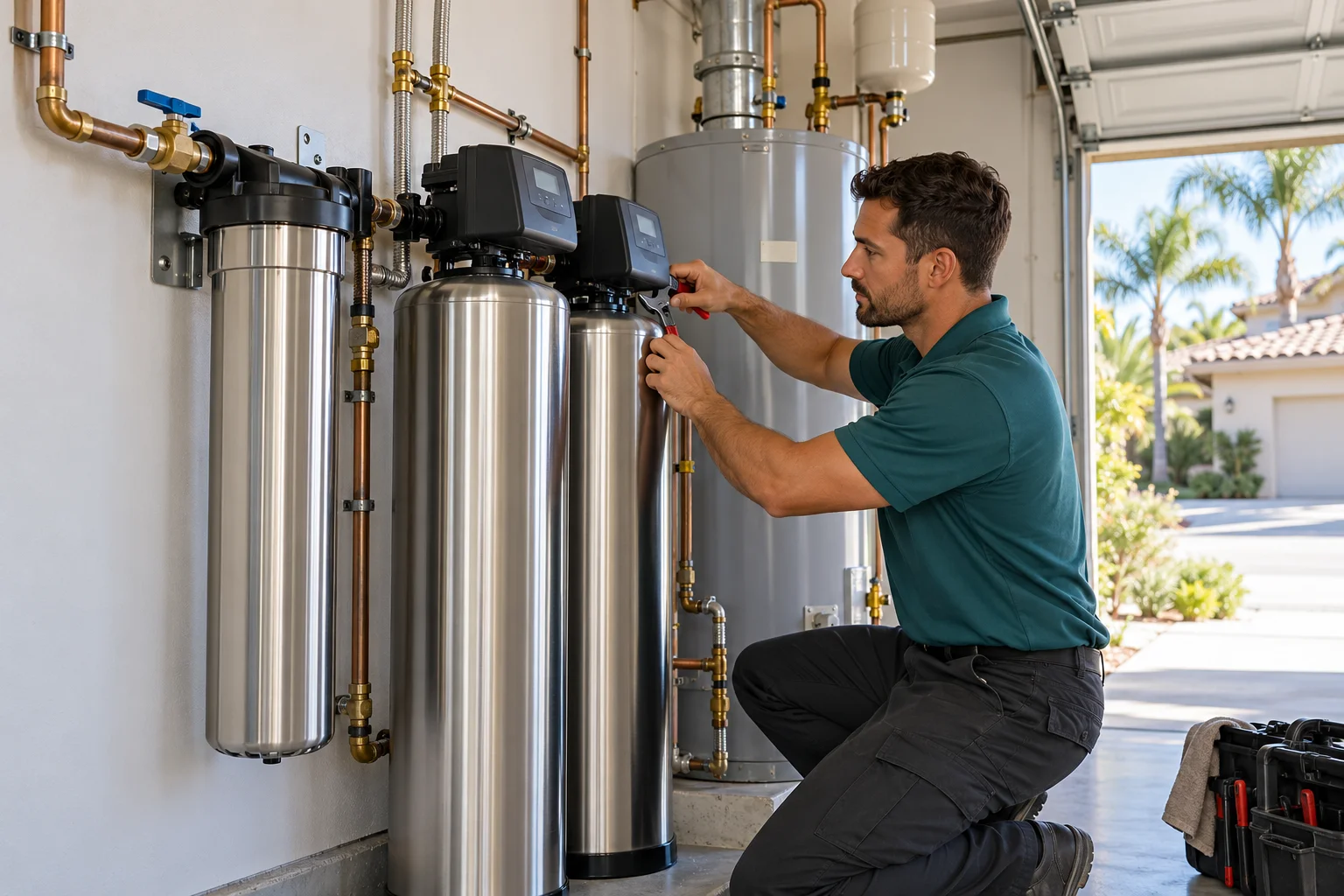
A point-of-entry system treats water entering the residence. This is the usual location for whole-house water filtration or an ion-exchange softener. A point-of-use device treats one selected tap, often at the kitchen sink. Reverse osmosis and under-sink filters commonly fit that narrower role.
These technologies aren’t interchangeable. Ion-exchange softeners reduce calcium and magnesium hardness. Carbon filtration may address an exact certified aesthetic claim. Reverse osmosis treats water through a membrane and produces both treated and reject water. No single technology removes every contaminant.
Hardness is a common comparison point in the City of San Diego. The City says its drinking water typically averages about 16 grains per gallon, or 276 ppm. It reports a range of 16 to 18 grains, depending on water demand and location. That figure applies only to the City’s system, not every San Diego County utility or private well.
The City’s 2025 Consumer Confidence Report contains different plant and purchased-water measurements. That report lists average total hardness from 13.8 to 14.2 grains per gallon at its three treatment plants. Purchased treated water averaged 8.5 grains. Those figures describe reported supplies, not a guaranteed result at any address.
Start with the serving utility’s current report and the actual concern. A free in-home water test can help frame the conversation. Ask what the visit measures, what it doesn’t measure, and whether a state-certified laboratory is needed.
How to tell a licensed pro from a sales-only pitch
A useful consultation connects the proposed equipment to evidence. The pro should explain the water concern, treatment location, capacity, maintenance, and exact model claims. A pitch that jumps from one sample to a large package deserves closer review.
Clear Water Pros SD is a referral service. We arrange the in-home water test and connect homeowners with separately licensed providers. The homeowner contracts with and pays the selected provider directly.
Before signing, check the provider through the California Contractors State License Board. Confirm that the business name on the proposal matches the license record. Also ask the CSLB whether the listed classification covers the proposed installation. A specific license-class rule for every water treatment project couldn’t be confirmed from the approved material for this page.
Certification language also needs precision. NSF/ANSI 42 covers certified aesthetic reduction claims. NSF/ANSI 53 covers specified health-effect contaminant claims. NSF/ANSI 44 covers ion-exchange softeners that reduce calcium and magnesium hardness. NSF/ANSI 58 covers reverse osmosis systems.
Those standards aren’t performance rankings. A standard number alone doesn’t prove reduction of every contaminant. Request the exact model number and its applicable certified reduction claim. The replacement element matters too.
Installation scope should be written down. Ask who handles plumbing changes, startup, testing, cleanup, and future filter replacement. Our guide to who installs whole-house water filters in San Diego explains the installer question in more detail.
Permit requirements can change by jurisdiction and property. The City of San Diego lists eligible water-softener work under its Simple No-Plan Plumbing/Gas Permit process. That guidance isn’t a countywide rule. Confirm the current route with the building division serving the property.
City water vs well water changes the job
A municipal customer should begin with the current report from the utility serving that address. San Diego County contains many separate service areas, so a City of San Diego figure shouldn’t be applied to Chula Vista, East County, inland North County, or another provider’s territory.
The San Diego County Water Authority can help residents identify regional water information, but the serving retail utility’s report is the address-specific starting point. Check current notices too. A report describes the utility’s water during its reporting period. It doesn’t diagnose a building’s plumbing or guarantee conditions at one tap.
Private wells require a different process. Federal EPA public-water rules don’t apply to privately owned wells. CDC guidance calls for a state-certified laboratory and annual testing for total coliform, nitrate, total dissolved solids, and pH. Local health or environmental authorities can identify additional tests suited to the location.
Well owners should also test after flooding, well repair, or a change in taste, color, or smell. Pregnancy or a child moving into the home are other reasons CDC gives for additional testing. If testing finds harmful germs or chemicals, use another safe water source and seek health-department or well-contractor guidance. Boiling can kill germs, but it doesn’t remove chemical contamination.
Visible or sensory clues help define the next question, but they don’t identify a contaminant. Orange staining might prompt iron testing. A rotten-egg odor can originate in a well, plumbing, or water heater. An oily-looking sheen can have more than one source.
Don’t select equipment from appearance alone. Match treatment to the laboratory result, flow needs, and the part of the home being treated. Then test again when appropriate to confirm the selected treatment worked. For public systems, learn how to read a San Diego water quality report before comparing proposals.
Questions to ask before anyone comes out
A short phone conversation can expose major differences between home water treatment companies near me. Describe the water source, the concern, and where you notice it. Mention existing filters, softeners, reverse osmosis equipment, septic service, or a tankless water heater.
Ask these questions before booking:
- Is the visit a basic in-home screening or laboratory sampling?
- Which characteristics will be measured during the visit?
- Which contaminants can’t the visit confirm?
- Will I receive the measured results before discussing equipment?
- Is the proposal for one tap or the whole residence?
- What exact model and treatment technology are being proposed?
- Which certified reduction claims apply to that exact model?
- What flow, capacity, and household-use assumptions were used?
- What maintenance does the manufacturer require?
- How often must consumable parts be checked or replaced?
- What do replacement filters, salt, service, and reject water add to ownership?
- Who performs the installation, and who receives payment?
- Does this address require a permit or property approval?
- What warranty terms come from the manufacturer and provider?
For a softener, sizing should use measured hardness and household water use. Irrigation demand may need to be excluded. Oversizing can waste water. Ask whether regeneration responds to demand or runs on a fixed timer.
For reverse osmosis, compare exact-model efficiency and contaminant claims. Efficiency is treated water divided by incoming water. A general product label shouldn’t be turned into a promise for every home.
For salt-free equipment, ask what the unit actually does. Salt-free conditioning doesn’t remove hardness ions. Evaluate its exact scale-reduction claim instead of accepting a promise of softened water.
Access also affects the proposal. A garage installation, exterior main line, tight cabinet, or missing drain can change the written scope. Our San Diego water filter installation guide covers the practical details worth documenting before work begins.
What this visit cannot promise
An in-home visit can organize the decision, but it can’t make every water claim certain. A basic test may measure hardness or other stated characteristics. It isn’t automatically a state-certified laboratory analysis, medical clearance, or proof that every contaminant is absent.
A total dissolved solids meter has similar limits. Conductivity can help estimate dissolved solids, but the relationship changes with water composition. It doesn’t identify individual chemicals. The EPA’s secondary guideline for TDS addresses aesthetic and technical concerns, not a universal drinking-safety cutoff.
Taste and odor aren’t safety tests either. Utilities may use chlorine or chloramine for disinfection, and the two can taste different. Some utilities switch between them. Check the serving utility’s current report rather than assuming one disinfectant applies across San Diego County.
The visit also can’t promise a particular health result. Treatment choices should follow the identified concern and the exact model’s certified claims. Anyone with medical needs, including a restricted sodium diet or dialysis requirements, should consult the appropriate healthcare professional.
A proposal shouldn’t promise universal contaminant removal. It also shouldn’t guarantee savings, appliance life, or a fixed maintenance schedule without model-specific support. Feedwater, household use, installation, and maintenance all affect performance.
Pricing can’t be confirmed from this page. Clear Water Pros SD doesn’t publish a package price, installation fee, or provider guarantee here. Ask the licensed provider for a written quote covering equipment, installation, permits, consumables, maintenance, and exclusions.
The same caution applies to timing. Availability and on-site duration depend on the provider and installation scope. Get those details in writing before authorizing work.
When to call us
Call when you want the water concern defined before choosing softening, carbon filtration, or reverse osmosis. We’ll arrange the test and connect you with a separately licensed Water Filtration pro who can prepare the installation proposal.
Call us at (858) 400-4647 to set up a free in-home water test.