A whole-house filter belongs on the main before the rest of the house. If you’re looking for water filtration system installers near me in San Diego, you need a licensed pro who can work that line, set a bypass, and leave every indoor tap on treated water. Clear Water Pros SD books the free in-home water test and connects you with a separately licensed installer. You contract with that pro directly.
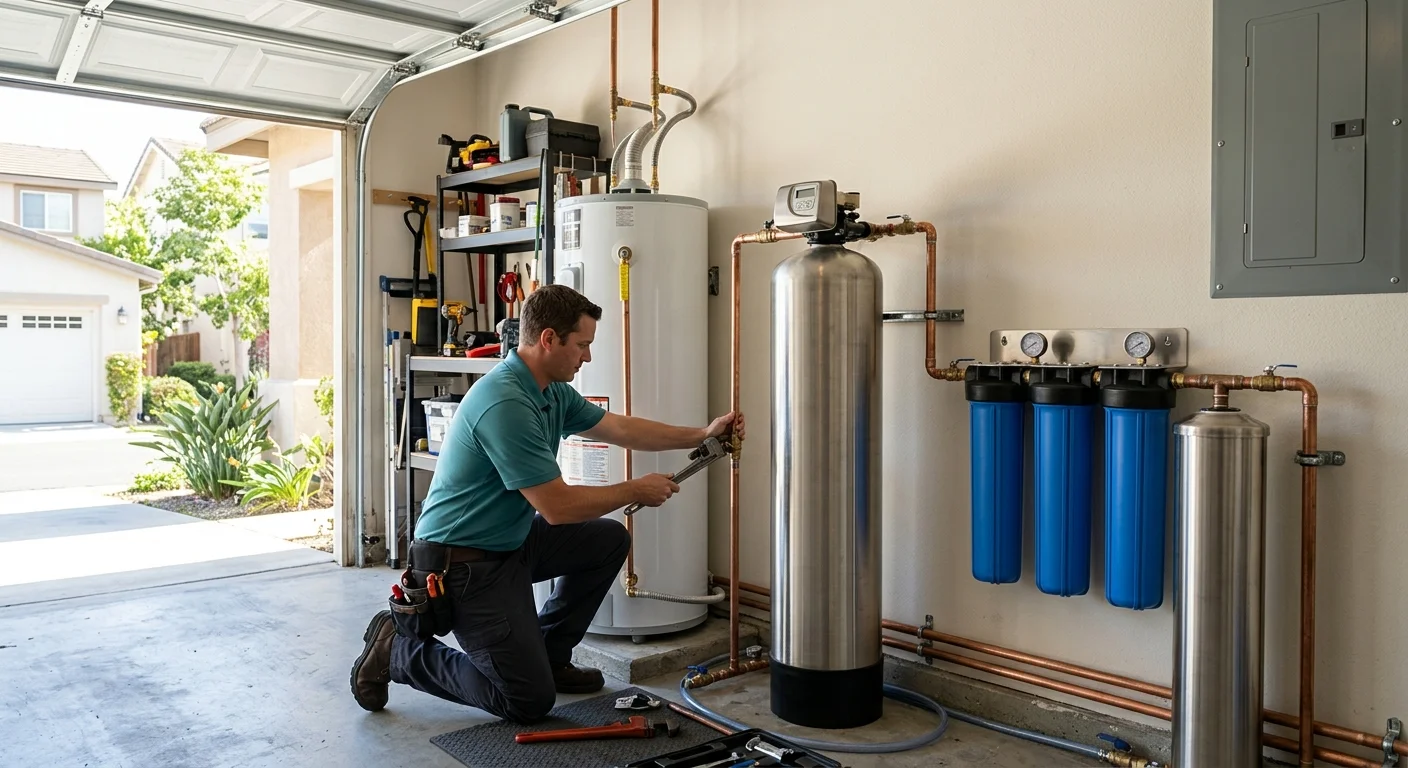
What whole-house installation actually includes
A whole-house unit is a point-of-entry system. It treats water as it enters the residence, not one kitchen faucet. EPA’s home-treatment guidance is the right frame: identify the water concern first, then compare certified reduction claims, maintenance, and whether you want whole-house scope or a single tap. No single technology removes every contaminant.
The licensed pro cuts into the cold main after the meter and shutoff, and usually before the water heater. Typical work on a whole-house water filtration job includes a sediment or carbon tank (sometimes both), isolation valves, a bypass so the house can run during service, and a firm pad or wall mount so the vessel does not sit on bare dirt. If the model has a drain or flush line, that line has to reach an approved drain. The pro restores pressure, checks for leaks, and walks you through the first filter change.
This is not a water softener. NSF/ANSI 42 covers certified aesthetic reduction claims, such as chlorine taste and odor on a listed model. NSF/ANSI 53 covers specified health-effect contaminant claims on a listed model. NSF/ANSI 44 is the ion-exchange softener standard. NSF/ANSI 58 is reverse osmosis. A standard is not a ranking, and it does not prove reduction of every contaminant. Ask for the exact model’s certified reduction claim before anyone orders equipment.
San Diego County water is not one chemistry. The City of San Diego Public Utilities site says drinking water in the City typically averages about 16 grains per gallon (276 ppm) and can range from 16 to 18 gr/gal (272 to 284 ppm) by area and demand. Helix Water District says water at 10 or more grains is considered hard, and the imported Colorado River and State Water Project supply the county buys averages about 14 grains. Those figures describe named sources. They are not a countywide average, not a well result, and not a reason to skip a test at your address. Confirm the serving utility and read that utility’s current Consumer Confidence Report. The San Diego County Water Authority is a starting point for wholesale supply context. Your retail district still publishes the report that matches your tap.
The day-of sequence, from shutoff to first draw, is covered in our water filter installation in San Diego guide. This page is about who is qualified to put that system on a San Diego main.
Irrigation is a layout call, not a default. Many county homes tee hose bibs and landscape lines off the main before indoor plumbing. Ask whether outdoor water stays untreated so you are not sending filtered water to the yard. EPA notes that oversizing treatment to unused demand can waste water on softeners. For a filter, the same idea holds: size the vessel to indoor use, not the sprinklers, unless you have a stated reason to treat those lines.
Filter change cost belongs in the ownership comparison. EPA’s November 2024 home-treatment guide groups point-of-entry systems as costing thousands and generally requiring professional installation. That is a national category from that guide, not a San Diego quote and not a Clear Water Pros SD price. The written scope from the installer you hire is what you pay.
License, permit, and bypass questions to ask
The person on the main should hold an active California contractor license for the work they propose. We could not confirm in our claims file which exact CSLB classification covers whole-house filter installation on every job. Do not guess C-36, C-55, or any other class from a blog. Look the license up on the CSLB license check before you sign. Ask for the license number in writing. Confirm it is current and matches the company on the contract.
Clear Water Pros SD is a referral brand. It does not hold the contractor license, does not own trucks, and does not perform the install. The pros we connect you with are licensed. You hire and pay that pro.
Permits are local to the address. The City of San Diego lists water-softener installation among qualifying Simple No-Plan Plumbing/Gas Permit work for eligible properties, with scope and historic-property rules that change the route. That City page is about softeners. It is not a countywide filter-permit rule, and it is not proof that a whole-house carbon tank is no-plan work. We could not confirm a single permit fee, a countywide filter ordinance, or a softener ban. Call the building division that covers the parcel: City of San Diego Development Services inside the City, or the county or city building department if you are in Chula Vista, El Cajon, Oceanside, unincorporated East County, or anywhere else. Historic homes and HOA rules can add a second review. The installer should tell you who pulls the permit, if one is required, before cutting pipe.
Bypass is not optional on a point-of-entry tank. A bypass lets household water keep running if the vessel is isolated for a cartridge change or a leak. Valve styles differ: lever, knobs, a three-valve assembly, or a manufacturer’s own head. Do not force a stuck handle. Confirm bypass by running a cold tap after the pro shows you the path. Follow the exact model manual, not a generic YouTube clip.
Ask these items out loud before anyone orders a tank:
- Which NSF/ANSI claim does this exact model carry, 42, 53, both, or neither.
- Where the bypass sits, and how you isolate the unit without shutting the whole house.
- Whether irrigation and hose bibs stay on raw water.
- Who pulls any required permit, and which agency has the address.
- What the first-year filter set costs, in writing from the installer, not as a brand promise from us.
- How the drain or flush line is routed if the model needs one.
If the answers are vague, wait. A whole-house filter is a plumbing change on the only water line into the house.
Garage and side-yard layouts in San Diego homes
San Diego County is not one housing stock. The installer’s first job is to find the main and the space around it, then design the set from that, not from a catalog photo.
In much of the City and the older coastal grid, North Park, Normal Heights, Mission Hills, Ocean Beach, the water heater often sits in the garage or a cramped side closet. The main comes through a slab or a short buried run along the driveway. A tall media tank has to clear the heater and the car. Short copper stubs and tight 90s are common. A pro who has never worked a 1920s bungalow will fight that layout.
Coastal north county is different again. Encinitas, Carlsbad, and Solana Beach mix older laterals with newer PEX re-pipes. Salt air and outdoor equipment pads show up more. Side-yard setbacks and HOA sight-line rules can block a tank that would be fine in a Clairemont garage. Ask where the vessel will live before you fall in love with a 12-inch-diameter photo.
Inland and East County ranch homes, El Cajon, Santee, Lakeside, Ramona, often have more side-yard length and a longer run from meter to heater. That does not make the water “harder” than the coast. Helix’s published position on imported supply is about 14 grains, and the City’s own 2025 Consumer Confidence Report shows plant hardness averages in the mid-14s at Alvarado, Miramar, and Otay, with purchased treated water lower. Do not pick equipment from a neighborhood rumor. Pick it from a test and the serving utility’s report.
South Bay tract homes in Chula Vista, Otay Ranch, and Eastlake tend to put the heater in the garage on a tight pad, with HOA CC&Rs on exterior equipment. A tank that spills past the garage plane can fail an architectural review even when the plumbing is sound. The licensed pro should measure the pad, the door swing, and the heater clearances on the first visit.
Slab-on-grade is the county default. There is often no basement mechanical room. That means the filter lives where you park, where the dog runs, or on a shaded side of the house. Direct sun on a plastic tank is a maintenance problem in August. Leave service space so a cartridge can come straight up and out. If the main is copper, the joint work is different from PEX. If a prior owner already added a softener, the new filter has to sit in a sane order on that same wall, with valves you can still reach.
Well properties in Hidden Meadows, Fallbrook, and Rainbow are a separate class. Private wells are not the City system and not Helix imported supply. CDC guidance is to use a state-certified lab and to match treatment to the identified problem. A municipal carbon tank is not a well plan by default.
How this job differs from under-sink reverse osmosis
Whole-house filtration and kitchen reverse osmosis are different licenses of attention, different plumbing, and different standards. If you only want better drinking water at one tap, start with who installs reverse osmosis systems in San Diego. That job lives under the sink. This job lives on the main.
Point-of-use RO treats a selected tap. NSF/ANSI 58 is the RO standard. An RO system produces treated water and reject water. EPA’s WaterSense consumer page states labeled units demonstrate at most 2.3 gallons of reject water per gallon treated under its criteria. That is a label criterion, not every system’s field performance, and not a savings promise. EPA also gives national examples of five or more reject gallons per treated gallon, and up to ten for some inefficient units. Those are national examples, not a measurement of a San Diego install.
A whole-house carbon or sediment filter does not make reject water in that RO sense. It also does not replace RO for dissolved solids at the drinking tap. EPA is plain: no single technology removes every contaminant. Homes that want chlorine reduction at the shower and a tighter drinking-water spec at the kitchen often end up with both, on two contracts or one combined scope from the same licensed pro.
Flow is the other split. An under-sink RO can wait on a storage tank. A point-of-entry filter has to keep up with showers, laundry, and a dishwasher at once. Undersizing a whole-house vessel shows up as weak upstairs fixtures, especially in two-story Clairemont and Mira Mesa houses with long copper runs. The installer sizes from measured use and the model’s rated flow, not from a brochure gallon number.
Maintenance diverges too. Kitchen RO service is cartridge and membrane work in a cabinet. Whole-house service is a heavier vessel, sometimes a media change, and a bypass you have to understand at 6 a.m. when the tank is isolated. Do not treat the two as the same “water filtration” hire. Ask which scope is on the contract.
What this visit cannot promise
A water test and an install visit cannot certify that every tap is medically safe. They cannot promise a contaminant-free house. “Removes 99.99% of contaminants” is manufacturer marketing, and it is not a claim we will make. Certified reduction is model-specific. Verify the listing.
The visit cannot promise a hardness number for a city we have not fetched from that agency’s own report. It cannot rank San Diego among the hardest water in California. It cannot quote a package price, a “starting at” figure, or a same-day arrival. Clear Water Pros SD does not publish job costs, and it does not perform the physical work.
It cannot skip your utility’s current report. The City of San Diego 2025 Consumer Confidence Report (Public Water System 3710020) is one document for City customers. Helix, Otay, Padre Dam, Vallecitos, Vista Irrigation District, and private wells each have their own picture. Do not transplant City plant tables to a Ramona well or a Lakeside tap.
It cannot treat a TDS reading as a safety clearance. EPA’s secondary TDS guideline is 500 mg/L for aesthetic and technical concerns. It is not a drinking-safety cutoff. A conductivity estimate is not a lab analysis of a named contaminant.
It cannot apply a softener permit path to a filter, or a filter path to a well chlorinator. Scope stays on the written proposal. If you need RO, that is a different install. If you need ion-exchange softening, that is NSF/ANSI 44 work with its own salt, drain, and (in the City) a permit conversation that is already documented for softeners, not for this tank.
What the visit can do is match a licensed installer to the main you actually have, in the garage or side yard you actually have, after a test you can see. That is the commercial question behind water filtration system installers near me. Home water filtration companies near me is the same search with different words. Whole house water filter installation San Diego is the job on the ticket. Who installs whole house water filters is the license and the layout, not a brand slogan.
When to call us
Call when you want a point-of-entry filter on a San Diego main and you need a licensed Water Filtration pro to set it, not a pitcher or a kitchen-only unit. We run the in-home water test, then connect you with that separately licensed installer. Call us at (858) 400-4647 to set up a free in-home water test.