A dedicated drinking-water faucet on a San Diego kitchen sink is usually an under-sink reverse osmosis unit, not a whole-house plant. The person who fits it is a separately licensed water-treatment or plumbing pro. Clear Water Pros SD books the free in-home water test and connects you with that installer. You contract with the pro directly, and you pay that pro.
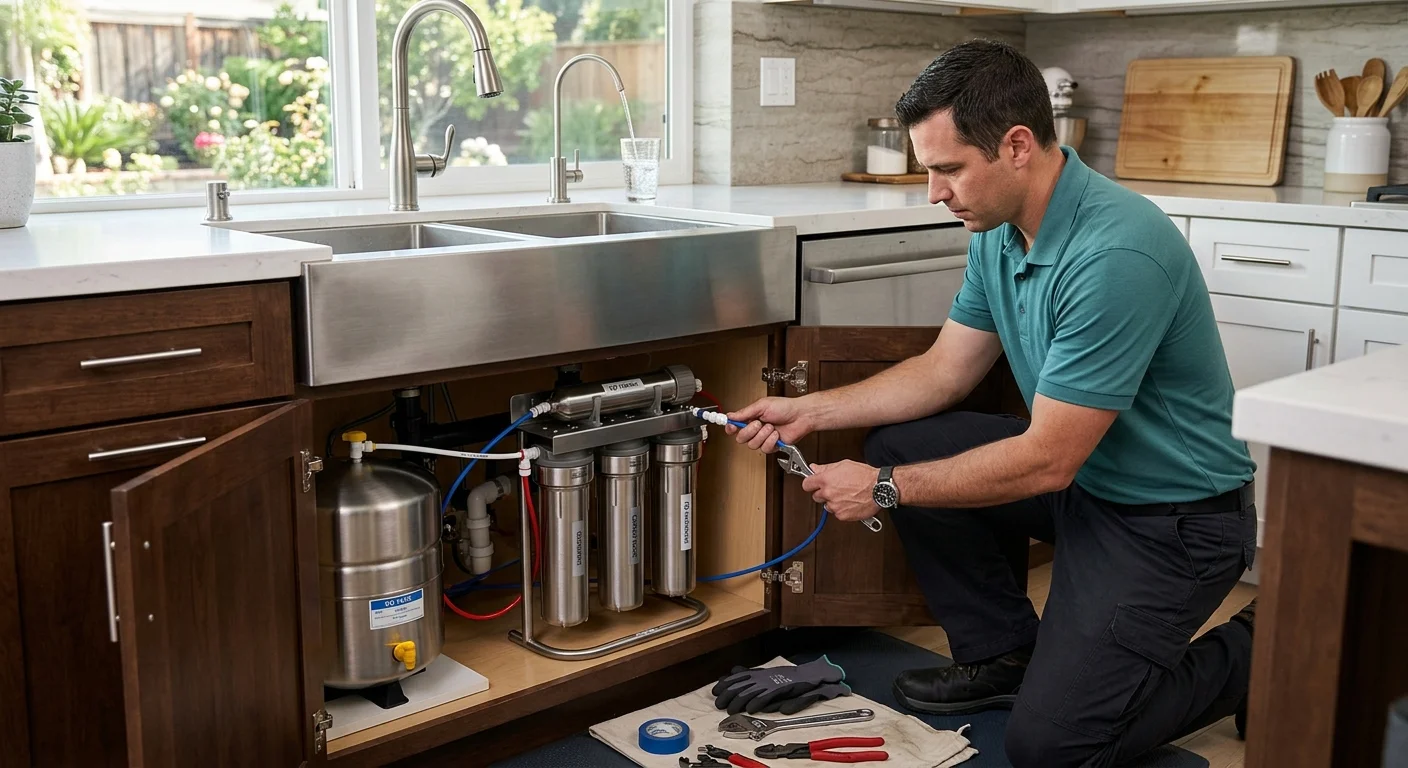
What reverse osmosis installation actually includes
Most reverse osmosis drinking water setups in this county are point-of-use. They treat one kitchen tap. They do not treat showers, laundry, or the hose bib.
NSF/ANSI 58 is the standard that covers reverse osmosis systems. That label is not a ranking. It does not prove a unit reduces every contaminant. Check the exact model’s certified reduction claims before anyone orders parts.
A typical install is a stack of plumbing work, not a pitcher swap. The licensed pro shuts the cold line under the sink, tees a feed to the unit, drills or uses an existing hole for a dedicated faucet, sets the storage tank, and runs a drain line for reject water. Some jobs add a fridge or ice-maker line. The first fill and a leak check happen on that visit in many kitchens. How long the visit lasts depends on the cabinet and the model. No one here promises a clock.
EPA’s home-treatment guidance is the right starting rule. Identify the goal from your serving utility’s report and from testing that fits the property. No single technology removes every contaminant. Reverse osmosis produces treated water and reject water. Performance and efficiency are model-specific.
City of San Diego water is hard on the city’s own publications, and those numbers are not interchangeable. The city’s plumbing page says drinking water in San Diego typically averages about 16 grains per gallon, or 276 ppm, and can range from 16 to 18 gr/gal, or 272 to 284 ppm, depending on demand and the area of the city. That figure is for the City of San Diego system only. It is not countywide, and it does not describe private wells. The city’s 2025 Consumer Confidence Report lists different hardness readings by treatment plant: Alvarado averaged 13.8 gr/Gal, Miramar 14.1, Otay 14.2, and purchased treated water 8.5. Those are 2025 plant and purchased ranges, not a tap result for every address. They are a different City publication covering a different measurement.
Helix Water District, which publishes for parts of East County, states that water at 10 or more grains is considered hard. It also states that imported Colorado River and State Water Project supply averages about 14 grains. That Helix line is about the imported supply, not your kitchen tap. Confirm the serving agency for the address, then read that agency’s current report. The San Diego County Water Authority is a useful regional starting point. Your retail report is still the document for the tap.
Kitchen reverse osmosis is a drinking-water job. Scale at the water heater is a different job. If you want both, ask the licensed pro for two scopes, not one vague package.
Under-sink layouts in San Diego kitchens
The hard part of reverse osmosis installation in San Diego is often the cabinet, not the membrane. Coastal condos in Pacific Beach, Downtown, and the South Bay stack a disposal, dishwasher box, and pull-out trash into a 36-inch sink base. Inland ranchers in Santee, El Cajon, and Escondido often have deeper cabinets and more room for a tank. North County tract kitchens in Mira Mesa, Oceanside, and Carlsbad vary house to house, even on the same street. Central-city remodels in North Park, Mission Hills, and Golden Hill can hide shutoffs behind finished panels.
Island sinks are a separate layout. Newer open plans in Carmel Valley, 4S Ranch, and parts of Chula Vista put the sink in an island with a long run back to a drain. The tank still needs a level, dry floor. The drain still needs a legal, leak-checked connection. The licensed pro should walk that path before anyone cuts a hole in a quartz top.
Measure the clear width, depth, and height with the cleaning bottles out. Note the garbage disposal, the dishwasher air-gap stem, and any existing filter already hogging the cold line. A tank that looked small on a product page can block the shutoff once it is in. If the fridge ice maker needs a line, that is extra tubing and another leak point, not a free extra.
Condo and HOA buildings add a paper step. Some associations want written notice before a new faucet appears on the deck. That rule is the association’s, not a county water rule. Ask the manager before the installer books the visit. Older copper or mixed piping in central neighborhoods can also change fittings. The pro confirms what is under the sink, not a catalog photo.
Private wells are another feed, not a city tap. This page does not establish how many county homes use wells. If the address is on a well, use a state-certified laboratory and match treatment to the lab result. Do not treat a neighbor’s city CCR as your well chemistry.
Drains, air gaps, and space to confirm first
Confirm three things before anyone buys a system: drain path, air-gap hardware if the model or the jurisdiction requires it, and actual cabinet volume. Skip that, and the unit sits in a box in the garage.
Reject water has to go somewhere. EPA’s WaterSense consumer page states that labeled reverse osmosis units demonstrate at most 2.3 gallons of reject water per gallon treated under its criteria. That is a label criterion, not every system’s field performance. EPA also gives national examples of five or more reject gallons per treated gallon, and up to ten for some inefficient units. Those are EPA national examples, not a measurement or a promise for the unit in your cabinet. Compare the exact model’s independently certified efficiency. Do not treat a website ratio as your bill.
Where that drain ties in is a local plumbing judgment. Some kitchens already have a dishwasher air gap on the sink deck. Some use a drain saddle on the tailpiece. Some models use an air-gap faucet. A countywide reverse-osmosis air-gap mandate could not be confirmed for this page. The licensed pro checks the model manual and the building department that covers the address. City of San Diego plumbing-permit pages list water-softener installation among qualifying Simple No-Plan plumbing work for eligible properties. That is City jurisdiction guidance for softeners. It is not a countywide reverse-osmosis permit rule, and it is not a fee schedule. Ask the installer and the city or county counter for the property. Do not guess a permit price.
Feed pressure, tank precharge, and which parts a homeowner may service are model-specific. Follow the exact manual. Persistent dripping at the drain, the tank, or the faucet stem is a reason to isolate the unit and call the installer, not a reason to open a pressurized housing. An existing unit that will not fill or that has gone dry is reverse osmosis repair in San Diego, not a new-install question.
Space is the other gate. Leave room to change prefilters without emptying the whole cabinet. Leave a path to the cold shutoff. If the only dry floor is next to a leaking disposal, fix the disposal first. Water filter installation in San Diego covers the broader under-sink pattern. Reverse osmosis is the version with a tank, a drain, and a dedicated faucet.
How to choose a licensed installer
Search interest in who installs reverse osmosis systems near me is really a license-and-fit question. The brand on this site is a referral service. It does not hold the contractor license, own trucks, or perform the work. The pros we send install the unit. You want a California license you can look up, a written scope for this kitchen, and a model whose NSF/ANSI 58 claims match the reason you want treatment.
Look the license up on the CSLB license check before you sign. Ask whether the person on site is the licensee or a worker under that license. Ask what the bid includes: faucet hole, drain connection, tank placement, fridge line, haul-away of an old unit, and the first set of filters. Ask what it excludes. A low number that skips the deck hole is not a bargain.
Bring the serving utility’s current report to that conversation. If taste and chlorine are the complaint, the certified claim on the carbon stage matters as much as the membrane. If fluoride reduction is the goal, CDC notes that reverse osmosis may reduce fluoride, and NSF/ANSI 58 treats fluoride reduction as an optional exact-model claim. The City of San Diego’s November 2024 water-quality FAQ describes adjustment to 0.7 ppm. That is a City target, not a countywide tap concentration. Other retailers and blends differ. Verify the current report.
Do not hire on a promise that the unit removes every contaminant. Do not hire on a health claim this page cannot source. Do not hire on a lifespan slogan. Ownership cost is filters, membrane service, and reject water, plus the install itself. EPA’s November 2024 home-treatment guide describes reverse osmosis and distillation as tending to cost a few hundred dollars and possibly requiring professional installation, with point-of-entry systems costing thousands. Those are EPA national planning categories, not a San Diego quote and not a Clear Water Pros price. For local planning ranges and what changes a bid, read reverse osmosis cost in San Diego, then confirm the current number with the licensed pro.
A plumber who only hangs a tank and a water-treatment installer who only sells a box are both incomplete. You want someone who can plumb the drain and select a certified model. A water softener is a different appliance at the main. This page is the kitchen drinking-water install.
What this visit cannot promise
An in-home water test and an install visit cannot certify that every tap in the house is safe. They cannot turn a kitchen RO unit into whole-house treatment. They cannot promise a waste ratio, a filter calendar that fits every address, or a medical outcome.
EPA notes that reverse osmosis can lower treated-water pH in treatment applications. That is a process note. It is not a household output range, a mineral benefit, or a taste guarantee. Actual pH depends on the system, the feedwater, and how the unit is run and maintained.
CDC is also clear on limits that people skip. Distillation and other home methods have different gaps. A generic filter is not proof of safe water or approved medical-device water. Match treatment to the identified problem. Test to confirm it worked before you treat the new tap as settled.
Manufacturer marketing lines such as “removes 99.99% of contaminants” are not used here. They are not verifiable as stated. NSF certification is claim-specific. Iron’s EPA secondary guideline of 0.3 mg/L is an aesthetic guideline, not a reason to assume reverse osmosis is the iron tool for every well. If the complaint is rust or sulfur on a well, that is a different diagnosis.
No one on this site promises same-day arrival, a brand price, or a warranty that belongs to the manufacturer. Filter and membrane replacement follow the model manual and the water you actually have. A unit that is never serviced is just a tank under the sink.
If hardness at the heater is the real problem, say so on the test visit. Kitchen reverse osmosis will not soften the shower. If drinking water at one tap is the real problem, this is the right job.
When to call us
Call when you want a licensed reverse osmosis installer for a San Diego County kitchen, and you need the cabinet, drain, and certified claims checked before anyone cuts a hole. Call when an old under-sink unit is leaking, sitting in bypass, or due for a model that matches your current water report. Call us at (858) 400-4647 to set up a free in-home water test.