The dedicated faucet on the sink just sighs. Ice from the fridge line tastes off, or the tank never seems to refill. That is a point-of-use reverse osmosis problem, usually under a San Diego kitchen sink. Clear Water Pros SD connects you with a licensed water-treatment or plumbing pro. The brand does not repair RO systems itself.
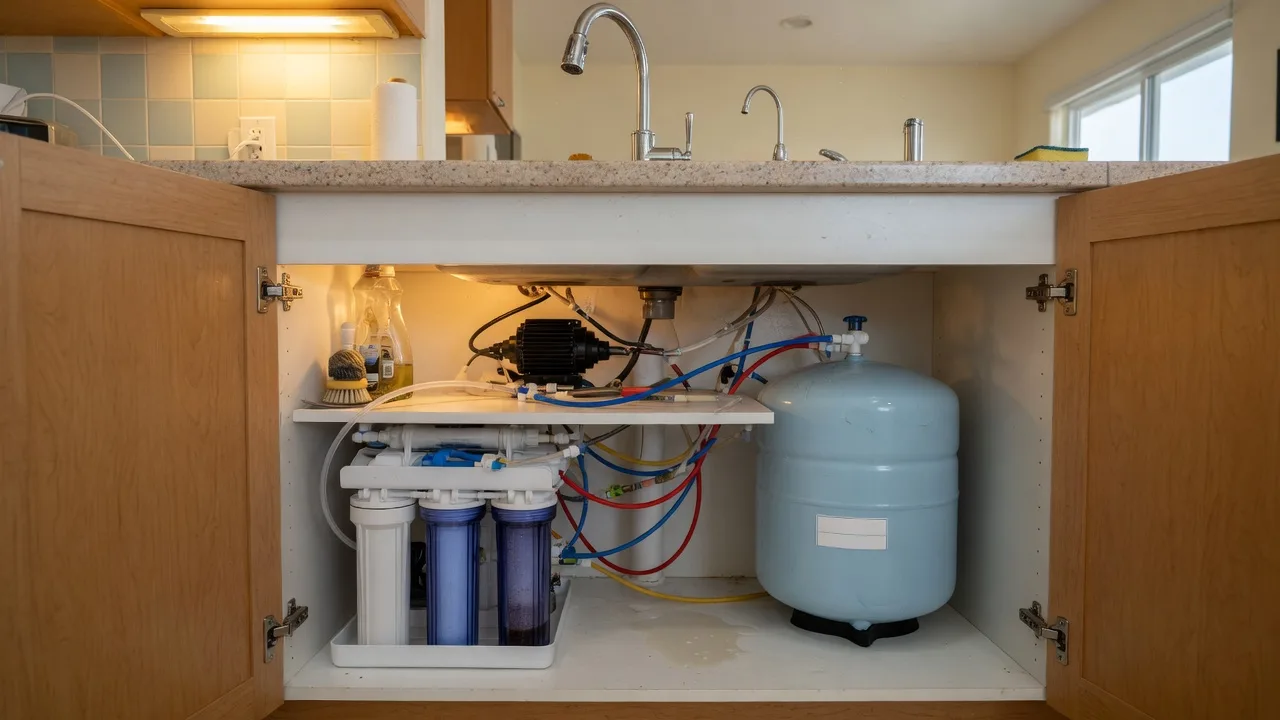
What you are actually repairing
Most reverse osmosis drinking water setups in this county treat one kitchen tap. They do not treat showers or the hose bib. NSF/ANSI 58 is the standard that covers reverse osmosis systems. The label is not a ranking. Check the exact model’s certified reduction claims.
EPA’s home-treatment guidance: identify the goal from your serving utility’s report and from testing that fits the property. No single technology removes every contaminant. An RO system produces treated water and reject water. Performance and efficiency are model-specific.
EPA’s WaterSense consumer page says labeled units demonstrate at most 2.3 gallons of reject water per gallon treated under its criteria. That is a label criterion, not every system’s field performance. EPA also gives national examples of five or more reject gallons per treated gallon, and up to ten for some inefficient units. Those are national examples, not a measurement of your cabinet.
Who installs reverse osmosis systems in San Diego covers a new install. This page is the unit that is already there and has stopped behaving.
Manufacturer troubleshooting categories, not a universal spec
Crystal Quest’s reverse osmosis troubleshooting page, captured for our claims ledger, lists common causes of no water or low flow:
- Clogged pre-filters
- Low feed pressure (that manufacturer discusses a 35 to 60 PSI window)
- Kinked tubing
- Storage-tank air charge (that manufacturer cites about 5 to 8 PSI on an empty tank, often around 7 PSI)
- Auto shut-off valve faults
Treat those numbers as that manufacturer’s guidance. They are not a universal spec. The exact model manual controls pressure, tank precharge, and which parts a homeowner may service. Do not invent a repair price.
A San Diego under-sink cabinet is a tight, wet workplace. Disposal leaks, a garbage-cramped trap, and a fridge line tee all crowd the tank. If the only dry floor is next to a leaking disposal, fix the disposal first.
Hard water is the context, not the diagnosis
City of San Diego drinking water typically averages about 16 gr/gal (276 ppm) on the City plumbing page, ranging 16 to 18 gr/gal by area and demand. That is the City system only. The City’s 2025 Consumer Confidence Report lists different hardness averages by plant: Alvarado 13.8 gr/Gal, Miramar 14.1, Otay 14.2, purchased treated water 8.5. Those are 2025 plant and purchased ranges, not every tap.
Hardness scale on a prefilter, or a tank that never fills because the feed is restricted, shows up faster on those taps than on a soft well. A well in Ramona is a different feed. Test that well. Do not copy City numbers onto it.
RO can lower treated-water pH in treatment applications, per EPA’s treatment-technology overview. That is process scope. It is not a household output range or a health claim.
If the complaint is taste after a carbon stage, that can be a different unit. This page stays with the RO faucet that is weak, noisy, or dry.
Safe homeowner checks
Close the feed valve. Open the RO faucet to relieve pressure before anyone twists a housing. Then, only if the manual allows it:
- Look for kinks in the colored tubing
- Check that the tank valve is open
- Note the last filter-change date on the housings
- Look for drips at housings, the drain saddle, and the tank valve
Do not open a pressurized housing. Do not adjust a tank air charge unless the model manual says a homeowner may, and you have a gauge. Crystal Quest’s PSI figures are theirs.
EPA cost categories from the November 2024 home-treatment guide: RO and distillation systems tend to cost a few hundred dollars and may need professional installation. That is a national category, not a San Diego repair quote.
Frequently asked questions
Why is my reverse osmosis faucet so slow?
Clogged pre-filters, low feed pressure, a tank that has lost its air charge, or a failing auto shut-off are the categories Crystal Quest lists. A licensed pro should confirm against the model.
Does a slow RO mean the membrane is dead?
Not by itself. Prefilters clog first on many kitchens. The membrane is a later suspect after feed pressure and prefilters are in spec.
Can Clear Water Pros SD fix it today?
The brand books the visit and refers a licensed provider. Response times are not a verified claim on this ledger. The pro you hire sets the schedule.
Book the under-sink visit
Call (858) 400-4647 when the dedicated faucet is dry, the tank never fills, or the unit is leaking into the cabinet. We will connect you with an independent local water-treatment professional after a free in-home water test if you want the feedwater checked first.