A Valley Center well can supply one home while a nearby property receives district water. That difference changes which report to read, what to test, and how to choose treatment.
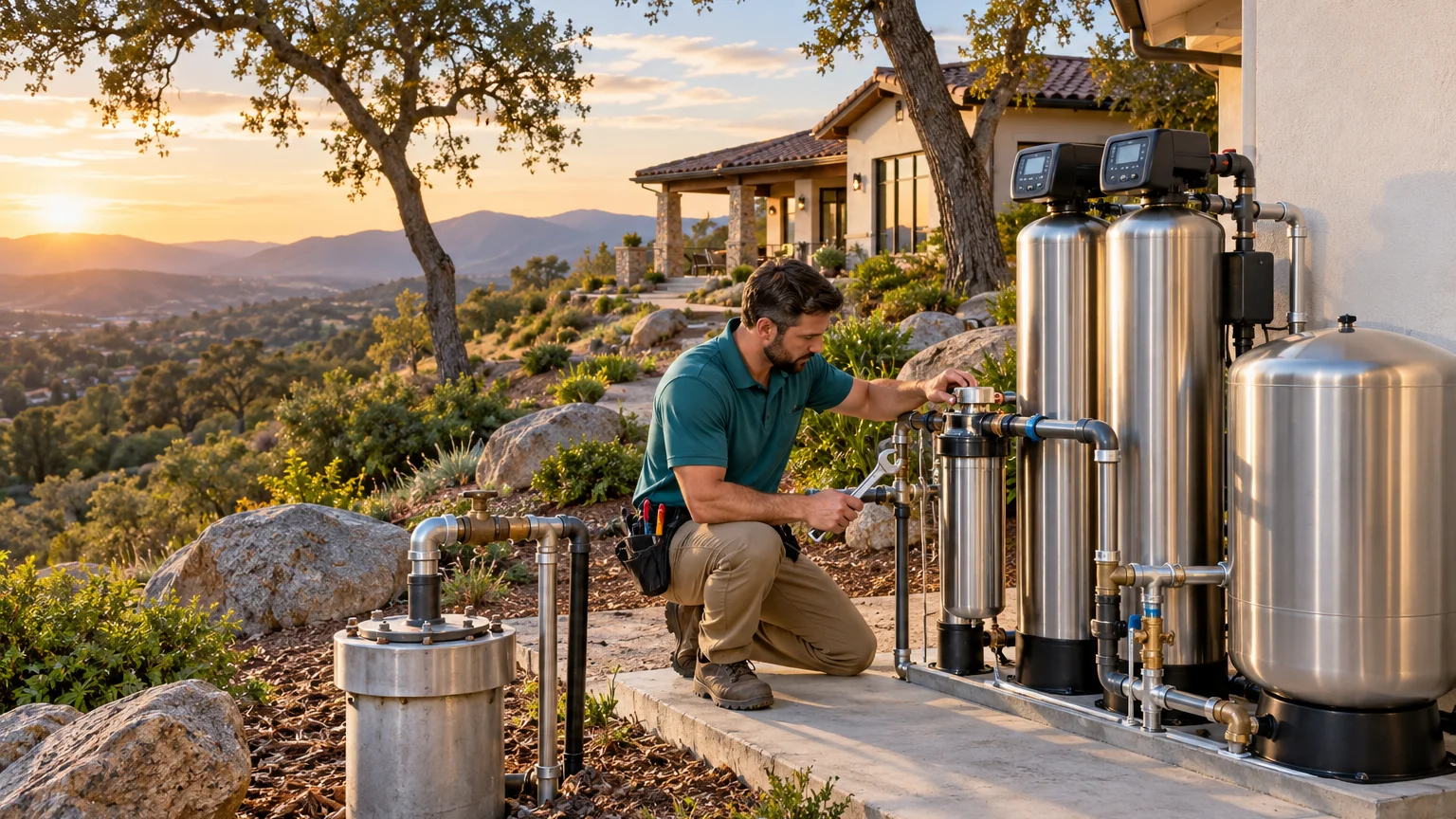
Valley Center well water filtration should begin with a state-certified laboratory. A licensed pro can then match the equipment to the results. Color, odor, scale, or sediment can guide the investigation, but none proves what’s in the water.
Valley Center Municipal Water District vs private wells
Start by identifying who supplies the property. Valley Center Municipal Water District publishes water-quality information for the public water it serves. That information doesn’t describe every private well in Valley Center, Pauma Valley, or the surrounding inland North County hills.
A district customer should read the current Valley Center Municipal Water District report and notices. Confirm that the service address falls within the report’s scope. Supply conditions and reporting periods matter, so an older report shouldn’t replace the current one.
A private well owner is responsible for testing the water. EPA rules for public systems don’t apply to privately owned wells. A report from VCMWD, the City of San Diego, or another utility can’t establish the condition of a private 92082 well.
Don’t rely on the mailing address alone. A Valley Center address doesn’t prove that the home uses VCMWD water. Look for a district bill, well equipment, or property records. A visible pressure tank can suggest a private system, but paperwork and a qualified inspection provide better confirmation.
The distinction also affects treatment planning. A public-water customer can begin with the serving utility’s report and address-specific concerns. A private-well owner needs representative testing from that well. If the home switches between sources, tell the laboratory and the treatment pro.
No verified, property-level figures for arsenic, nitrate, iron, sulfur, or hardness across Valley Center could be confirmed from the approved sources. Those values shouldn’t be guessed from neighboring wells. Test the actual supply before selecting equipment.
Tests that matter before you treat a VC well
CDC recommends that private wells receive annual tests for total coliform, nitrate, total dissolved solids, and pH. Use a state-certified laboratory. Ask San Diego County environmental health staff which additional tests fit the location, well history, and nearby land use.
Testing also matters after flooding, well repairs, or a noticeable change in taste, color, or smell. Pregnancy or a child moving into the home are other reasons CDC gives for discussing additional testing. Your laboratory can explain sampling containers, tap preparation, holding times, and delivery.
A free in-home water test can help start the treatment conversation. Confirm its scope with the provider. An in-home screening isn’t automatically a certified laboratory analysis, and it shouldn’t be treated as clearance for every contaminant.
Total dissolved solids readings need context. EPA’s secondary guideline is 500 mg/L, but that addresses aesthetic and technical concerns. It isn’t a universal drinking-safety cutoff. A conductivity meter or TDS estimate also can’t identify individual substances.
Coliform results need careful interpretation. Total coliform is an indicator, not identification of every pathogen. CDC says fecal coliform or E. coli likely means feces entered the well. If testing finds harmful germs or chemicals, don’t drink the water until it’s treated. Contact the health department or a well-water contractor, then test again before resuming use. Boiling can kill germs, but it doesn’t remove chemical contamination.
Record the sampling date, laboratory, result, reporting limit, and treatment status. Keep the untreated result beside any follow-up result. That creates a useful baseline for the licensed pro and future property owner.
Whole-house options that follow the lab results
No single treatment method addresses every well-water problem. The right whole-house water filtration system follows the laboratory findings, household demand, plumbing layout, and equipment instructions.
Sediment filtration can protect downstream equipment when testing and inspection identify suspended material. Iron treatment depends on the form and concentration found. Approved evidence supports oxidation followed by filtration as one possible category, but it doesn’t establish one system for every well.
Odor also needs diagnosis. Hydrogen sulfide can originate in the well, plumbing, or water heater. Note whether the odor appears at hot taps, cold taps, or both. A rotten-egg smell doesn’t prove sulfur bacteria or identify a treatment by itself.
Ultraviolet treatment may be considered when microbial control is the identified goal. A licensed pro must size and configure the system around the tested water and the exact equipment requirements. UV shouldn’t be presented as treatment for dissolved chemicals.
Ion-exchange softening addresses calcium and magnesium hardness. NSF/ANSI 44 covers certified ion-exchange softeners that reduce those hardness minerals. Softening doesn’t prove removal of arsenic, nitrate, microbes, or every other contaminant. Salt-free conditioning also doesn’t remove hardness ions.
Reverse osmosis is usually a point-of-use option for a selected tap. NSF/ANSI 58 covers reverse osmosis systems, but certification isn’t a blanket promise. Check the exact model’s certified reduction claims.
Compare maintenance, replacement filters, water use, drainage, and bypass requirements. With private wells, treatment can interact with pumps, pressure tanks, and septic systems. EPA advises septic-property owners to ask the septic manufacturer or local service provider about capacity, performance, and warranty implications before adding a softener.
How Valley Center differs from Escondido and Ramona
Valley Center, Escondido, Hidden Meadows, and Ramona shouldn’t share one assumed water profile. They may all appear in inland North County searches, but a nearby city’s utility report or private-well result doesn’t transfer to a Valley Center parcel.
For a 92082 hill property, establish the source first. Then use the serving utility’s current report or test the private well. Pauma Valley properties need the same address-specific check. The community name alone can’t establish the water source, well construction, or chemistry.
Our guide to Escondido and Hidden Meadows well water filtration covers that area’s source-checking process. The Ramona well water filtration guide addresses Ramona separately. Those pages can help you organize questions, but their local findings shouldn’t be copied into a Valley Center treatment plan.
This distinction matters when a neighbor reports staining, scale, odor, or a specific lab result. Nearby observations can justify testing. They don’t establish what’s present in your well. Depth, construction, maintenance history, plumbing, storage, and treatment already installed can change what reaches a tap.
Separate water-quality problems from well-production problems too. Weak pressure, pump cycling, air at faucets, or declining yield may involve the well, pump, pressure tank, or plumbing. Clear Water Pros SD doesn’t drill or rehabilitate wells. A licensed well contractor should assess production and well construction. A licensed Water Filtration pro can evaluate treatment after testing identifies the water concern.
That division prevents filtration equipment from being sold as a cure for a mechanical well problem. It also keeps pump work from replacing a needed laboratory investigation.
County and VCMWD pages to verify
Use current agency information before ordering equipment. For public water, find the Valley Center Municipal Water District Water Quality page. Confirm the report year, covered system, source information, detected substances, and any active notices.
Private-well owners should find San Diego County’s Private Wells program page. Ask the county which environmental health office handles the property and what records or local testing guidance apply. Agency names and page locations can change, so begin at the official county website rather than an old saved document.
The California State Water Resources Control Board’s Domestic Wells pages provide state-level information. They don’t replace an address-specific laboratory result or county guidance. The San Diego County Water Authority can help identify regional water information, but it doesn’t certify the condition of a private well.
When comparing providers, verify the license connected to any contracted installation through the California Contractors State License Board. Clear Water Pros SD is a referral service. The homeowner contracts with and pays the separately licensed provider directly.
Bring these items to the consultation:
- The current laboratory report and sampling date
- The serving utility’s current report, if applicable
- Well, pump, pressure-tank, and treatment records
- Photos of staining, sediment, or visible equipment
- Notes about hot-only, cold-only, or whole-house symptoms
- The exact models and replacement elements being compared
Ask the pro to connect each treatment stage to a result. For certified equipment, verify the exact model and reduction claim. Also request the maintenance schedule, replacement-filter requirements, water use, drainage needs, and follow-up testing plan in writing.
When to call us
Call when a Valley Center or Pauma Valley well needs testing before filtration is selected, or when an existing system no longer matches the lab results. We’ll connect you with a licensed Water Filtration pro who can review the property and explain suitable options. Call us at (858) 400-4647 to set up a free in-home water test.