Coffee on a Village balcony still starts at a City of San Diego tap. In 92037 that water is municipal, treated, and reported at the city system. The kitchen that serves it may be a tight condo cabinet off Prospect Street or a wide island on Mount Soledad.
Where La Jolla tap water comes from
La Jolla sits inside the City of San Diego. Bird Rock, the Village, the Muirlands, and Mount Soledad share that utility, ZIP 92037. The City of San Diego Public Utilities Department treats and delivers the water. The 2025 Consumer Confidence Report names the system as Public Water System 3710020.
The mix is imported water plus local reservoir water. Imported supply comes from the Colorado River and the State Water Project. Helix Water District, writing about that imported supply the region buys, says water with 10 or more grains of hardness is considered hard, and that the imported Colorado River and State Water Project supply averages about 14 grains. That is a statement about the purchased supply. It is the figure for a given La Jolla kitchen only after you match your address to the City’s current report.
City plants named in the 2025 report are Alvarado, Miramar, and Otay, plus purchased treated water. This page could not confirm which plant serves every 92037 block. Coastal north of downtown often tracks with Miramar in local conversation. Confirm it on the City’s water-quality pages for your street. Do not copy a neighbor’s plant name from a group chat.
Hardness in City publications is measured two ways, and both are City documents. The City’s home-plumbing page, read for this ledger, says drinking water in San Diego typically averages about 16 grains per gallon, or 276 ppm, and can range from 16 to 18 gr/gal, or 272 to 284 ppm, depending on water demand and the area of the City you live in. The 2025 Consumer Confidence Report lists plant totals in grains per gallon: Alvarado average 13.8 (11.9 to 15.8), Miramar 14.1 (11.7 to 16.6), Otay 14.2 (11.7 to 15.8), and purchased treated water 8.5 (3.18 to 13.6). Those are different City publications covering different measurements. Neither one is a private-well figure, and neither one is a tap result for every La Jolla address.
You drink City water here. Well-water pages for Fallbrook or Hidden Meadows do not describe a Prospect Street condo. For source mix, treatment, and current notices, start with the City water-quality portal and the San Diego County Water Authority water-quality page. Then look at the glass in your own kitchen.
Taste, chloramine, and hardness in 92037
Taste at the tap is what sends most 92037 kitchens looking at reverse osmosis drinking water. Scale on a glass shower in Bird Rock is a hardness story. A pool-like smell in a Muirlands kettle is often a disinfection story. Those are different jobs. An under-sink RO unit treats the drinking and cooking tap. It does not treat the whole house.
The disinfectant in use, the residual, and disinfection byproducts belong in the serving utility’s current report. CDC notes that water treated with chlorine can taste and smell different from water treated with chloramine, and that the report is how you identify the disinfectant. This page does not assume a countywide disinfectant or a La Jolla-only residual. Open the City report for the year you are in and read the disinfectant table for your system.
Hardness is the part you can see on fixtures. At 10 grains and above, Helix calls the water hard. City of San Diego taps, on the plumbing page quoted above, sit in a 16 to 18 grain band that varies by area and demand. USGS classifies hardness as calcium carbonate: 0 to 60 mg/L soft, 61 to 120 moderately hard, 121 to 180 hard, and over 180 very hard. That is classification guidance. It is not a home-safety certification and it is not a prediction of appliance life on Soledad Mountain Road.
People still ask if they can drink the tap in La Jolla. City water is treated to meet EPA limits under the Safe Drinking Water Act, with California’s Division of Drinking Water adding its own limits. The City publishes the results in the annual report. The 2025 report is the edition fetched for this site. Read the current year before you treat a headline as the last word. For a walkthrough of how to read those tables, use our page on whether San Diego tap water is safe alongside the City PDF.
Fluoride is a City target, not a promise at every 92037 faucet. The City FAQ posted in November 2024 describes adjustment to 0.7 ppm. Treated Water Authority supply, blends, and other supplies differ. CDC home-treatment guidance says reverse osmosis may reduce fluoride. NSF/ANSI 58 treats fluoride reduction as an optional claim on the exact model. Details live on does San Diego water have fluoride.
Hexavalent chromium is in the same 2025 City report. The California MCL is 10 ppb. Alvarado, Miramar, and Otay show ND. Purchased treated water shows an average of 0.1 ppb and a range of ND to 0.4 ppb. Those rows describe the City system that year. They are not a lab slip for your kitchen.
Under-sink RO in village condos vs Soledad houses
Point-of-use reverse osmosis treats a selected tap. Point-of-entry equipment treats water as it enters the residence. EPA’s home-treatment guide is blunt: identify the goal first, because no single technology removes every contaminant. NSF/ANSI 58 is the standard that covers reverse osmosis systems. NSF/ANSI 42 covers certified aesthetic reduction claims. NSF/ANSI 53 covers specified health-effect contaminant claims. A standard is not a ranking. Verify the exact model’s certified reduction claim before you buy.
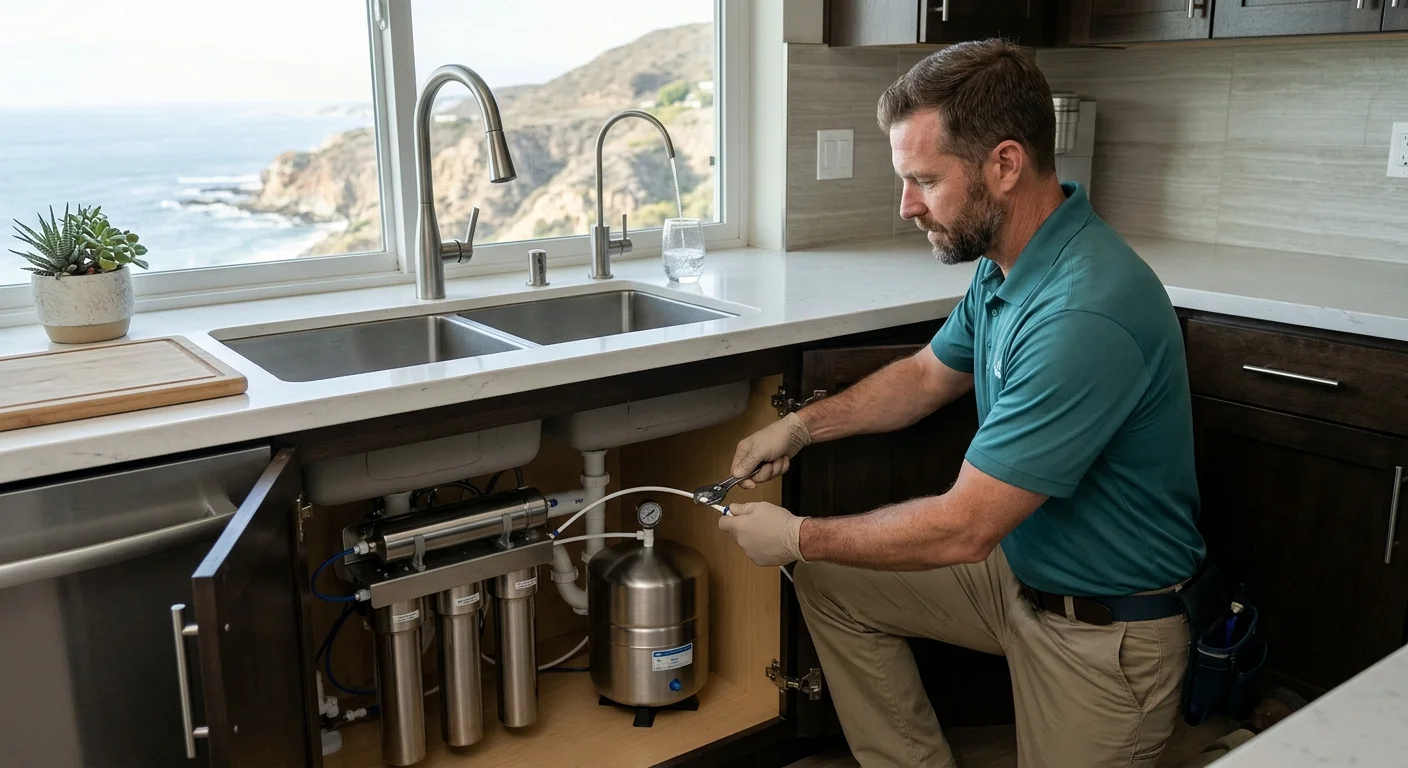
Village and Bird Rock condos are the tight case. Cabinets off Girard, Pearl, and Coast are shallow. A disposal, a dishwasher shutoff, and a trash bin already share the space. An under-sink RO stack needs a cold-line tee, a drain connection for reject water, a storage tank in many models, and a hole for a dedicated faucet. In a stacked building, the HOA and the board’s rules on drilling stone and tying into the waste line matter as much as the tank diameter. A licensed pro should see the cabinet before anyone orders a system. Under-sink drinking water filtration is the right scope conversation when the whole house is off the table.
Mount Soledad and Muirlands houses usually give the cabinet more air. Islands and wider bases make tank placement easier. The drinking job is still the kitchen cold line. Longer hillside pipe runs change flow at distant baths. They do not turn a drinking faucet into whole-house treatment. If scale on glass and a tankless heater are the complaint, that is a different system, sized from measured hardness and use.
RO always sends water two ways: treated water to the faucet, reject water to the drain. EPA’s WaterSense consumer page states that labeled units demonstrate at most 2.3 gallons of reject water per gallon treated under its criteria. That is a label criterion, not field performance for every install. EPA also gives national examples of five or more reject gallons per treated gallon, and up to ten for some inefficient units. Compare the exact model’s efficiency. EPA WaterSense is the place to read the label language.
Downsides belong on the same page as the sales pitch. RO can lower treated-water pH in treatment applications. Exact home output depends on the system, the feedwater, and upkeep. EPA is also clear that an RO system produces treated and reject water, and that performance is model-specific. This page has no verified medical source on kidney effects from drinking RO water. If you have a kidney condition or a restricted mineral diet, ask your physician before you change what you drink.
Filter and membrane changes are part of ownership cost. Follow the manufacturer’s interval for that model. Pitcher and tap filters, RO, and point-of-entry systems sit in different EPA cost categories in the November 2024 home-treatment guide. Those are broad national categories. They are not a La Jolla quote.
A licensed Water Filtration or plumbing pro does the install. Clear Water Pros SD connects you with that pro. You contract with the pro directly. For who actually puts the faucet in, read who installs reverse osmosis systems in San Diego. Check the license on the CSLB license lookup before work starts.
What an in-home test still adds
The City report is the right first document. It is still a system report. It does not measure the line in your wall, the leftover fridge filter, or the sediment sitting in a Village building’s recirculating loop. EPA’s home-treatment guide says to identify treatment goals using the serving utility’s report and appropriate testing, and to keep utility data on its own service area.
A free in-home water test is how we start that conversation in 92037. The offer is a visit to test at the tap and walk the kitchen with a licensed pro. It is not a state-certified laboratory panel, a contaminant-safety clearance, or a promise that one device handles every analyte. Ask the pro what the visit actually measures. If you need a certified lab, use a state-certified laboratory and ask the County or the City which extra tests fit the property.
Condo kitchens need the tape measure as much as the sample vial. Tank height, drain access, shutoff condition, and whether the sink deck has a spare hole decide the model more than a plant average. Soledad houses still benefit from a hardness reading at the house, because City hardness varies by area and demand.
Bring the current Consumer Confidence Report to that visit. Match the disinfectant, hardness method, and any optional claims you care about, fluoride included, to the NSF listings on the exact unit. Include replacement-filter cost when you compare ownership. Salt-free conditioning and softeners are whole-home hardness tools. They are a separate decision from an under-sink RO faucet.
City of San Diego pages to verify
Keep the City in the loop. Screenshots from a national database go stale. These are the pages to open for a 92037 address.
The City water-quality portal points to the current report and notices. The 2025 Consumer Confidence Report is the edition this site fetched, with the plant hardness, sodium, and hexavalent chromium rows cited above. Look for a newer year when the City posts it.
The City’s page on water and your home plumbing is the source of the 16 grain typical figure and the 16 to 18 grain range. Use it with the area-and-demand qualifier. The Water Authority water-quality page explains imported supply at the regional level.
City Development Services lists water-softener installation among Simple No-Plan plumbing work for eligible properties. That is City jurisdiction guidance for softeners. This page could not confirm a separate published RO-only permit rule. Ask the licensed pro which permit path applies to your building, especially in an HOA.
If a health limit or a treatment claim matters to you, pair the City PDF with EPA and NSF. EPA sets federal drinking-water limits. California DDW adds state limits. NSF/ANSI 58 is the RO standard. The model label is the claim you can hold in your hand.
When to call us
Call when you want drinking water treated at one La Jolla tap and you need a licensed Water Filtration pro to see the cabinet, the drain, and the City report together. Village condos and Soledad houses need that site check before anyone picks a tank. Call us at (858) 400-4647 to set up a free in-home water test.