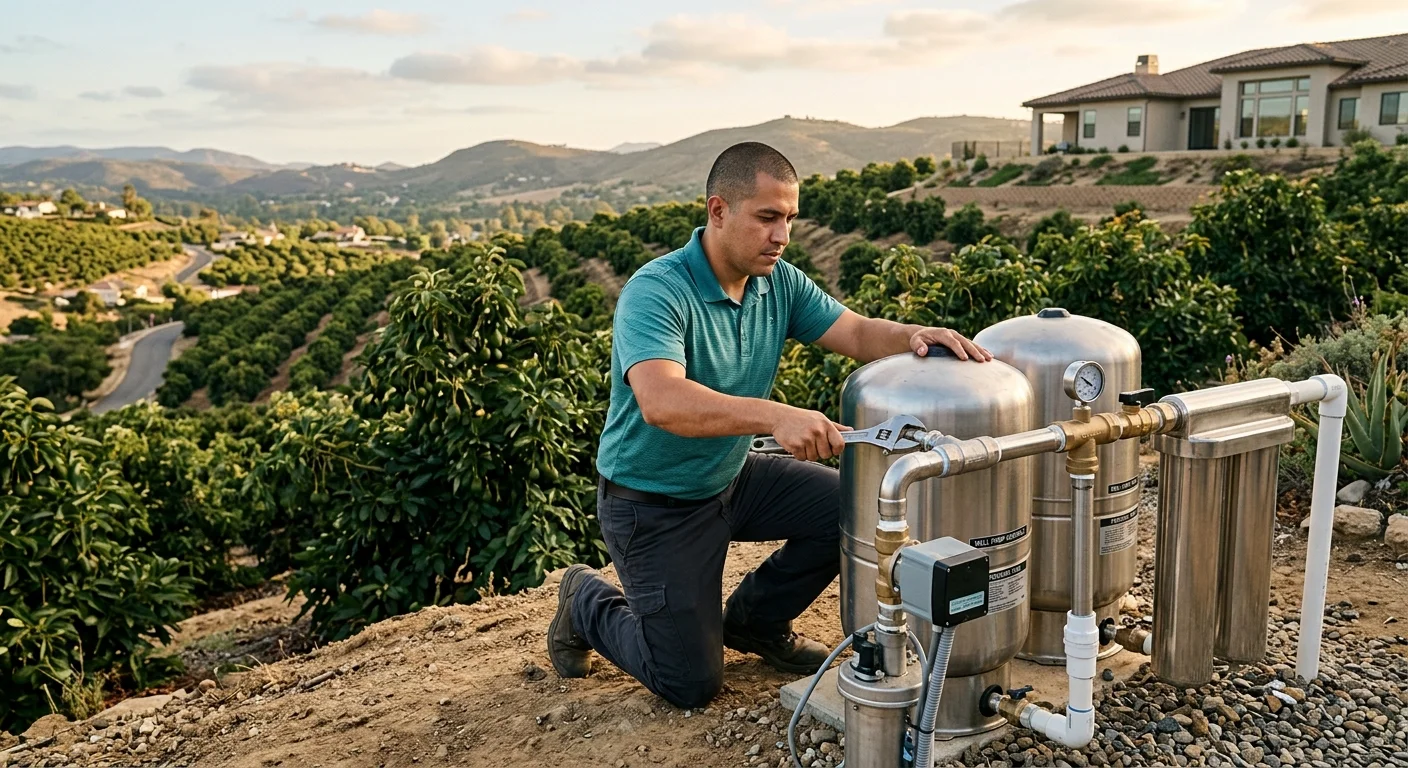
A private well on a Fallbrook hillside, a Rainbow grove parcel, or a Bonsall ranch is its own small water system. Rainbow Municipal Water District and Fallbrook Public Utility District publish quality reports for metered customers. Those pages do not describe the well, pressure tank, and piping on a private lot. Fallbrook well water filtration starts with a state-certified lab panel, then a licensed pro matches treatment to what that panel actually shows.
City water vs private wells around Fallbrook and Rainbow
Inland north county mixes district meters and private wells more than coastal San Diego. Rainbow Municipal Water District covers Rainbow and a wide unincorporated belt along I-15. Fallbrook Public Utility District serves the Fallbrook town core. Bonsall sits in the same agricultural hills. Plenty of homes there draw from a well even when the next driveway is on a meter.
A district customer drinks water that already went through a treatment plant. Plants use steps the serving utility sets, including filtration and disinfection. A private well does not get that plant process. Soil and rock over an aquifer can strain out some particles. That natural path is not a treatment plant, and it does not lock in drinking-water chemistry. Rainbow well water and Fallbrook water filtration for a metered house are different jobs.
The City of San Diego publishes hardness figures for its own system. One City plumbing page says drinking water there typically averages about 16 grains per gallon, or 276 ppm, and can range from 16 to 18 grains depending on demand and area. The City’s 2025 Consumer Confidence Report lists plant hardness ranges for Alvarado, Miramar, Otay, and purchased treated water. Those numbers describe City of San Diego taps. They do not describe a Fallbrook well, a Rainbow well, or a Bonsall well.
Helix Water District publishes that water at 10 or more grains per gallon is considered hard, and that imported Colorado River and State Water Project supply averages about 14 grains. That is a statement about imported supply, not about a well on an avocado lot. Do not copy a City or East County figure onto a north county well.
Confirm who serves the address before you buy equipment. Some parcels can connect to Rainbow MWD or FPUD. Some stay on a well. Some keep a well for irrigation and a meter for the house. Searchers looking up water filtration San Diego on city mains and well owners in these hills are solving different problems. Pull the current Rainbow MWD water quality report or the FPUD report if you are on a meter. Treat a well as untreated source water until a lab says otherwise.
Tests that matter before you treat a north county well
CDC guidance for wells is to use a state-certified laboratory. Ask San Diego County environmental health staff and the State Water Board which extra tests fit the location. CDC recommends annual testing for total coliform, nitrate, TDS, and pH.
Nitrate has many possible sources. CDC lists animal waste, septic systems, wastewater, flooded sewers, polluted stormwater runoff, fertilizers, farm runoff, decaying plants, and local geology. That list is about possible sources. It is not a reading for your well. Grove irrigation, septic tanks on large lots, and livestock can sit near wells in this belt. A lab result is the only way to know whether nitrate is present.
Local arsenic, iron, and sulfur levels for Fallbrook, Rainbow, and Bonsall wells could not be confirmed from the verified sources we hold. Do not size media from a neighbor’s story or a countywide guess. If fixtures stain, EPA’s secondary guideline for iron is 0.3 mg/L. EPA ties that number to rusty color, sediment, metallic taste, and reddish or orange staining. It is an aesthetic federal guideline, not a Fallbrook well measurement.
A rotten-egg odor can come from hydrogen sulfide in the well, the plumbing, or the water heater. Trace the source before you buy sulfur media. Our guide to a rotten-egg smell in well water walks that path without guessing a local sulfur number.
A positive total-coliform result is an indicator. It does not name every pathogen. Harmful or suspected contamination calls for another safe water source and health-department guidance. Boiling does not remove chemical contamination. Match treatment to the identified problem, then test again to confirm it worked before you go back to using the well as usual.
TDS is a dissolved-solids screen. EPA’s secondary TDS guideline is 500 mg/L for aesthetic and technical concerns. It is not a drinking-safety cutoff. It does not prove other contaminants are absent.
Clear Water Pros SD can arrange a free in-home water test. Ask the provider what that visit actually measures. An in-home screen is a starting point. It is not a substitute for a state-certified well panel when you need coliform, nitrate, or metals. Identify the water concern first. Then size treatment.
Whole-house options that follow the lab results
Once the lab is in, treatment follows the result. EPA’s home-treatment guidance is plain: no single technology removes every contaminant. Point-of-entry systems treat water entering the residence. Point-of-use devices treat a selected tap, often the kitchen cold line.
Whole-house water filtration is the point-of-entry path most well homes look at when sediment, iron, odor, or hardness shows up at every fixture. A licensed pro may stack steps: a sediment prefilter, iron or sulfur media, a softener or conditioner, carbon, reverse osmosis at the sink, or UV after a microbial finding. UV, iron treatment, sulfur treatment, and softening are options the pro sizes after the test. They are not a default package for every Fallbrook well.
NSF/ANSI 42 covers certified aesthetic reduction claims. NSF/ANSI 53 covers specified health-effect contaminant claims. NSF/ANSI 44 covers ion-exchange softeners that reduce calcium and magnesium hardness. NSF/ANSI 58 covers reverse osmosis systems. A standard is not a performance ranking. Verify the exact model’s certified reduction claim.
Ion-exchange softening adds sodium at about 8 mg/L for each grain per gallon of hardness removed, per University of Nebraska–Lincoln Extension. People on restricted sodium diets should talk with a physician. Drinking and cooking water is often taken from a kitchen cold line that bypasses the softener. Salt-free conditioning does not remove hardness ions. Evaluate the exact scale-reduction claim.
If the property uses a septic system, EPA advises checking with the septic manufacturer or local service provider before installing a softener. That check is about overload, warranty, and system performance. It is not a local ban. Softener restrictions in Fallbrook or Rainbow were not confirmed in our verified sources.
Reverse osmosis produces treated water and reject water. EPA notes some inefficient point-of-use units can send five or more gallons of reject water per treated gallon, and up to ten. WaterSense labeled units demonstrate at most 2.3 gallons of reject water per gallon treated under its criteria. That is a label criterion, not field performance for every model. Compare EPA WaterSense listings for certified efficiency. An under-sink RO unit does not treat showers, laundry, or hose bibs.
EPA’s November 2024 guide to selecting home treatment describes basic pitchers and tap filters as typically under $100, RO and distillation as tending to cost a few hundred dollars and possibly needing professional installation, and point-of-entry systems as costing thousands and generally requiring professional installation. Those are national category notes from that guide. They are not a Clear Water Pros SD price and not a quote for Bonsall well water treatment. Filter replacements, salt, media, and the written scope set the real ownership cost.
How this stretch differs from Escondido wells
Escondido and Hidden Meadows sit south of this belt, with their own mix of city service and canyon wells. We covered that pattern in Escondido and Hidden Meadows well water filtration. Fallbrook, Rainbow, and Bonsall are the agricultural north edge of the county. Lots are larger. Avocado and citrus groves are part of the landscape. A well here often shares a hillside with irrigation piping, a septic system, and a pressure tank in a garage or pump house.
The municipal neighbor is Rainbow MWD or Fallbrook Public Utility District, not the City of Escondido. That changes which Consumer Confidence Report you read if the house is on a meter. It does not tell you the chemistry of a private well two parcels over.
We do not have a verified hardness ranking that says this stretch is harder or softer than Escondido wells. A countywide typical hardness number is not a figure we can state. USGS classifies hardness as calcium carbonate: 0–60 mg/L soft, 61–120 moderately hard, 121–180 hard, and over 180 very hard. That is classification guidance. It is not a Fallbrook tap result and not a prediction of treatment need.
Treatment still follows the lab. A Hidden Meadows well and a Rainbow well can need different media even when both sit in inland north county. Copying a neighbor’s tank setup is a common way to overspend on the wrong stage.
County and Rainbow MWD pages to verify
Start with the serving agency if you have a meter. Rainbow Municipal Water District publishes water-quality information for its customers. Fallbrook Public Utility District does the same for the Fallbrook system. Read the current report for the year and the system that actually serves the address. Rainbow MWD water quality pages describe Rainbow MWD taps. They do not stand in for a well sample.
For a private well, San Diego County Department of Environmental Health and Quality well programs are the local place to ask about well construction, destruction, and testing advice. The State Water Board Division of Drinking Water sets statewide drinking-water rules for public systems. A domestic well is not a public water system. County and state staff can still point you to certified labs and extra analytes that fit the area.
The San Diego County Water Authority explains imported supply for member agencies. That is useful background for metered Rainbow MWD and FPUD customers. It is not a well report.
City of San Diego plumbing pages list water-softener installation among Simple No-Plan Plumbing/Gas Permit work for eligible City properties. That is City jurisdiction guidance. It is not a countywide permit rule, and it is not a Fallbrook or Rainbow ordinance. Confirm permits with the County or the agency that has authority over the parcel. A licensed pro should pull what that jurisdiction requires. Check the pro on the CSLB license lookup.
Clear Water Pros SD is a referral service. We arrange testing and connect you with licensed water filtration pros. We do not drill wells, haul tanks, or treat wells ourselves. The homeowner contracts with the pro directly and pays that pro directly.
When to call us
Call when a Fallbrook, Rainbow, or Bonsall well needs a treatment plan tied to lab results, or when every tap shows staining, odor, or sediment. A licensed water filtration pro sizes the equipment after the tests, not before. Call us at (858) 400-4647 to set up a free in-home water test.